Cuban Missile Crises: Calm Bedtime History

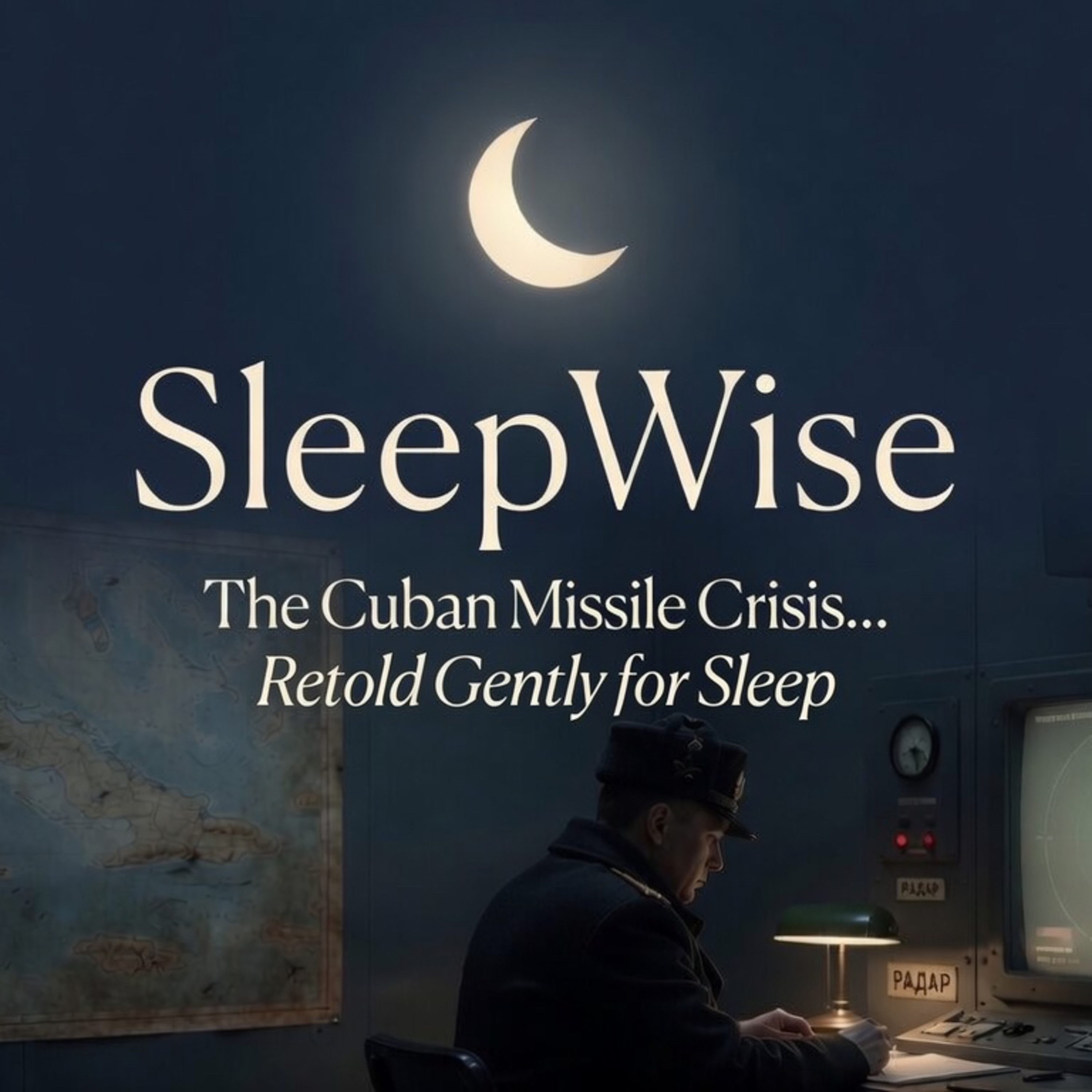


Tonight, we drift into one of the strangest and most important stories of the twentieth century — the nights when the Cold War came closest to ending in fire, and the quiet men who stood between the world and catastrophe.
This is the story of the Cuban Missile Crisis as it has rarely been told: not from the Oval Office or the Kremlin, but from the silent submarines beneath the Atlantic, and from a dim bunker outside Moscow two decades later. It is the story of Vasili Arkhipov, who in 1962 refused to launch a nuclear torpedo while his own captain demanded it. It is the story of Stanislav Petrov, who in 1983 looked at an alarm reporting incoming American missiles and, against protocol, decided to wait.
Move slowly with us through thirteen days in October, through the depths of the Sargasso Sea, through the red-lit interior of a Soviet submarine, and into the quiet after, when the world kept turning because specific human beings, in specific moments, chose restraint.
There is no need to keep track of every name or date. Let the story carry you. The arc of it is gentle, and the ending is already known: the world survived, and here you are, safe in your bed, beneath it.
If these quiet journeys help you rest, consider subscribing to SleepWise and sharing the channel with anyone who might enjoy falling asleep while learning something new.
—-
#SleepStory #BedtimeStoryForAdults #SleepWise #BedtimeStory #SleepMeditation #SleepAid #FallAsleepFast #InsomniaRelief #SleepPodcast #RelaxationStory #CalmingStory #SoothingStory #SleepTalk #DeepSleep #SleepNarration #NightTimeStory #SleepSounds #RelaxingStory #StoriesToFallAsleepTo #ASMRSleep #ColdWar #ColdWarHistory #CubanMissileCrisis #StanislavPetrov #VasiliArkhipov #NuclearHistory #ColdWarStory #History #HistoryStory #HistoryPodcast #HistoricalStorytelling #TwentiethCenturyHistory #SovietHistory #AmericanHistory #WorldHistory #NuclearWeapons #PoliticalHistory #MilitaryHistory #HistoryChannel #HistoryLovers #CalmNarration #SoothingVoice #MeditativeStorytelling #QuietStories #GentleHistory #SlowStorytelling #EducationalStory #LearnWhileYouSleep #BedtimeHistory #NightReading #StoriesForSleep #AudioStory #NarratedStory #LongFormStorytelling #ImmersiveStorytelling #Mindfulness #Relaxation #Wellness #SleepHealth #Unwind #NightRoutine #BedtimeRoutine #QuietMind #CalmMind #PeacefulSleep #SleepBetter #RestfulSleep #SleepingStory #ListenToSleep #AdultBedtimeStory #EducationalContent #LearningWhileSleeping #CuriousMinds #HistoryBuff #ColdWarBuff
0:00 Good evening and welcome back to Sleep Wise. Tonight we drift toward a story that was almost never told because the people at its center were not supposed to speak of it, and for many years they did not. It is a story about the Cold War, but not the version written in textbooks, Not the presidents, not the Cabinet rooms, not the famous broadcasts we have all half remembered. Tonight we move quietly to the places where the world actually came closest to ending. The bunkers beneath pine forests, the submarines rolling through dark water, the ordinary desks where ordinary men sat beneath flickering lights and held the future in their hands without quite realizing it.
1:02 At the heart of our journey is a Soviet officer named Stanislav Petrov. And a night in September of 1983, when an early warning system told him that nuclear missiles had been launched at the Soviet Union from the United States. He was alone with that information. He had only a few minutes to decide what to do with it. The world you are resting in tonight is the world that followed his choice. But his story does not begin in 1983. To understand what Petrov did and why it mattered so enormously, we must first travel back 21 years, to October of 1962, to 13 days in which much of the world held its breath and most people had no idea how thin the breath had become.
2:06 We will visit the rooms where decisions were made, and the oceans where they were nearly unmade, and the silent submarines where officers deep underwater argued in the dark about whether to end civilization. One of them said no. His name was Vassili Arkipov, and almost no one has ever heard of him. These are the hidden hinges of history. Not the loud declarations and famous speeches, but the private pauses, the individual hesitations, the quiet refusals.
2:50 The long strange fact that the 20th century did not end in fire was not, in the end, the achievement of systems or treaties. It was the achievement of specific human beings in specific rooms, on specific nights, choosing to wait. If these quiet journeys help you rest, you can follow Sleep Wise and share it with someone who might enjoy falling asleep while learning something new. Tonight we will move slowly. There is no need to keep track of every name or date. The arc of the story will carry you. You can let the names pass like lights through a train window. So let the lamp dim a little.
3:45 Let the blanket settle. The year will soon be 1962, and the world will be younger than it knows, and somewhere off the coast of Havana a warm wind will be moving across the sea. Before we arrive there, let us linger for just a moment longer in the wider story and in the soft, surprising idea that lies beneath it, that sometimes the most important thing a person ever does is quietly decline to act.
4:26 It helps to remember what the world felt like then before we step into this specific crisis. By the autumn of 1962, the Cold War had been gathering weight for nearly two decades. 2 great powers stood on opposite sides of a conflict they had never officially declared, and beneath every evening newspaper ran a quieter tension that people had learned to live with. The Soviet Union and the United States were not at war, and yet the world was arranged around the possibility that they soon might be. School children in America practiced hiding beneath their desks, and families in Moscow listened carefully for sirens. Both nations had built weapons capable of destroying cities in minutes, and both knew the other had them. Life went on inside this strange arrangement. People fell in love, raised children, wrote letters, tended gardens.
5:43 The possibility of annihilation lived quietly in the margins, acknowledged and set aside so that ordinary life could continue at all. Cuba sat in the middle of this long silence, 90 miles from the coast of Florida. The island had in 1959 come under the leadership of Fidel Castro, whose revolution had turned away from the United States and toward the Soviet Union for support. By 1961, an American backed attempt to overthrow Castro at the Bay of Pigs had failed humiliatingly and relations had hardened further. What happened next would depend on a decision made in Moscow that few outside the Kremlin had any way of anticipating. In the spring of 1962, Nikita Khrushchev made a quiet choice. He would place intermediate ranged nuclear missiles on Cuban soil.
6:53 Khrushchev was a blunt man, sometimes theatrical, a former coal miner who now ran the world's largest nuclear arsenal. The reasoning behind his decision was many, layered, and we will come to it. For now, it is enough to notice the scale of the gamble. Missiles launched from Cuba could reach Washington or New York within minutes, too fast for any defence to intercept. It was a move that, if completed quietly, would redraw the balance of power overnight.
7:37 If discovered too soon, it could tip the world into the very war it was meant to prevent. On the 14th of October 1962, an American U2 reconnaissance plane flew high over western Cuba and photographed what its pilots could barely believe. The next day in Washington, analysts studying the grainy images recognized the unmistakable shapes of missile launch sites under construction. The photographs reached President Kennedy's desk on the 16th. What followed came to be known as the 13 Days.
8:22 A crisis so dangerous that those who lived through it on both sides would spend the rest of their lives trying to understand what they had survived. And its most dangerous moments, as we will see, would happen in places no one was watching at all. The American version of this story is often told as a righteous response. The Soviet Union had done something provocative, and President Kennedy had to answer. That framing is not wrong, but it is incomplete, and tonight we will try to hold both sides of the table at once. From Khrushchev's perspective, the world looked rather different.
9:17 American missiles had already been quietly installed in Turkey and in Italy, positioned just across the border from the Soviet Union and aimed at Soviet cities. To Khrushchev, the Americans had already done what he was only now attempting. Khrushchev himself was a complicated figure, easy to caricature and harder to understand. He had survived Stalin, which required both luck and a particular kind of cunning. He was emotional, sometimes impulsive, and capable of both warmth and sudden anger. And he carried within him the memory of a Soviet Union still recovering from the devastation of the Second World War. There was more beneath the calculation. The Soviet Union, despite appearances, was militarily weaker than most Americans believed. Its long range missile force was smaller and less reliable than the public imagined, and Khrushchev knew it. Placing missiles in Cuba would narrow that gap quickly. It would also, he hoped, protect Cuba itself, which he genuinely believed the United States was preparing to invade for a second time.
10:45 It was a move of weakness disguised as boldness, and of principle tangled with bluff. He believed, perhaps too easily, that he could complete the deployment before the Americans noticed. He believed the missiles could be installed and then revealed, and only then would serious negotiation begin. He miscalculated in both regards. The U2 photographs arrived earlier than he expected, and when Kennedy did discover the missiles, his response was more forceful than Khrushchev had anticipated. 2 proud men, each misreading the other, had brought the world to a threshold neither had truly intended to cross. Kennedy, for his part, was a young president still shaped by the failure of the Bay of Pigs.
11:49 He had been embarrassed, then humbled, and was now determined not to appear weak. His advisers were divided, some urging an immediate strike on the missile sites, others counselling patience. This is one of the unsettling lessons of history. Great catastrophes do not always require great villains. Sometimes they require only ordinary leaders, each reasoning inside their own frame, misjudging the signals of the other. For 13 days, the world would hang in that misreading.
12:32 Presidents would meet in Washington and in Moscow. Ships would draw closer to one another across the Atlantic. And as we will see, the closest the world came to nuclear war during those 13 days was not in a board room or a situation room. It was underwater in the dark beneath the surface of the Sargasso Sea. While the world's attention turned to Cuba itself, something else was happening in the waters around it. 4 Soviet diesel electric submarines were making their way slowly across the Atlantic toward the Caribbean. They had left their base at SATA Bay on the Kola Peninsula in the Soviet Arctic several weeks before. These were Foxtrot class submarines, designated B4B36B59 and B130.
13:41 They had been built for cold northern waters and were unsuited to the warm tropical seas they were now approaching. The crews did not yet know how punishing that mismatch would become. The journey S took them through some of the roughest waters in the Atlantic. Autumn storms battered the submarines as they moved, forcing them to dive often and to surface only at night to recharge their batteries undercover of darkness. For men already far from home, the Atlantic in October was not a gentle companion. Each submarine carried the usual armament of torpedoes and defensive weapons, but aboard each of them, hidden within that arsenal, was a single nuclear torpedo. Its warhead was roughly equivalent in destructive power to the bomb that had destroyed Hiroshima. The Americans did not know this for weeks. Almost no one outside the highest levels of the Soviet Navy knew the full details of what was being sent into the Caribbean.
15:03 Even within the submarines, the nuclear weapons were kept under strict and unusual controls. And yet the rules for their use were dangerously ambiguous. A nuclear torpedo could be fired only with the agreement of specific officers aboard under specific conditions, but those conditions themselves were open to interpretation. In the confusion of a crisis, interpretation is a fragile thing. Communication between Moscow and the submarines was also far more limited than one might imagine. Radio signals did not travel well underwater, so a submerged vessel had to rise toward the surface to receive orders. And rising toward the surface in hostile waters was the one thing the submarines most wished to avoid. The submarines were meant to escort a flotilla of Soviet cargo ships, bringing equipment and personnel to Cuba. Their presence was intended to be invisible, a silent insurance policy beneath the waves. the United States was not to know they were there until, if ever it mattered. What no one in Moscow had fully
16:33 accounted for was the experience of being hunted. American destroyers, once alerted to unknown submarines, would begin to search the Atlantic systematically, and when they found the Soviets, they would use methods that, at depth, could be mistaken for something far more dangerous than a signal. The quietest chapter of the Cuban Missile Crisis was beginning. It would not be written on television screens or in Oval Office recordings. It would be written in the rolling dark of the Sargasso Sea, where few on Earth had any way of knowing what was happening at all.
17:24 Of the four submarines, it is B59 that will carry us furthest into this story. Commanded by Captain Valentine Savitsky, it was a vessel like the others, roughly 300 feet long, with a crew of around 78 men packed into its narrow corridors. Built for the cold. Sent to the tropics, it had been at sea for weeks by the time it approached Cuban waters. Inside, conditions had become close to unbearable. The air temperature in the engine rooms rose above 50°C, hot enough that men worked in shifts of minutes rather than hours.
18:13 The cooling systems, overwhelmed by the warm sea water, could not do what they had been designed to do. Fresh water was rationed to a few sips a day. Carbon dioxide levels rose steadily, thickening the air until thought itself grew slow. Crewmen fainted at their stations, and some began to experience the blurred edges of hallucination. Savitsky himself was an experienced captain, known among his men as disciplined and fair. But he had been at sea for weeks in conditions that would strain any commander. And the weight of command in a submarine is a particular and lonely kind of weight.
19:06 Everything depends on the captain, and the captain in turn depends on information he may not have, and there was silence for days. B 59 had been unable to receive clear transmissions from Moscow. The submarine carried radios meant for Soviet naval frequencies, and long range communication in the Atlantic had grown unreliable at depth. Cut off from command, Savitsky and his officers relied on what they could pick up from the surface. They tried, when safely possible, to tune to American commercial radio broadcasts. This was their only window on a world that might already have moved past them.
20:01 On October 27th, 1962, the Americans located B 59. A group of United States Navy destroyers, part of the quarantine line around Cuba, detected the submarine beneath them. They began the process of forcing it to surface. The American fleet had grown patient and persistent in recent days. The destroyers coordinated their movements above B 59, turning the water overhead into a kind of hunting net for a submarine, trying to remain invisible. The effect was disorienting and inescapable. They did this by dropping what were called practice depth charges.
20:53 These were small explosive devices, not intended to destroy a submarine, but to signal to it that it had been found and should come up. The Americans believed the message was perfectly clear. Inside B 59, the message was not clear at all. The charges struck the hull with concussive force, shaking the interior and throwing men against bulkheads. To the exhausted, overheated crew, it did not feel like a signal. It felt like the beginning of a war. Inside the pressure hull of B59, time had begun to feel strange.
21:39 The detonations overhead came in irregular waves, each one shaking dust from seams and making the lights flicker. For men whose blood was already thick with carbon dioxide and heat, each blast seemed to arrive not as a message, but as an answer to a question they had not known to ask. The interior of the submarine was a narrow steel world lit by dim red bulbs, the usual color used to preserve a cruised night vision. In that red shadow, light faces looked tired and uncertain. Every sound carried and every tremor in the hall felt like something larger than it was.
22:30 Captain Savitsky did what any captain would do in such a moment, he reasoned from the evidence he had. He had been out of radio contact with Moscow for days. He had no way to confirm whether war had broken out on the surface, and now explosions were striking his hull. From his perspective, the simplest explanation was also the most alarming. If war had begun while they were submerged, the Americans would already be hunting Soviet vessels. Depth charges from destroyers would be exactly what one would expect.
23:15 He could not know that the charges were small, practice sized devices. He could not know that the Americans were signaling, not attacking from inside a submarine. An explosion is an explosion. Savitsky made a decision. According to the accounts later given by surviving crew members, he ordered his officers to prepare the special weapon for use. That weapon was the nuclear torpedo, the one the Americans did not know existed. By the testimony of those who were there. He spoke the kind of words a man speaks when he has accepted something terrible.
24:03 He had nearly decided that B 59 would fire its nuclear torpedo at the American fleet above them. He believed sincerely and almost certainly incorrectly, that the war had already begun. It is worth pausing here to feel the shape of that moment. A Soviet submarine cut off from its command in hostile waters under what felt like direct attack, a captain reaching A conclusion any other captain in his place might also have reached. The torpedo itself was capable of vaporizing an American destroyer, and everyone aborted. The detonation would almost certainly have been interpreted in Washington as a Soviet first strike. The American retaliation would have been immediate, and general historians who later studied the moment have struggled to describe it without drifting toward melodrama. The closest approximation is something like this. The chain reaction that would have followed a single nuclear torpedo launched by a single submarine crew acting on incomplete information, would likely have entered the world we now inhabit.
25:33 And yet the torpedo had not yet been fired. The order had been given, but one last step remained in the quiet protocol of Soviet naval command. It required more than a single man to end the world. Soviet nuclear weapons aboard submarines were not governed by a single man's authority. They were governed by a small circle of officers, and all the officers of that circle had to agree on B59. That circle consisted of three men. The protocol had been carefully designed. It reflected at the highest levels of Soviet command and understanding that nuclear weapons were different in kind from every other weapon.
26:30 No one man, however senior, should be able to use them alone. The first was Captain Valentin Savitsky, who had already decided. The second was Ivan Maslenkov, the submarine's political officer, whose role was to represent the Communist Party within the vessel and to share in decisions of this magnitude. He too was ready. Under ordinary circumstances, the agreement of those two would have been enough. A submarine at sea, sealed within its own command, would have proceeded on the authority of its captain and its political officer. But B 59 was not sailing under ordinary circumstances. The third man in the circle was not a member of B59's own crew. He was Vassili Arkipov, the chief of staff of the entire submarine flotilla, who happened to be aboard this particular vessel as part of his duties supervising all four submarines. His presence was almost accidental, and its consequences would be enormous.
27:53 Because Arkapov held flotilla rank, his authority within the nuclear decision equaled Savitsky's own. To fire the torpedo, all three officers would have to agree. Two had one had not. Arkhipov said no. What happened next was not a shouted confrontation. By the accounts that survive, it was a sustained argument carried out in the narrow, red lit interior of the submarine among men who had known one another for weeks of shared suffering.
28:38 Arkapov did not deny that they were under attack, but he did not believe it was wise to assume so. He pressed for restraint, for surfacing first, for finding out what was happening before turning a possible miscommunication into a certain catastrophe. In the close air of that submarine, he held his ground. The argument is said to have lasted some time. In the years that followed, when fragments of the story began to emerge, different crew members remembered the exact words differently. What they agreed on was the shape of it. One man holding out against two in a setting where fear and exhaustion pushed toward the opposite conclusion, Savitsky was, by several accounts, furious. He was the captain, the man responsible for his ship and his crew, and he had reached his conclusion. But the protocol was the protocol, and the protocol required consent.
29:55 He could not obtain. In the end, Arkapov's refusal was decisive. The nuclear torpedo was not fired. B59 surfaced instead into the evening air of the Atlantic, where American destroyers waited not with missiles but with signaling lamps. It is tempting, in retrospect, to imagine that the man who prevented a nuclear exchange must have been marked by fate, singled out by some clear quality that had long prepared him. For the moment, the truth is quieter. Vassili Alexandrovichakopov was, before October of 1962, an ordinary Soviet naval officer with an ordinary career. He had been born in 1926 in a small village outside Moscow into a peasant family.
31:01 He entered Naval Service during the Second World War, a young man shaped by a country that had lost more than 20 million of its own in a single conflict. He understood from the beginning of his adult life what the consequences of war actually looked like. In 1961, a year before the Cuban Missile Crisis, Arkapov had already survived one of the worst moments in Soviet naval history. He had been serving aboard the submarine K19A new nuclear vessel, when it suffered A catastrophic reactor failure at sea. The cooling system broke down and the reactor threatened to melt.
31:51 To save the submarine and the hundreds of crew aboard, a small team of engineers had to enter the reactor compartment and rig an emergency cooling system by hand. They did this knowing that the radiation would kill them. And it did. All 22 members of the engineering team died, most within weeks. Arkapov himself was dosed with significant radiation that day, though he survived. He saw at close range what it looked like when men died for a reactor.
32:32 He saw it in the faces of the engineers who volunteered to enter a chamber from which no one returned healthy. In the months after K-19, Arkipov's reputation among fellow officers deepened quietly. He was known as a man who had not panicked, who had helped maintain order aboard A vessel that might easily have dissolved into fear. The crew had lived, in part because their officers had refused to give way to terror. One can only guess how such an experience shaped him.
33:12 Perhaps it taught him caution. Perhaps it taught him what the machinery of nuclear fire actually does to a human body up close, rather than as an abstraction. Whatever the reasoning, by the time he stood in the close air of B59 a year later arguing against the launch of a nuclear torpedo, he was not reasoning from theory. He was reasoning from memory. He knew, in a way few others in that submarine could know, what was actually at stake. He was, by all accounts, a quiet man, not charismatic, not theatrical, not the kind of officer who draws attention in a crowded room. And yet, on the evening of October 27th, 1962, his quietness became one of the most important acts of restraint in human history.
34:17 He would go on to live a long and unremarkable career in the Soviet Navy, rising to the rank of Vice Admiral before retiring in the 1980s. He rarely spoke about what happened aboard B59. For most of his life. Almost no one outside his immediate circle knew what he had done. While these events unfolded beneath the Atlantic, another quiet catastrophe was nearly arriving above it. October 27th, 1962 came to be called Black Saturday. It was the day the Cuban Missile Crisis reached its sharpest edge on both sides.
35:07 Early that morning, an American U2 reconnaissance plane flew over Cuba on a standard photographic mission. The pilot was Rudolph Anderson, a careful and experienced officer. He was a father and a husband, and he was about to become the only American killed in combat during the crisis. Anderson had flown such missions before, including several of those that had produced the original images of the missile sites. He was known for his skill and for his calm.
35:48 His colleagues would later remember how quietly he carried the weight of what he had helped discover. Soviet forces on the island, acting on local initiative and not on Khrushchev's explicit orders, fired a surface to air missile at the U2. Anderson's plane broke apart in the upper atmosphere. His death reached Washington within hours. Inside the Kennedy White House, the reaction was immediate and grave. The ex com, the committee of senior advisers handling the crisis, had been warning for days that any American aircraft lost would mean retaliation. The standing plan had been to strike the Cuban missile sites in return.
36:43 Kennedy hesitated. He knew that if he followed the plan, he would almost certainly begin the escalation that led to war. He also knew that if he did not, he risked being seen as weak and of losing control of the crisis. While he hesitated, his brother Robert Kennedy was working through quieter channels. A series of back door conversations had been under way between American and Soviet intermediaries in Washington, trying to find a formula both sides could accept. That evening, Robert Kennedy met with the Soviet ambassador and offered one.
37:32 The offer was twofold. The Soviet missiles would be removed from Cuba and in return the United States would pledge not to invade the island. A second part of the deal, not made public at the time, was that American missiles in Turkey would also eventually be withdrawn. What is striking in hindsight is how much of this hinged on individual restraint. Kennedy could have ordered the air strikes his advisors were urging him to. The commanders in the field were in many cases fully ready.
38:16 None of this reached Savitsky or Arkapov in B59. None of it reached Rudolf Anderson's family. Yet for a stretch of hours that evening, neither the American president nor the Soviet premier, nor any officer in any submarine knew for certain whether the world had already passed the point of return. The deal, when it came, came quietly. It would be accepted in Moscow the following morning. It would be announced to the world in phrases that carefully understated how close the alternative had been. This is perhaps the strangest part of the whole story. On the evening of October 27th, the most powerful people on earth were operating almost blind. Each side held pieces of information the other lacked, and neither side knew how little the other knew. Kennedy did not know that there were Soviet submarines beneath his quarantine line carrying nuclear torpedoes. American intelligence had identified the surface fleet and tracked some of the submarines, but the presence of nuclear weapons aboard was not understood. If it had been, the American
39:48 response to B59's depth charging might have been very different. Khrushchev did not know that one of his own submarine captains had nearly launched a nuclear torpedo at an American destroyer. The radio silence that cut B 59 off from Moscow cut Moscow off from B59 as well. Decisions were being made in the depths that no one in the Kremlin could influence. Savitsky did not know that Kennedy and Khrushchev were, at that very hour, edging toward a settlement. He did not know that the war he believed had started had not, in fact, started at all.
40:39 He was acting on the best information available to him, and that information was dangerously incomplete. Arkapov did not know that his refusal would one day be remembered. He was doing what he believed was right, not what he believed was historic. Most pivotal moments in history are experienced this way, without trumpets, without certainty of their own importance. Even the depth charge crews on the American destroyers did not know what they were doing. They believed they were performing a routine signaling operation. They had no idea that the sound of their small explosions was being interpreted 10 fathoms below, as the opening of the Third World War.
41:34 This is the humbling architecture of the Cuban Missile Crisis and of many crises. Since the people at the edge of catastrophe are not usually working with complete information, they are working with fragments under pressure, with exhaustion pressing down on them and fear quietly shaping every judgment they make. There is a strange lesson buried here about how civilizations actually survive. The grand systems matter, of course. Treaties matter, and diplomacy matters, and leaders matter. But in the deepest moments, the moments that only a handful of people will ever know were moments at all. The world sometimes rests on a single person choosing not to act on the steadiness of a quiet officer, or a tired pilot, or an operator at a monitoring station who looks at an alarm and decides against procedure, to wait to ask again, and to refuse for a little longer, to be sure.
42:50 And yet, somehow, against all of this, the world did not end. Not because the system was well designed, and not because the leaders were wise. It did not end because specific human beings, in specific moments, chose the quieter path. On the morning of October 28th, 1962, Nikita Khrushchev addressed the Soviet Union by radio. He announced that Soviet missiles would be dismantled and withdrawn from Cuba. For millions of people listening, it was the first indication that the crisis was ending. In Washington, the message was received with quiet relief rather than triumph.
43:47 The Kennedy administration had spent the previous night preparing for both possibilities, and the air of the White House was still thick with exhaustion. Kennedy, according to those who were present, asked to be left alone for a little while after the news arrived. The public version of the deal was straightforward. Khrushchev would remove the missiles from Cuba. the United States would pledge not to invade the island. The private version was more complicated. In his back channel conversation the previous evening, Robert Kennedy had also conveyed a second American commitment.
44:37 The 15 Jupiter missiles stationed in Turkey, aimed at Soviet cities, would be withdrawn within a few months. That second part of the deal was not announced publicly. Both sides agreed to keep it confidential, at least for a time. To the American public, it was important that Khrushchev appeared to have backed down first. This shaped the way the crisis would be remembered for decades. In the United States, it was often described as a clear victory, a moment when the young president had stared down the Soviet premier and prevailed.
45:22 The truth, as usual, was more tangled than the story inside the Soviet Union. Khrushchev's position was damaged by the outcome. Many in the Politburo believed he had embarrassed the country, and within two years he would be quietly removed from power. He would spend his last decade living in a modest Dodger, dictating his memoirs into a hidden tape recorder. The submarines, too, came home. When B59 surfaced into the evening air of the Atlantic, the first thing the exhausted crew noticed was the coolness of the breeze on their faces. Some had not breathed fresh air in weeks. The American destroyers above made no hostile move. They signalled, they watched and eventually they withdrew, allowing B59 to proceed on the surface. Neither side.
46:29 Sailors in that moment had any idea how narrowly the water beneath them had avoided becoming the site of the first nuclear weapon used in anger since 1945. The submarine travelled slowly north and eventually made the long journey back to the Soviet Arctic. The crew, exhausted and sick, returned to a country that had no idea what they had been through and that would not know for decades. The world, in the weeks that followed, continued as though nothing extraordinary had happened. Newspapers moved on to other stories and families planned for winter.
47:15 Only a very small number of people scattered across Washington, Moscow and the Atlantic understood how thin the thread had been. What Kennedy and Khrushchev privately understood about those 13 days was different from what either government admitted in public. Both men had come closer than they wanted to acknowledge, even to themselves, to beginning a war they could not win. Both carried that knowledge quietly for the rest of their lives. In the weeks after the crisis, the two leaders began an unusual correspondence.
47:59 Long letters passed between Washington and Moscow, often hand delivered by trusted intermediaries. The tone of these letters was different from the posturing of public statements. They were at times strangely personal. Khrushchev wrote of the weight that had pressed down on him during the crisis, of the fear that one misstep by either side could have cost everything. Kennedy, in reply, acknowledged that he had felt something similar. The letters were not public documents. They were written by men who had briefly glimpsed what the end of the world might look like, and who no longer quite trusted the machinery they themselves had designed. There was no political benefit in such candor, which may be why it was possible at all.
49:02 Both men now understood something they had not quite grasped before. The systems they commanded were larger and more dangerous than the men who commanded them. Nuclear weapons, once they existed, did not belong entirely to the governments that held them. Out of this chastened understanding came concrete change. Within a year, the United States and the Soviet Union installed a direct teletype line between the White House and the Kremlin, what the public would later call the hotline. It was designed so that the two leaders could reach each other in minutes rather than in hours should another crisis arise. They also negotiated the Limited Test Ban Treaty, signed in 1963, which banned nuclear tests in the atmosphere, in outer space and underwater.
50:08 It was the first formal nuclear arms control agreement of the Cold War. It was modest in its scope but significant in what it represented more broadly. The two leaders began to treat each other as participants in a shared predicament. The language of public rivalry continued, of course, because both governments required it. But privately, A quieter understanding had taken hold. Kennedy would not live long enough to see most of what came next. He was assassinated in Dallas in November of 1963, barely 13 months after the crisis.
50:59 Khrushchev, writing his memoirs years later in forced retirement, spoke of him with a surprising warmth. The two men had stood on the edge of something together. They had pulled back together, and in pulling back, had begun to understand one another in a way their public positions had not allowed. It was a small thing in the long arc of the Cold War, and yet it mattered. For 30 years, much of what had happened during the Cuban missile crisis remained partially hidden.
51:43 Both governments had reasons to keep certain details quiet. The public accounts, written by officials and journalists of the time, were accurate as far as they went, but they did not go as far as the truth. It was only in the early 90s, after the Soviet Union had dissolved, that the fuller picture began to emerge. Soviet archives opened at least partially to outside historians. Veterans who had been sworn to silence for their entire careers began to speak.
52:25 In October of 1992, on the 30th anniversary of the crisis, a remarkable conference was held in Havana. Participants included figures from all three sides, American, Soviet, and Cuban. Among those attending was Robert McNamara, who had been the United States Secretary of Defense during the crisis. McNamara was now in his 70s. He had long believed he understood what had happened in those 13 days. He was about to learn that he did not. The man who stood up to speak was a former Soviet naval officer named Vadim Orlov, who had served aboard B 59 during the crisis.
53:18 He had spent decades bound by Soviet secrecy. Now, in a conference room in Havana, he was free at last to describe what he had seen during the conference. A former Soviet officer stood up and described the presence of nuclear torpedoes aboard the four Soviet submarines that had been operating near Cuba. He spoke of the depth charging of B59HE spoke of the officers who had nearly authorized the launch of a nuclear weapon against the American fleet.
54:00 McNamara sat in silence for a long moment. Then, according to those present, he said something that has since become one of the most quoted reflections on the crisis. The world, he said, had come far closer to nuclear war than anyone on the American side had ever realized. He would repeat that thought in the years that followed in interviews and documentaries. He had served as Secretary of Defense through the crisis and sat in every important meeting. And he had not known that was the particular chill of the Havana conference.
54:46 The American leadership, watching from Washington, had believed itself to be in full command of events. It had not been. What had held back the catastrophe, in the end, was not the brilliance of policy or the steadiness of high command. It was a quiet officer in a stifling submarine, arguing against two of his colleagues in the red lit dark, a man almost none of the decision makers in Washington had ever heard of. The name Vassili Arkipov would slowly enter the public record over the years that followed.
55:31 It would appear in books and documentaries always spoken of with a kind of stunned gratitude, a man who had saved the world without quite intending to, and who had done so by simply declining to agree. But the story of restraint did not end with Arkapov. 2 Decades later, another Soviet officer would find himself in a similar position, facing a similar choice in a setting almost as dangerous. His name, as we have mentioned, was Stanislav Petrov.
56:14 To understand what he faced on the night of the 26th of September in 1983, we must briefly return to the surface of the world as it had become in those intervening years. The Cold War, contrary to the hopes of those who had stepped back from the brink in 1962, had not softened. In some ways, by the early 1980s, it had grown sharper. The leaders who had pulled back in 1962 were gone. Kennedy had been assassinated in Dallas, and Khrushchev had been removed from power not long afterward.
57:02 The private warmth that had grown between them had no natural inheritors. In Moscow, A new generation of aging and often unwell leaders now ran the Soviet Union. In Washington, Ronald Reagan had come to the presidency with a more confrontational view of Soviet power than most of his recent predecessors. The two sides had resumed, in both rhetoric and hardware, the shape of their former hostility. The Soviet leadership of the early 1980s was, by several historical accounts, genuinely afraid.
57:46 Yuri Andropov, who became general secretary in 1982, believed seriously that the United States might be preparing a nuclear first strike. This was not pure paranoia, though it carried elements of paranoia within it. Beginning in 1981, Soviet intelligence services had been tasked with watching for signs of an imminent American attack. The program was called Operation Ryan, an acronym in Russian for nuclear Missile attack. Agents around the world were instructed to report anything that looked like preparation for war. This kind of instruction shapes what people see. If you're told to look for signs of an attack, you begin to find them.
58:44 Ordinary events become ominous. Routine exercises become suspicious, and the information flowing into the Kremlin tilts quietly toward alarm. Into this atmosphere on the 1st of September 1983, fell a specific and terrible event, a Korean Airlines passenger plane, Flight 07, straight off course into Soviet airspace over the Sea of Okotsk. A Soviet fighter, unable to identify it clearly and fearing a military incursion, shot it down.
59:25 All 269 people aboard were killed. The incident became an international sensation, with both sides using it to accuse the other of recklessness. By late September of 1983, relations between the two superpowers had deteriorated to their most dangerous point in two decades. That was the world into which Stanislav Petrov reported for work on the evening of the 25th. A tense world. A frightened world. A world whose most powerful governments were both already half convinced the other might strike first.
1:00:12 Sir Pukhov, 15, was the name of the facility. It was a reinforced bunker roughly 60 miles South of Moscow, hidden among pine forests, where Soviet officers monitored an early warning system called OCO, meaning I. Its purpose was to detect American nuclear missiles the moment they were launched. The detection came from satellites. Oco's satellites watched American missile fields from orbit, searching for the infrared signatures of rocket engines at ignition.
1:00:53 If the system saw a launch, it would sound an alarm, and officers would alert the Soviet General Staff within minutes. The General Staff would in turn notify the political leadership. From there, a retaliatory launch could be authorized. The window between detection and decision was measured at most in 20 minutes. Petrov was not an ordinary duty officer. He was an engineer who had helped develop parts of the OCO system, which meant he understood its internal workings more intimately than most of the men who sat at its consoles. He was on duty that night largely by chance, having taken the shift of a colleague.
1:01:44 The evening began quietly. It was approaching midnight on the 25th of September, turning toward the early hours of the 26th, Petrov drank tea, reviewed his displays, and listened to the soft sounds of a bunker full of men at their stations. And then the alarm began. The screens showed a missile launched from an American base in Montana. A red light flashed, a computer voice announced the launch, and the system classified the threat at its highest possible confidence. Petrov stared.
1:02:30 He had been trained for this moment. But training is training, and this was not a drill. The weight of what he was seeing settled on him in a way he would later describe as almost impossible to put into words. Around him, the bunker had come alive. Officers were hurrying to their stations. A siren sounded somewhere in the corridors outside. The quiet shift of a moment ago was no longer quiet. His first thought was that the launch could not be real.
1:03:11 A genuine American first strike, he reasoned, would not be a single missile. It would be hundreds of missiles launched all at once from many silos, designed to overwhelm Soviet defenses before they could respond. One missile made no military sense. It would invite a massive counter attack without achieving anything meaningful. Either the Americans were making a catastrophic mistake, or the system itself was. As Petrov hesitated, the alarm shifted. A second launch appeared on the display, and then a third.
1:03:55 And then a fourth. And then a fifth. Within minutes, Oka was reporting that five American missiles had been launched from the same base, all heading toward the Soviet Union, all coming in a direction that could only mean one thing. The protocol was clear. Petrov was required to report the detection to the General Staff. The General Staff would then notify the political leadership, and the Soviet Union would have perhaps 20 minutes at most to decide whether to launch a retaliatory strike. The retaliatory strike, once ordered, could not easily be called back.
1:04:41 Soviet missiles would leave their silos, American cities would be struck, and the United States would respond in kind. Petrov did not report what he was seeing. His later accounts describe the reasoning in pieces, because the moment itself did not leave room for orderly thought. He believed, on balance, that the system was wrong. He was not sure, but he was sure enough. Petrov would later say that if the number of reported missiles had been higher, he might well have reported it as a real attack. 5 missiles was for him, too few to be believed, 500 or 5000, and he might have reached for the phone to say something very different. There were, he also knew, checks on the OCO system. Ground radars should, within minutes, be able to confirm or deny the presence of real missiles in the sky. The difficulty was that those radars could not see over the horizon until the missiles were already close. He picked up the phone.
1:06:01 He called his superiors at the main command center. He reported a malfunction in the early warning system rather than an incoming attack. This was not what protocol required. Protocol required that he report what the system was telling him and let others decide. Petrov had chosen instead to make the judgment himself and to carry the consequences of that judgment alone. The minutes that followed were among the longest of his life. He did not yet know whether he was right. He could not know for certain until the missiles either arrived or did not. He sat at his consul, waiting.
1:06:51 The bunker around him was busy with activity. Men were tracing the phantom launches, calling in data, trying to confirm or deny what the screens were showing. If he was wrong, the first American warheads would reach a Soviet soil in roughly 20 minutes. There would be, in those final moments, no retraction possible, no decision to take back. They did not arrive. The night passed and the sun rose over the Soviet Union on the morning of September 26th, 1983, and no American warheads had struck. Petrov had been correct.
1:07:38 The system had malfunctioned. The cause investigated later turned out to be a rare alignment of sunlight reflecting off high altitude clouds over North Dakota. The satellites had interpreted the bright reflection as the infrared plume of rocket engines. A system built to watch for the impossible had briefly seen it where it was not. What came next in Petrov's own life was, in its way, as telling as the night itself. He had prevented what might have become a nuclear exchange between two superpowers. He had done so by ignoring protocol. Neither of those facts was quite acceptable to his superiors. In the days that followed, he was questioned repeatedly. Officials wanted to understand what had happened, but they were also looking for someone to blame. The investigation was complicated. On one hand, the system had failed, and Petrov had been correct to doubt it.
1:08:53 On the other hand, he had violated the procedures he was sworn to follow. Those interviewing him pressed repeatedly on one question. Why had he chosen to trust his own judgment over the instruments? His answer, as he later described it, was simple. The computer had its reasons, and he had his, and that night his had been the more accurate. The Soviet military, not entirely sure what to do with him, chose a quiet middle path. He was not punished in any serious way.
1:09:34 He was not, however, decorated either. He was transferred to a less sensitive post. The incident itself was classified and erased from public record. Officially, nothing had happened at Serpakov, 15 that night. Petrov retired from the military a few years later. In the late 1980s, he lived in a small apartment in a town outside Moscow on a modest pension. His wife was ill, and his life in retirement was, by most accounts, quiet and unremarkable. For more than a decade, he told almost no one what he had done. He was bound by oaths of secrecy, and perhaps also by something harder to name.
1:10:29 Not shame, exactly, and not pride, but a kind of reserve that seemed natural to him. In the years that followed, he cared for his wife through a long illness. When she died, he lived alone. Neighbors knew him as a polite, soft spoken older man who kept to himself. The story began to emerge only in the late 1990s, when a former Soviet officer who had been involved in the investigation wrote about the incident. Journalists eventually found Petrov in his small apartment. They were struck, as many would later be, by how utterly ordinary he seemed.
1:11:19 Honors followed slowly. He received a special award from the United Nations, and he became the subject of a documentary film. He travelled in his 70s to places where he was quietly applauded by strangers. He did not seek any of this. He was uncomfortable with praise and always insisted, when asked that he had simply been a man at a desk, doing his best with incomplete information. He did not think of himself as a hero and was faintly puzzled when others did. He died in 2017 in the same small apartment where he had lived for most of his retirement. He was 87 years old, and his passing was reported quietly around the world by people who had never met him but felt in some unspecifiable way, that they owed him something. When the two stories are set beside one another, they begin to form a pattern.
1:12:36 A Soviet naval officer in a submarine off the Florida coast in 1962. A Soviet intelligence officer in a bunker outside Moscow in 1983. Two men, 2 moments, 2 decisions that the world barely noticed at the time. In each case, the system seemed to demand a response that the man in the middle of the system resisted. In each case, that resistance rested not on defiance, but on careful judgment. Both Arkapov and Petrov were deeply loyal to their country, their Navy, their service.
1:13:25 Neither believed himself to be acting heroically. They simply did not believe in their respective moments that what they were being asked to do was right. There are almost certainly other such moments we will never know about. The Cold War produced countless false alarms, near misses and ambiguous signals. Some of them were quietly managed by people whose names have not yet been spoken aloud. In 1961, AB 52, carrying two hydrogen bombs, broke apart in flight over North Carolina.
1:14:10 One of the bombs fell into a field, and one of its safety switches is said to have been the last barrier between that bomb and detonation. Engineers later described how narrowly the ground itself had escaped being cratered. In 1995, Russian radar detected what appeared to be a missile launched from Norway. It was in fact a scientific rocket carrying instruments to study the Northern Lights. For a few minutes in Moscow, though, the nuclear briefcase was actually opened before officers examining the data advised their president to wait. The 20th century did not end in fire, and the reasons for that are many.
1:15:04 Treaties mattered. Deterrence mattered. And luck, it must be said, mattered too. But embedded in that larger survival is something quieter, a small collection of men and women who, in specific rooms on specific nights, held the whole structure in place not by accomplishing something dramatic, but by declining to set in motion something catastrophic. Most of their names will never be widely known. Many of the incidents are still classified or disputed or simply lost to record. What we can say is that the list of such moments is longer than most people realize.
1:15:56 This is not an argument that the world is safe because good people are always present at the right moment. It is not an argument that systems can be trusted to produce such people reliably. It is something humbler and perhaps more unsettling than that. It is the observation that the survival of civilization has at times depended on specific human judgment exercised by specific human beings under conditions that offered very little margin for error. It is a thought worth holding lightly and carefully. There is a particular kind of wonder in these stories, and it takes a moment to notice it is not the wonder of heroism. Archipoff and Petrov were not heroes in the way heroes usually appear in stories, with a clear enemy and a decisive act of courage.
1:17:08 What they did in each case was a little stranger. They refused to participate in what might have been the ending of the world. They held for a moment against the pull of events. This is a kind of courage that does not look like courage from the inside. It often feels to the person doing it like ordinary prudence. It feels like waiting, like checking, like holding off on a conclusion until the evidence is a little clearer.
1:17:51 From the outside, in retrospect, it can look astonishing. The historian sees the paths not taken and feels, in hindsight, how narrow the choice really was. But the person at the console rarely felt that way. They simply did the next reasonable thing. There is comfort in that, and also some discomfort. The comfort is that such small acts of restraint can matter enormously. The discomfort is that civilization has sometimes rested on the steadiness of people we would otherwise pass without noticing.
1:18:47 Writers and philosophers have sometimes noticed the quiet power of people who simply decline to participate in something wrong. It is, they observe, a form of courage that rarely looks like courage. It is not the same as active resistance, but it is not nothing either. In these Cold War stories, that refusal took a technical form. Arkapov refused the launch protocol and Petrov refused the report. Neither man framed his choice in moral language, and both simply declined to Co operate with something their judgment could not accept. It is worth noticing how much hinged on something so modest. Neither man made a speech.
1:19:46 Neither man stood on a stage. What they did was invisible from the outside, almost unrecognizable as action. And yet the consequences of what they did were, in the fullest sense, immeasurable. What this suggests about the world is quietly important. We often speak of catastrophes as inevitable, or as products of vast systems beyond any one person's control. These stories, told together, gently resist that telling. They suggest that systems, however large, still pass through the hands of individuals, and that those individuals, even when tired, frightened and poorly informed, retain some small space in which to pause, to question, and to wait.
1:20:58 It is not a guarantee that such pauses will always happen. It is not a promise that the world will always be saved in the small hours by a quiet person at a desk. But it is a reminder that such pauses are possible and that they have, more than once in history, made all the difference. Let us return for a moment to the bunker at Serpakov 15 on the morning of the 26th of September 1983. Petrov is still at his console.
1:21:46 The alarm has been quieted, and the reports of missiles have faded into the silence of a system caught in its own mistake. He is tired. He has been at his station for hours, and he will not sleep well for many nights to come. But the sun is beginning to rise over the forests outside, and the Soviet Union is still there, and so is the United States, and so are the cities, the roads, the lamps and windows, the sleeping children in unfamiliar houses far away. He does not yet know that he has done something the world will remember.
1:22:36 He does not yet know that decades from now, strangers will speak his name with gratitude. He simply knows that a long night has passed and that morning has come. Outside the bunker, the pine forests of southern Russia are quiet. Birds have begun to call. Somewhere in Moscow, the first buses of the morning are running, and the first windows are lit against the last of the dark. And far beyond that, in other places, other people are asleep. They do not know how close the night came to being different. They never will, most of them.
1:23:32 And that is part of what it means to be saved by a quiet stranger. It has always been so. The long survival of the world has depended in part on people we have not heard of, who did small things at the right moment, not because they believed themselves important, but because they could not quite bring themselves to believe the alarm. This is, in its way, the gentlest kind of history. It has no parades, no speeches, no grand declarations, only a man at a desk choosing against the weight of a system to wait a little longer.
1:24:24 If there is a lesson in such a story, it is not a frightening one. It is a reminder that even within the largest and most dangerous structures, the human pause remains possible, that there is in every system a small space still held by the judgment of an ordinary person, and perhaps that is a kind of comfort to rest on. The machinery of the world is large and often difficult and not always wise, but it is still run in places by people who can decide to wait, to check, to refuse, to assume the worst.
1:25:17 The world has its dangers, as it always has, but it also has woven through its long history the quiet pattern of restraint, the steady hand, the unremarkable pause. Somewhere to night. A clock is ticking in a quiet room. A lamp is casting soft light on a familiar wall. The world is turning through its slow night as it has always turned, carrying with it all the unseen stories that have held it in place.
1:26:04 You are one of the sleepers it is carrying. You are part of what has been kept over many nights by many quiet hands. There is nothing more you need to do to night. The world slows and so do we. Good night.