Edison vs Tesla: A Bedtime Story About the Men Who Gave Us Electricity

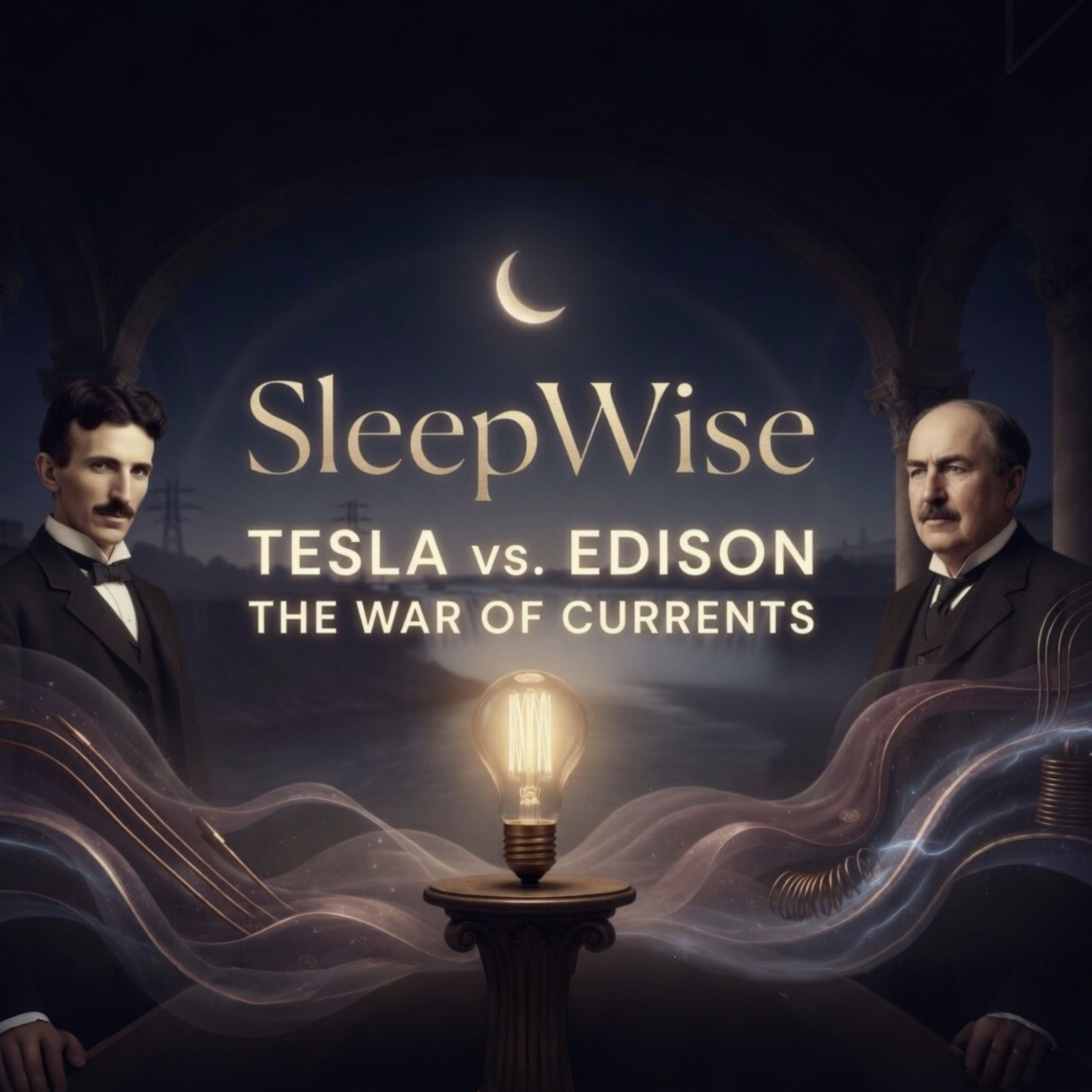


Tonight on SleepWise, we drift through the true story of Edison vs Tesla and the war that decided how electricity would reach the world. This calming bedtime story for adults covers the invention of the light bulb, the rise of direct current, Tesla’s alternating current motor, the electrification of the Chicago World’s Fair, the harnessing of Niagara Falls, and the deeply human rivalry behind it all.
Thomas Edison was the builder — stubborn, tireless, and brilliant at turning ideas into industries. Nikola Tesla was the dreamer — elegant, visionary, and capable of seeing the future more clearly than the present. Together and against each other, they created the electrical grid that powers modern civilization. Their story is told here softly, with care for both men, in a voice designed to help you rest.
Learn how alternating current works, why Edison tried to frighten the public away from it, how Tesla gave up a fortune to save the technology he believed in, and what their rivalry reveals about the permanent tension between vision and pragmatism. No heavy science, no difficult terminology — just a rich, true story told gently enough to fall asleep to.
If you enjoy sleep podcasts, bedtime stories for adults, history storytelling, or soothing educational content, SleepWise is for you. Follow and share with a friend who loves learning something new before bed.
—-
#SleepWise, #SleepStory, #BedtimeStory, #SleepStoryForAdults, #BedtimeStoryForAdults, #SleepPodcast, #BedtimePodcast, #FallAsleepFaster, #SleepAid, #CalmStory, #SoothingStory, #RelaxingStory, #MeditativeStorytelling, #StoriesForSleep, #SleepContent, #WindDown, #NightTimeStory, #SleepNarration, #CalmNarration, #ASMRStorytelling, #Edison, #Tesla, #NikolaTesla, #ThomasEdison, #EdisonVsTesla, #TeslaVsEdison, #WarOfCurrents, #CurrentWars, #AlternatingCurrent, #DirectCurrent, #ACvsDC, #HistoryOfElectricity, #ElectricalEngineering, #Electricity, #Invention, #Inventors, #HistoryOfInvention, #GreatInventors, #ScienceHistory, #HistoryOfScience, #TechHistory, #HistoryNerd, #ScienceNerd, #LearnWhileYouSleep, #EducationalContent, #LearnSomethingNew, #CuriousMinds, #HistoryStory, #TrueStory, #HistoryPodcast, #SciencePodcast, #EducationalPodcast, #StorytellingPodcast, #NarrativePodcast, #Westinghouse, #GeorgeWestinghouse, #NiagaraFalls, #PearlStreetStation, #ChicagoWorldsFair, #WhiteCity, #MenloPark, #LightBulb, #ElectricalGrid, #PowerGrid, #Transformer, #ScienceStorytelling, #HistoryAtNight, #SleepEducation, #NightTimeLearning, #CalmingContent, #RelaxAndLearn, #DeepSleep, #BetterSleep, #SleepHygiene, #GoodNight
0:00 Good evening and welcome back to Sleep Wise. Tonight we drift into a story about light. Not the light of stars or sunrise, but the kind that human beings learn to summon from wire and glass. The kind that hums quietly inside the walls of nearly every room you have ever slept in. It is a story about electricity and about two men who disagreed so deeply over how it should reach the World that their conflict became one of the strangest rivalries in the history of invention.
0:42 Their names were Thomas Edison and Nikola Tesla. Edison is remembered as the Great American inventor, the man who gave the world the phonograph, the practical light bulb, and the first electrical grid. Tesla is remembered as the visionary, the man who imagined alternating current, wireless transmission, and futures that even now have not fully arrived. One became the pragmatist and the other the dreamer, and the distance between those two words contains almost everything worth knowing about.
1:25 How new ideas enter the world. But to night, we will hold both men gently. Neither was simple. Edison was not merely A businessman grinding through patents. He was curious, tireless, and genuinely brilliant in his own way. Tesla was not merely A misunderstood genius floating above the earth. He was proud, sometimes reckless, and capable of mistakes that no amount of brilliance could undo. Their story is richer than any version that turns 1 into a hero and the other into a villain.
2:09 Before we reach either of them, let us begin where the story truly starts, a world without electric light. It is difficult now to imagine how dark that world was. We are so accustomed to light at the Press of a switch that darkness has become almost optional, something chosen for sleep or atmosphere. But for most of human history, night was a serious matter. When the sunset, the world dimmed in ways that shaped everything. How people worked, how they travelled, how they gathered and how they feared. By the middle of the 19th century, cities had grown large enough that darkness was an inconvenience on an industrial scale.
3:05 Gas lamps lined the wider streets of London, Paris and New York, casting pale yellow glow across cobblestones. They were an improvement over candles and oil, but they were imperfect. Gas was expensive. It smelled, it sometimes leaked, and it occasionally exploded. The flame flickered. The light was uneven and beyond the reach of the gas lines. In smaller towns and rural homes, the old darkness still held. Something better was needed, and the century knew it.
3:45 The question was not whether electricity could produce light that had already been shown in laboratories and public spectacles. The question was whether it could be made safe, affordable, and available to ordinary people in ordinary rooms. That question would take decades to answer, and the answer would not come from a single mind. It would come from a collision. The hunger for better light did not appear suddenly. It grew alongside the cities themselves, alongside factories that ran longer hours and streets that filled with strangers after dark.
4:34 By the 1870's, the science of electricity had matured enough that serious minds were turning toward practical uses, but the gap between laboratory wonder and household reality remained enormous. The foundations had been laid decades earlier. In the first half of the century, Michael Faraday had shown that a changing magnetic field could produce an electric current, a discovery so fundamental that nearly every generator built since owes something to his quiet experiments with coils and magnets. Faraday was not an engineer or an industrialist. He was a careful observer who trusted nature to reveal its patterns, and the pattern he found became the heartbeat of the electrical age.
5:36 Before him, Humphrey Davy had demonstrated the arc lamp, a device that produced a brilliant, almost violent light by sending current across a gap between 2 carbon rods. Arc lamps were dazzling, but they were also harsh, loud, and far too bright for a parlor or a bedroom. They found their way into lighthouses and public squares, but they were not the answer for ordinary rooms. The light they gave was impressive in the way a bonfire is impressive, Powerful but uncontrollable, too much for the intimate spaces where people actually lived.
6:22 Other inventors across Europe and America tinkered with various approaches. Some explored incandescent light, the idea that a filament heated by current could glow steadily without burning away too quickly. The principle was understood in broad terms, but no one had yet found the right combination of materials, vacuum and design to make it last. Bulbs flickered and died. Filaments crumbled. The air inside the glass conspired against the glowing thread.
7:02 Meanwhile, generators were improving, Dynamos grew more reliable, more efficient and more available. The raw material of electricity was becoming easier to produce, but the question of what to do with it at the other end of the wire remained stubbornly open. Power without purpose is only noise, and electricity still lack the practical devices that would make it worth delivering to homes and offices. This was the world waiting for someone bold enough to treat electricity not as a curiosity but as a system.
7:45 Not a spark to be admired in a lecture hall, but a service to be sold, installed and trusted. The science was ready. The engineering was close. What was missing was a certain kind of ambition, the willingness to imagine not just a device, but an entire network of devices working together. That ambition was already forming in a young man from Ohio who had taught himself telegraphy, who had sold newspapers on trains, and who had recently built a laboratory in the New Jersey countryside that he called, without much modesty, the invention factory. Thomas Alva Edison arrived in the public imagination like a force of weather.
8:45 By his late 20s, he had already earned A reputation as a man who could solve problems that others found impossible, and he did so with a combination of stamina, shrewdness, and sheer volume of effort that few could match. He was not, in the traditional sense, a scientist. He had almost no formal education. What he had instead was an extraordinary tolerance for failure, an instinct for what the public would want, and a workshop filled with skilled men who turned his rough ideas into working devices.
9:25 Edison did not sit alone in a Garret waiting for inspiration. He organized invention the way a factory owner organized production by dividing problems into smaller pieces, assigning tasks, testing relentlessly, and keeping careful records of what did not work so that the same ground was never covered twice. Menlo Park, the laboratory he established in 1876 in rural New Jersey, was something genuinely new. It was not a university, not a corporate office, not a garage.
10:06 It was a place designed for the sole purpose of producing inventions on demand. Glass blowers, machinists, chemists and electricians worked side by side. Supplies lined the shelves. The goal was not to understand nature for its own sake, but to make things that could be sold, patented, and delivered to a waiting market. The phonograph came from this place in 1877, and it made Edison famous almost overnight. A machine that could record and reproduce the human voice seemed almost supernatural to a world that had never heard its own echo played back from a device.
10:57 Edison became known as the Wizard of Menlo Park, a title he enjoyed and cultivated. He understood that invention was not only a technical act, but a public one. The press loved him, and he loved the press in return. His personality was complicated in the way that very driven people often are. He was generous with praise when it suited him and dismissive when it did not. He could be warm, funny and deeply curious in one conversation, and stubborn, petty and territorial in the next. He slept little, worked obsessively, and expected the same from everyone around him.
11:50 He was partially deaf, a condition that seemed to sharpen his focus rather than diminish it, as though the quieter world he inhabited allowed him to concentrate more fiercely on the problems in front of him. By the late 1870s, Edison turned his attention to electric light, not because he was the first to imagine it, but because he sensed that the moment had arrived when imagination could become infrastructure. He did not want to build a better candle. He wanted to replace gas lighting entirely, and he intended to do it not with a single invention, but with a system so complete that a customer would need nothing else. The race to build a practical incandescent light bulb is one of the most celebrated chapters in the history of invention. Though the word race is slightly misleading, Hedison was not the only person working on the problem across the Atlantic. Joseph Swan in England had been experimenting with carbon filaments in evacuated glass bulbs for years, and others had tried similar approaches in various forms. What made Edison different was
13:22 not the idea itself, but the relentlessness with which he pursued it and the completeness of the vision surrounding it. The central challenge was deceptively simple. Pass an electric current through a thin filament and it glows, but it also burns in open air. The heat destroys the material almost instantly. Place the filament inside a glass bulb and remove the air, and the burning slows. But early vacuums were imperfect, and early filaments were fragile. The trick was to find a material that could endure, A substance that would glow brightly without crumbling, blistering or evaporating too quickly.
14:15 Edison and his team tested thousands of materials. The number has become part of the legend, sometimes exaggerated, but the essential truth holds. They tried platinum. They tried various metals. They tried carbon in many forms. They tested fibers from plants, threads, papers and splints of bamboo. Each failure was logged, studied and set aside. Edison reportedly said that he had not failed. He had simply found many ways that did not work. Whether or not he said it exactly that way, the sentiment captures something real about his method.
15:02 Progress came not from flashes of brilliance, but from systematic elimination. In October of 1879, the breakthrough arrived. A carbonized cotton thread filament placed inside a bulb with a strong vacuum glowed steadily for more than 13 hours. Later versions using carbonized bamboo lasted far longer. The light was warm, soft and steady, nothing like the harsh glare of an arc lamp. It was the kind of light a person could read beside, eat beside, fall asleep beside. Edison announced his success with characteristic showmanship. He invited reporters and dignitaries to Menlo Park for a public demonstration on New Year's Eve, and the laboratory glowed with dozens of bulbs strung along the street and inside the buildings.
16:05 The effect was quietly revolutionary. Here was not a spectacle of blinding arcs or crackling sparks, but something gentler, a glimpse of what ordinary evenings might feel like in a world lit by electricity. Yet Edison understood something that many of his competitors did not. A light bulb by itself was only a beginning. Without a way to generate electricity, deliver it through wires, measure its use, and charge customers for it, the bulb was a beautiful orphan.
16:47 The real work was still ahead. This is where Edison's mind showed its true character. Many inventors would have stopped at the bulb and waited for the world to figure out the rest. Edison did not wait. He understood, perhaps more clearly than anyone else alive, that electricity was not a product but an ecosystem, and that every piece of that ecosystem had to be designed, built, and coordinated before a single customer would pay for the privilege of turning on a light.
17:31 He began with the generator. His team designed Dynamos capable of producing steady, direct current machines large enough to serve an entire neighborhood from a single station. Then came the wiring. Edison's engineers laid copper cables beneath the streets, developing insulation methods and junction systems that could carry current safely underground. They designed switches, fuses, safety cut offs and meters that could track how much electricity each customer consumed.
18:13 Because without metering, there was no business model, and without a business model there was no industry. The scope of this thinking was extraordinary. Edison was not merely inventing a device. He was inventing a utility. He studied the gas lighting industry carefully, not because he admired it, but because he intended to replace it. And he knew that replacement meant matching its convenience while exceeding its quality. Gas had pipes, so electricity would have wires.
18:56 Gas had meters, so electricity would have meters. Gas had central stations, so electricity would have central stations. The parallel was deliberate. On September 4th, 1882, Edison's Pearl Street station in lower Manhattan began operation. It was the first central power station in the United States designed to deliver electricity to paying customers. The area it served was small, roughly one square mile of the financial district, and it powered about 400 lamps in 85 buildings.
19:39 By modern standards, the scale was modest. By the standards of the day, it was a revolution. The system ran on direct current. Electricity flowed from the generator, through the wires to the lamps and back again in a single, steady direction, like water through a pipe. Direct current was simple, well understood, and safe at low voltages. Edison trusted it deeply. He had built his empire around it, and he believed it was the right foundation for the electrical future. And for a brief, shining moment, it seemed as though he might be right.
20:25 The lights worked. The customers paid. The press celebrated. Edison had done something no one else had managed. He had not merely demonstrated electric light, He had delivered it reliably to a neighborhood in the largest city in the country. The system was real, and it was growing. But hidden inside that triumph was a problem that Edison either underestimated or chose not to see. Direct current could not travel very far. The trouble with direct current was not philosophical, but physical.
21:09 Electricity moving through a wire encounters resistance, and resistance turns useful energy into wasted heat. The longer the wire, the greater the loss. At the low voltages Edison used, current could travel only about a mile from the generating station before it weakened beyond usefulness. Beyond that radius, the lights dimmed, flickered, and eventually failed to work at all. This meant that every neighborhood needed its own power station. For a dense city block in lower Manhattan, the model could function, But for a sprawling city, let alone a town, a suburb, or the countryside, it was impractical.
22:01 Imagine building a new coal-fired generating station every mile, each one requiring fuel, operators, maintenance and land. The cost would be staggering, the logistics impossible at any real scale. Edison knew about this limitation, but he believed it could be managed. He experimented with thicker copper cables, which reduced resistance but increased expense enormously. He explored higher voltages within the direct current framework, though this raised safety concerns he was reluctant to accept.
22:45 In his mind, the system he had built was fundamentally sound. Nikola Tesla was born in 1856 in the village of Smilian, in a mountainous region of the Austrian Empire that is now part of Croatia. His father was a Serbian Orthodox priest. His mother, though uneducated in the formal sense, was remarkably inventive in domestic life, building small tools and devices for the household with her hands. Tesla would later credit her with giving him the instinct for mechanical imagination.
23:29 From childhood, Tesla was different in ways that were both extraordinary and unsettling. He experienced vivid flashes of light that appeared before his eyes without warning. He could visualize objects in his mind with such precision that they seemed as real as the physical world. Later in life, he described being able to construct an entire machine, mentally rotate it, examine it from every angle, and even run it in his imagination to see where it might wear or fail, all before drawing a single line on paper.
24:14 This was not metaphor, it was the way his mind worked, and it set him apart from nearly everyone he would ever meet. Where Edison tested and tinkered in the physical world, building device after device until something functioned, Tesla designed in the theatre of his own consciousness. He trusted the images in his head with the same confidence that other engineers placed in their workshops. He studied engineering at the Technical University in Graz, Austria, where he first encountered a direct current motor called a Gram Dynamo. The machine worked, but it used devices called commutators to maintain the current's direction, and these produced visible sparking.
25:08 Tesla found this inelegant. A professor told him that eliminating the commutator was essentially impossible. Tesla disagreed quietly and carried the problem with him like a seed waiting for the right season. The answer came to him in 1882, while walking in a park in Budapest. By his own account, the idea appeared whole. He saw in his mind a rotating magnetic field, a field that could spin without mechanical switching, generated by currents that alternated in carefully timed phases. A motor built on this principle would not need commutators, would not spark, and could run with a smoothness and efficiency that direct current motors could not easily match. He reportedly sketched the design in the dirt with a stick. Whether that detail is perfectly true or slightly polished by memory, the core of the story is sound. Tesla had conceived the polyphase alternating current motor, and with it the foundation of a system that could generate, transmit, and use electrical power in an entirely different way from anything Edison had imagined. He did not yet have the
26:40 resources to build it. He did not yet have a patron or a laboratory. But the architecture was complete in his mind, and he carried it westward across the ocean toward the country where the electrical future was being written. Tesla arrived in New York in June of 1884 with very little money, a few personal belongings, and a letter of introduction addressed to Thomas Edison. The letter was reportedly written by Charles Bachelor, one of Edison's associates in Europe. And according to legend, it said something to the effect of I know 2 great men, and you are one of them. The other is this young man.
27:32 Whether those exact words were written is uncertain, but the spirit of the recommendation was clear. Tesla was considered exceptional. Edison hired him. The two men worked in the same orbit for several months, and the contrast between them was immediate. Edison was empirical, hands on, impatient with theory. He trusted trial and error. Tesla was theoretical, precise, and elegant. He trusted mathematics and mental models. Edison worked through the night on instinct and coffee.
28:16 Tesla worked through the night on vision and obsessive internal clarity. They respected each other's abilities, at least at first, but the fit was poor. The breaking point, as Tesla later told the story, involved a promise. Edison had allegedly offered Tesla a large sum, sometimes quoted as $50,000, if he could improve the efficiency of Edison's Dynamos. Tesla worked for months and deliver the improvements. When he asked for the payment, Edison reportedly laughed and said the offer had been a joke, that Tesla did not yet understand American humor. The truth of this exchange is debated. Edison's supporters have questioned whether such a clear cut promise was ever made.
29:17 Tesla's supporters have taken the story at face value. What is not debated is the outcome. Tesla left Edison's company in 1885 feeling cheated and disillusioned. The parting was not violent, but it was bitter, and it left a mark that neither man would fully forget. What followed was a period of genuine hardship. Tesla formed a small company, but his backers were interested in arc lighting, not in the alternating current system he wanted to build. When the venture dissolved, he found himself broke and overqualified, a man with one of the most powerful ideas in electrical engineering, digging ditches in New York for $2.00 a day to survive. It was a humbling season.
30:16 The man who could design a motor in his mind and see it turning with perfect clarity was swinging a shovel in the winter cold, unable to find anyone willing to listen to his ideas about alternating current. Edison, meanwhile, was expanding his direct current empire, opening new stations, wiring new neighborhoods, and consolidating his position as the most important figure in the American electrical industry. The distance between them in 1886 was not merely professional. It was the distance between a man whose system was already built and a man whose system existed only in imagination. That distance would not last.
31:16 The turn came through George Westinghouse, a man whose name does not carry the same romantic weight as Edison's or Tesla's, but whose role in the story was indispensable. Westinghouse was an industrialist and inventor in his own right, best known for developing the air brake for railroads, a device that had saved countless lives by allowing trains to stop safely and reliably. He was practical, wealthy, and unafraid of large systems.
31:56 Westinghouse had been watching the electrical industry with growing interest. He understood the limitations of direct current. He had already begun experimenting with alternating current technology after encountering European work on Transformers, devices that could change AC voltage with remarkable efficiency. What he lacked was a complete system and specifically a workable AC motor. When he learned of Tesla's patents, he recognized their significance almost immediately.
32:40 In 1888, Westinghouse invited Tesla to Pittsburgh. The meeting was consequential. Westinghouse offered to license Tesla's alternating current patents for a substantial sum, reportedly $60,000 plus royalties of $2.50 per horsepower of AC electricity sold. It was an extraordinary deal, one that recognized not just the quality of Tesla's inventions, but their potential scale. If alternating current became the standard, those royalties could amount to a fortune. Tesla accepted.
33:25 He moved to Pittsburgh and worked alongside Westinghouse's engineers to adapt his polyphase system for practical use. The collaboration was not always smooth. Tesla's motor designs were elegant in theory. But to understand why the war mattered, it helps to pause and consider calmly what makes alternating current different from direct current. The distinction is not difficult, and once it settles in the mind, the entire conflict becomes clearer. Direct current flows in One Direction. Imagine a river that moves steadily from source to mouth, never reversing.
34:13 The electrons move through the wire in a single continuous stream. It is simple, intuitive, and easy to understand. Edison loved it For these reasons. A battery produces direct current. His early generators produced direct current. His entire system was designed around this one way flow. Alternating current behaves differently. Instead of flowing in a single direction, the current reverses itself many times per second, pushing forward and then pulling back in a smooth rhythmic wave.
34:59 The electrons do not travel far in any One Direction. They oscillate, trembling back and forth in the wire like the vibration of a plucked string. This sounds less efficient at first hearing, almost wasteful. Why push and pull when you could simply push? But the oscillation is precisely what gives alternating current its great advantage. Because AC changes direction rhythmically, it can be fed through a transformer, a remarkably simple device made of two coils of wire wrapped around a shared iron core.
35:44 When alternating current flows through 1 coil, it creates a changing magnetic field and that field induces a current Indiana the second coil. By varying the number of turns in each coil, the voltage can be stepped up or stepped down with very little energy lost. This was the key To send electricity over long distances without crippling losses, you need high voltage. High voltage pushes the same power through thinner wires with far less resistance. But high voltage is dangerous in a home.
36:25 The transformer solved both problems at once. Generate electricity at a moderate voltage, step it up for the journey across miles of wire, then step it back down to safe levels near the customer direct current Indiana. The 1880s had no equivalent trick. There was number simple way to change its voltage. What you generated was essentially what you delivered. Edison's system remained trapped within its small radius, Powerful but local, brilliant but limited.
37:05 Tesla's polyphase AC system added another layer of elegance. By using multiple alternating currents slightly out of phase with one another, he could create a rotating magnetic field that drove motors smoothly and powerfully. AC was not merely better for transmission, it was the foundation of a new kind of electric motor that would eventually power factories and appliances across the world. The physics was settled. The engineering was ready. What remained was persuasion, and persuasion, as Edison was about to show, does not always follow the quietest path.
37:54 Edison's campaign against alternating current began not with reason but with fear. He understood, perhaps instinctively, that if the public debate remained purely technical, he would lose. The physics favored AC, the economics favored AC. The only ground on which direct current could still compete was safety, and Edison intended to make that ground as vivid and disturbing as possible. He began by funding public demonstrations designed to associate alternating current with death in 1887 and 1888.
38:41 Harold Brown, an engineer with ties to Edison Circle, conducted experiments in which animals were killed using alternating current before audiences of reporters and officials. Dogs, calves and eventually a horse were subjected to lethal doses of AC electricity. The purpose was not scientific. It was theatrical. Each death was meant to plant the same message in the public mind, alternating current kills. Edison lent his laboratories, his equipment, and his reputation to these efforts, though he was careful to keep a degree of public distance from the ugliest details.
39:30 He wrote letters, gave interviews and publish pamphlets warning of the dangers of high voltage AC systems. He referred to electrocution by alternating current as being Westinghouse, A deliberate attempt to tie the name of his competitor to the image of violent death. The campaign reached its most notorious chapter with the electric chair. New York State was searching for a more humane method of execution than hanging, and Edison's allies worked to ensure that the device chosen would run on alternating current if the state itself used AC to kill condemned prisoners. The association between Westinghouse's system and lethality would be sealed in the public imagination. The first execution by electric chair took place in August of 1890 at Auburn Prison in New York. It was, by nearly all accounts, a grim affair. The procedure was botched, requiring multiple applications of current, and witnesses described the scene as far worse than the hanging it was meant to replace. Westinghouse reportedly remarked
41:01 that they would have done better with an axe. The episode did not achieve what Edison had hoped. Rather than turning the public decisively against AC, the botched execution generated sympathy for the condemned man and criticism of the entire enterprise. The ugliness of the event reflected poorly not on alternating current, but on the men who had manipulated the process for commercial advantage. Still, the campaign left scars. It introduced a note of genuine public anxiety about high voltage electricity that would linger for years. And it revealed something uncomfortable about Edison himself, that his brilliance as an inventor did not protect him from pettiness, desperation, or the willingness to use suffering as a marketing tool.
42:03 It would be easy at this point in the story to cast Edison as the villain and move on. But the truth is more tangled than that, and the tangle is worth sitting with for a moment because it touches something real about how even remarkable people behave when they feel the world shifting beneath them. Edison was not wrong that alternating current at high voltages was dangerous. It was high voltage AC lines could and did kill workers and bystanders who came into contact with them. The early infrastructure was imperfect. Wires were sometimes poorly insulated, poles were sometimes badly maintained, and accidents were not uncommon. Edison's concern for safety was not entirely manufactured. He had built his direct current system at low voltages partly because he believed, with some justification, that lower voltages were less likely to harm people. Where he crossed the line was in the method. Instead of advocating for better safety standards and better engineering, which would have served the public well, he chose spectacle.
43:32 He chose fear. He chose to kill animals on stages and attach his rival's name to an instrument of execution. The strategy was not born from pure cynicism, but it was not born from pure principle either. It lived in the uncomfortable space between genuine belief and commercial desperation. Tesla and Westinghouse responded with relative restraint. Westinghouse published counter arguments and pointed to the growing safety record of properly installed AC systems. Tesla, who was not naturally drawn to public battles, focused on his work and let the technology speak for itself. Neither man launched A comparable campaign of fear against direct current.
44:30 This restraint was not always strategic. Tesla was simply more interested in invention than in warfare. But the contrast in conduct remained striking. There is a quieter lesson here. When a person has built something real, something that works, and then watches a better alternative rise to challenge it, the response reveals character. Edison could have acknowledged the strengths of AC, pivoted his enormous resources toward new problems, or worked to incorporate Transformers into a hybrid system. Instead, he dug in.
45:18 He fought the future with the tools of the past. And in doing so, he diminished a legacy that might otherwise have been unambiguous. It is not that Edison was a lesser man than Tesla. In many practical respects, he was a greater 1. He delivered systems, built industries, employed thousands, and changed daily life in ways Tesla never managed. But in this chapter, his greatness was shadowed by something smaller, a refusal to let go of what he had already made in order to see what might come next. The war continued, but the outcome was beginning to take shape, and it would announce itself not with pamphlets or demonstrations, but with light on a scale no one had ever seen. In 1893, the city of Chicago hosted the World's Colombian Exposition, a grand fair celebrating the 400th anniversary of Columbus's arrival in the Americas. It was designed to showcase the best of modern civilization, and the organizers wanted it to be spectacular. Among the many contracts up, Forbid 1 stood out above the rest.
46:48 The fare needed to be lit, and it needed to be lit on a scale that would astonish the world. Edison's General Electric Company submitted a bid to illuminate the exposition using direct current. Westinghouse, backed by Tesla's alternating current system, submitted A competing bid. The difference in cost was decisive. Westinghouse offered to do the job for roughly half the price General Electric had proposed. The fair's organizers chose Westinghouse. It was a pivotal moment, not because alternating current had never been used before, but because the exposition would be the largest and most visible demonstration of electrical power the world had ever seen.
47:46 More than 27 million people would visit the fair over its six month run. Whatever system lit the grounds would be seen, discussed, and remembered by an entire generation. Tesla and Westinghouse delivered. The fair opened on the evening of May 1st, and when President Grover Cleveland pressed a golden Telegraph key to signal the start, roughly 100,000 incandescent lamps came to life at once. The effect was breathtaking. Buildings glowed wide against the night sky. Fountains shimmered, Walkways sparkled. Visitors who had never seen electric light in their own homes stood surrounded by it on every side, soft and steady and seemingly endless.
48:43 The press called it the White City. Photographs from the fair show a landscape that looks almost dreamlike. Classical architecture bathed in electric light, reflecting pools turned to mirrors, crowds moving through a world that felt like a glimpse of the future. For many visitors, it was the first time they understood what electricity could really do, not as a curiosity in a laboratory, but as a presence that could reshape the experience of night itself. Tesla himself was present at the fair, giving demonstrations that drew considerable attention.
49:30 He showed alternating current motors, fluorescent lighting, and high frequency electrical effects that seemed almost magical. He allowed current to pass through his own body to light lamps, a dramatic illustration of how AC at certain frequencies could be handled safely. The crowds were fascinated. The man who had once dug ditches in New York was now standing on a stage at the greatest public event in the country, showing the world the system he had imagined in a park in Budapest. The fair did not end the war of currents overnight, but it shifted the weight of public perception decisively. Alternating current had proven itself not in a pamphlet or an argument, but in light on the largest stage imaginable. If Chicago was the argument, Niagara Falls was the proof. For years, engineers and investors had debated how to harness the enormous energy of the falls, one of the most powerful natural forces on the North American continent. Water poured over the escarpment at a rate that staggered the imagination, and everyone
51:02 understood that whoever captured even a fraction of that energy could power cities, factories and railroads across a vast region. And international Commission was formed to evaluate proposals. Edison lobbied for direct current. Westinghouse and Tesla presented the case for alternating current. The Commission, after careful study, chose AC. The decision was influenced in part by the success at Chicago, but it rested ultimately on physics. The factories and cities that needed the power were more than 20 miles from the falls. Direct current simply could not bridge that distance. Alternating current stepped up to high voltage by Transformers could.
51:59 Construction began in 1893, and by 1896, the first AC power from Niagara Falls reached the city of Buffalo, NY. It was a landmark in the history of technology. For the first time, a large quantity of electrical power had been generated at one location and delivered over a significant distance to light homes, run street cars, and drive industrial machines in another. The achievement was not Tesla's alone. Hundreds of engineers, laborers and planners contributed to the project.
52:44 Westinghouse's company managed the contracts and built the equipment. But the underlying system, the polyphase alternating current design that made the transmission possible, was Tesla's invention. When the power reached Buffalo and the lights came on, it was a vindication not just of a technology, but of a way of thinking. The man who had seen rotating fields in his mind while walking through a park had been right. Edison's vision of small local generating stations, each serving its own neighborhood with direct current, was not destroyed overnight. Some DC systems continued to operate for decades, but the strategic question had been answered. The future of electrical power would be centralized generation and long distance AC transmission. The grid that would eventually stretch across continents, connecting power plants to cities hundreds of miles away, was born at Niagara.
54:03 There is something quietly moving about that moment. A waterfall that had roared for thousands of years, admired by generations who saw in it nothing but beauty and force, was now threaded into the life of a distant city. Nature's energy, captured by turbines converted into alternating current, lifted to high voltage, carried through copper across the countryside and delivered gently into lamps and motors. Each link in that chain held, and at the far end the lights were steady.
54:47 The War of Currents was not yet formally over, but after Niagara, the outcome was no longer in doubt. Alternating current had won, but victory, as it often does, arrived with complications that neither triumph nor technology could smooth away. Westinghouse had staked enormous resources on the war. The contracts for Chicago and Niagara, while prestigious, had been won at thin margins. The broader campaign to build AC infrastructure across the country required capital on a scale that strained even his considerable fortune. By the mid 1890's, the Westinghouse Electric Company was under severe financial pressure. Creditors circled.
55:44 Bankers demanded concessions. The company that had carried alternating current to the world was in danger of collapsing under the weight of its own ambition. It was during this crisis that Tesla made one of the most remarkable decisions in the history of invention. Westinghouse came to him and explained the situation plainly. The royalty agreement they had signed, $2.50 per horsepower of AC electricity sold, had become an existential threat to the company as alternating current spread, the royalties owed to Tesla were growing toward figures that no company could sustain. If the contract stood, Westinghouse might be forced into bankruptcy and the entire AC enterprise could fall into the hands of financiers who cared nothing for the technology.
56:48 Tesla listened and then, according to the accounts that have survived, he tore up the contract. He did not renegotiate. He did not ask for a reduced rate. He simply released Westinghouse from the obligation entirely. The decision cost him what would have been, by some estimates, hundreds of millions of dollars in future royalties. It was an act of extraordinary generosity, or extraordinary naivety, or perhaps both at once. Tesla believed in the technology more than he believed in the money.
57:33 He trusted that the work mattered more than the reward, and he was willing to sacrifice his own financial security to ensure that alternating current survived. Whether this was wise is a question the story never fully answers. Tesla would spend much of his later life in financial difficulty, dependent on modest consulting fees, occasional patents and the kindness of admirers. The fortune he gave away might have funded decades of research and sustained the independence he valued so deeply. Instead, it vanished into the survival of a company, and Tesla moved forward, lighter in wealth but no less devoted to his vision.
58:30 Westinghouse never forgot the gesture. He continued to support Tesla in quieter ways, and the two men maintained a mutual respect that outlasted the pressures of business. Their partnership had been imperfect, sometimes strained, but it had changed the world, and both of them knew it. The war of currents was over. What remained was the longer, quieter story of what became of the men who had fought it, and what their fates reveal about the difference between building a future and imagining one.
59:13 After the War of Currents, Tesla's life entered a stranger and more solitary chapter. He remained brilliant. His mind still moved with the same speed and clarity that had produced the polyphase motor. But the world around him was changing in ways that did not always favor the kind of inventor he was. In the late 1890s, Tesla turned his attention to wireless technology. He believed that electrical energy could be transmitted without wires, not just as signals but as usable power broadcast across distances. The way light radiates from a lamp. He built a laboratory in Colorado Springs where he conducted dramatic experiments with high voltage, high frequency electricity.
1:00:15 He produced artificial lightning bolts, lit lamps across a field without wires, and claimed to have detected signals from beyond the earth. The experiments were spectacular, but their practical applications remained elusive. His grandest ambition took physical form in Wardencliffe Tower, a transmission facility he began constructing on Long Island in 19 O1. The tower was intended as the anchor of a global wireless communication and power system.
1:00:55 Tesla envisioned a network that could send messages, images and electrical energy to any point on the planet. It was a vision so far ahead of its time that it still sounds ambitious today. But Wardenclyffe required enormous funding, and Tesla's primary backer, the financier JP Morgan, eventually lost confidence. Morgan had invested expecting a profitable wireless communication system, not a utopian scheme for free global energy. When Tesla's vision expanded beyond what Morgan considered viable, the money stopped.
1:01:44 Construction halted. The tower stood unfinished, a monument to an imagination that had outrun its resources. Tesla did not recover easily. He continued to file patents, give interviews and announce new ideas, some visionary, others increasingly difficult to verify. He spoke of energy weapons, of machines that could photograph thoughts, of power sources that defied conventional understanding. Some of these ideas contained seeds of future technology. Others drifted into territory that made even sympathetic observers uneasy.
1:02:35 He grew more isolated as the years passed. He lived in a series of New York hotels, often unable to pay his bills, moving when debts accumulated. He developed intense personal rituals and compulsions. He fed pigeons in the parks with a devotion that struck many as eccentric and others as heart breaking. He was still recognized, still occasionally celebrated, but the gap between his reputation and his circumstances widened steadily. There is no simple way to explain what happened to Tesla. He was not destroyed by a single failure or a single enemy. He was undone gradually by financial misjudgment, personal pride, the absence of a partner like Westinghouse, and the fact that some of his ideas were simply too early for the world around him.
1:03:41 Edison's later years followed a very different arc. Where Tesla drifted towards solitude and abstraction, Edison remained firmly planted in the world of commerce, production, and public life. He continued to work with fierce energy well into old age, and his reputation as America's greatest inventor only deepened with time. After the War of Currents, Edison gradually accepted what the market had decided. His company reorganized and merged into General Electric, eventually adopted alternating current alongside direct current.
1:04:29 Edison himself stepped back from the electrical utility business and turned his attention to other projects. He worked on improving the storage battery, experimented with cement construction, explored methods for extracting iron ore from low grade deposits, and invested years in developing a domestic source of natural rubber. Not all of these ventures succeeded, but the pattern was consistent. Edison kept working. He kept trying. He kept building. His public image solidified into something almost mythic.
1:05:13 He was the self-made man, the tireless worker, the embodiment of American ingenuity. Schools taught his name alongside Franklin and Lincoln. Journalists visited his laboratory for interviews and came away with quotable wisdom about persistence, hard work and the value of practical results. He became not just an inventor but a symbol. And yet, beneath the legend, there were limitations that time made clearer. Edison's method, brilliant as it was, depended on brute persistence more than theoretical insight. He was famously dismissive of mathematics and abstract science.
1:06:05 He once remarked that he could hire a mathematician whenever he needed one, a comment that revealed both his pragmatism and his blind spot. The electrical future that emerged after the War of Currents was built increasingly on theoretical foundations, on the mathematics of Maxwell, the physics of Faraday, and the engineering principles that Tesla had mastered. Edison's empirical approach, so effective in the workshop, became less dominant as technology grew more complex. He also carried the shadow of the war of currents for the rest of his life, though he rarely spoke of it directly. History would remember the animal electrocutions, the electric chair campaign, and the stubbornness with which he had fought against a superior system. These were not the acts of a fool. They were the acts of a man who had built something extraordinary and could not bear to see it replaced. But they complicated the legacy, adding a streak of ruthlessness to a story that might otherwise have been purely admiring. Edison died in October of 1931 at 84. The tributes were enormous.
1:07:37 President Hoover asked Americans to dim their lights in his honor. It was a fitting gesture. The man who had done more than almost anyone to bring electric light into daily life was mourned in the soft glow of the world he had helped create. Tesla died 12 years later, in January of 1943, alone in a room at The New Yorker Hotel. He was 8, a six. He had spent his final years in near poverty, sustained by a modest stipend from the Yugoslav government and occasional kindnesses from old admirers.
1:08:22 His room was filled with papers, sketches and notes that the FBI reportedly seized after his death, feeding decades of speculation about what secrets they might contain. The contrast between the two men's endings says something, though it is important not to let it say the wrong thing. It would be tempting to conclude that Edison was rewarded for his pragmatism and Tesla was punished for his idealism. But the truth is less tidy. Edison's success owed as much to his business instincts and willingness to compromise as it did to his inventiveness. Tesla's failure owed as much to his inability to manage money and partnerships as it did to the grandeur of his visions. Neither man's fate was purely a consequence of his ideas. Both were shaped by temperament, circumstance, and the particular cruelties and kindnesses of their era. What each man represents, though, is something more durable than biography.
1:09:44 Edison stands for the builder, the person who takes an imperfect idea and wrestles it into the world through sheer determination. He reminds us that invention without delivery is incomplete. A beautiful concept that never reaches a customer, never lights a room, never powers a machine, remains only a concept. Edison understood that the last mile of innovation, the wiring, the billing, the maintenance, the customer service, is not beneath the inventor.
1:10:26 It is part of the invention itself. Tesla stands for something else. He stands for the person who sees farther than the present allows, who imagined systems so complete and so elegant that they cannot be built within a single lifetime or a single budget? He reminds us that progress often begins with visions that seem impossible, and that the people who hold those visions are not always the ones who profit from them. Tesla's alternating current powers, the world his name adorns, a company he never founded.
1:11:10 His face appears on currency in countries he left behind. The rewards arrived, but they arrived too late and in the wrong form. The tension between these two figures is not a flaw in the story. It is the story. Every generation faces the same question in different dress. How much should we value the person who delivers him perfectly now versus the person who imagines perfectly for later? How do we balance the urgent and the visionary? How do we honor the builder without dismissing the dreamer, and honor the dreamer without forgetting that someone eventually has to lay the wire? There is no clean answer.
1:12:03 Edison and Tesla did not resolve that tension. They embodied it, lived inside it, and left it for the rest of us to carry forward. And so the current flows on the electrical grid that surrounds you tonight, humming softly inside the walls, reaching from power plants to substations to the outlet beside your bed, is fundamentally the system that Tesla envisioned in Westinghouse built. It runs on alternating current. It uses Transformers to step voltage up and down. It transmits power across hundreds of miles from centralized generating stations.
1:12:53 The architecture has been refined and modernized over more than a century, but the underlying principle remains what it was when the first AC power left Niagara Falls and arrived in Buffalo. You do not think about this when you flip a switch. No one does. That is part of the achievement. The best infrastructure disappears into the background of daily life, so reliable and so constant that it becomes invisible.
1:13:34 Electricity is the air conditioning that cools the room, the refrigerator that homes in the kitchen, the charge flowing into the phone on the night stand. It is the light you turned on without wondering where the power came from, and the light you will turn off when sleep finally arrives. Somewhere outside, a transformer sits on a utility pole or inside a green metal box on the sidewalk, quietly stepping voltage down from the transmission lines to level, safe for household use.
1:14:20 That transformer is a direct descendant of the devices that made alternating current practical. It does its work without noise, without drama, without recognition. It is one of the most important objects in modern civilization, and almost no one knows its name. The generators have changed, of course. Coal and steam have been joined by natural gas, nuclear fission, wind turbines and solar panels. The grid itself has grown into something enormously complex, a network of networks managed by computers and governed by regulations that Edison and Tesla could never have anticipated. But the fundamental insight that electricity should be generated centrally, transmitted at high voltage, and delivered locally at safe levels belongs to the world those two men brought into being.
1:15:35 Even direct current has found new life in certain applications. Modern electronics, batteries, and solar cells all work with DC. High voltage direct current transmission has become practical for very long distances and undersea cables. Thanks to advances in conversion technology that did not exist in Edison's day, the old rivalry has softened into coexistence. Both forms of current serve the modern world, each suited to different tasks, each carrying the memory of the men who championed them. Tonight, lying in the quiet, you are held inside a web of copper and aluminum, of generators and Transformers, of decisions made by engineers and investors more than 100 years ago. The current that reaches your room has travelled farther than you will ever know, and it arrives so gently that you feel nothing at all.
1:16:54 So now the story can grow quiet. Two men, born a generation apart on different continents, each brilliant in his own way, each flawed in his own way, fought over how the invisible force of electricity should reach the World. One built systems with stubborn hands and sold them with a showman's instinct. The other saw futures in his mind with a clarity that bordered on the supernatural and trusted that elegance would eventually be recognized.
1:17:38 They clashed, they wounded each other, and between them they created the foundation of modern life. Edison gave us the idea that invention is not complete until it serves a customer. Tesla gave us the idea that invention must sometimes aim beyond what the present can hold. Edison taught that persistence matters more than inspiration. Tesla taught that vision matters more than persistence. Neither lesson is the whole truth, and neither is wrong. The world needed both arguments, and it still does. The war they fought is over, but the tension they embodied is not.
1:18:34 It lives in every laboratory, every startup, every argument between the person who says ship it now and the person who says make it right. It lives in the distance between what the market wants and what the future needs. It lives wherever someone must choose between the profitable and the beautiful, between the proven and the possible. That tension is not a problem to be solved. It is a feature of how progress actually works.
1:19:15 Messy. Contentious and carried forward by people who disagree for reasons both sides believe are important. Perhaps that is something to be held the way a wire holds a current, the way a story holds a meaning that cannot be reduced to a single sentence. Edison and Tesla were not opposites. They were two halves of a conversation that the world still needs. A conversation about ambition, about craft, about what we owe the future and what we owe the present. The pragmatist without the dreamer builds only what already exists.
1:20:06 The dreamer without the pragmatist builds only what cannot yet be touched. Outside this room, the grid is still alive. Somewhere a turbine turns in the dark. Somewhere a transformer hums on a quiet St. Somewhere electricity crosses a distance that would have seemed impossible to the men who first argued about how to send it. The current does not remember who won or who lost, it only moves steady and patient through the night. If these quiet journeys help you rest, you can follow sleep Wise and share it with someone who might enjoy falling asleep while learning something new.
1:21:04 The lights are dimming now. The old argument has faded into the hum of the walls. Two men, long gone, still holding the world's lights on. One who built with his hands. One who built with his mind. Both necessary, both incomplete without the other. The room is dark, the current still flows. The world slows, and so do we. Good night.