Sleepy History: Henry Ford’s Assembly Line | A SleepWise Story
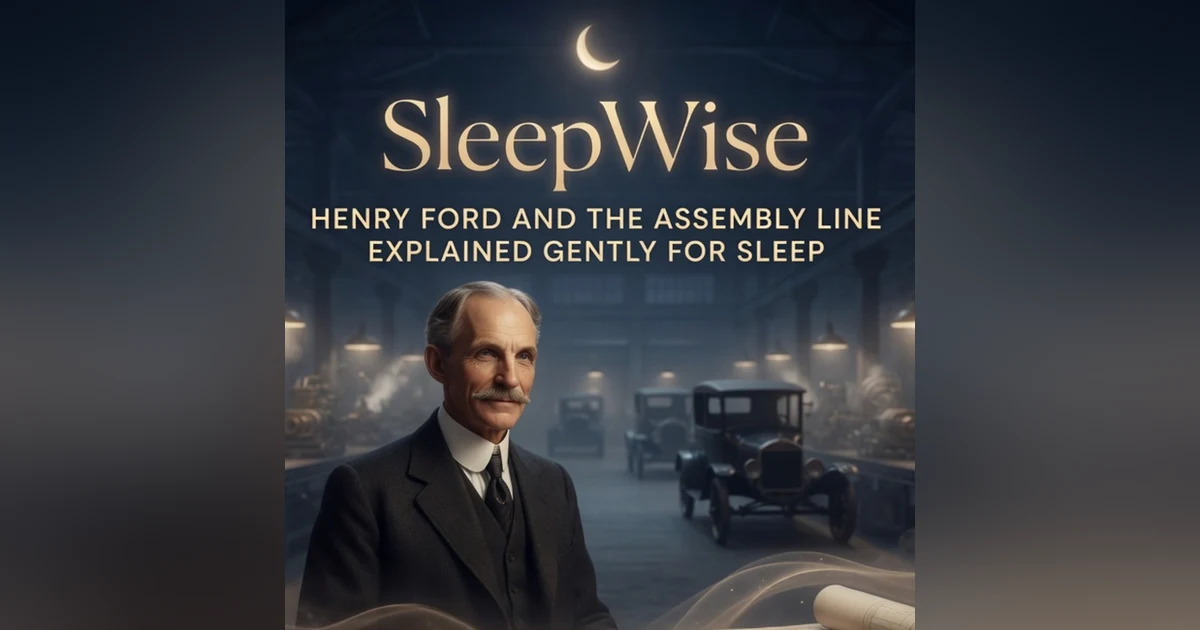


Tonight on SleepWise, we drift slowly into the autumn of 1913, into the brick-and-glass walls of a single factory in Highland Park, Michigan. There, on a quiet floor inside Henry Ford’s new plant, a chain was laid down for the first time, and a chassis that had once taken twelve and a half hours of human labor began to move past stationary workers, finishing in ninety-three minutes a job that had once taken most of a day. This is a calm, factual bedtime story for adults about Henry Ford, the assembly line, and the factory that quietly reshaped the rhythm of human work for a century.
Across twenty gentle segments, we follow Ford himself from a small Dearborn farm to the Crystal Palace plant designed by Albert Kahn, through the famous Five-Dollar Day that doubled factory wages overnight, and across the years the Model T turned automobiles from rare luxuries into ordinary household objects. We also walk, more carefully, through the darker chapters: the Dearborn Independent newspaper Ford purchased after the First World War, the antisemitic articles it published, and the long labor battles that ended at the Rouge plant in Dearborn. It is a story of invention and contradiction, of generosity and prejudice, of a man who lifted wages and lowered a curtain at the same time.
It is told gently, as SleepWise stories are, with no urgency and no need to remember the details. Just facts arranged like furniture in a quiet room, light turning slowly across them, and a steady voice carrying you toward sleep.
If these slow journeys through history help you rest, you can follow SleepWise and share the show with someone who might enjoy drifting off while learning something new about the makers of our modern world.
#HenryFord, #AssemblyLine, #SleepStory, #BedtimeStory, #SleepWise, #SleepStoriesForAdults, #BedtimeStoriesForAdults, #HistoryForSleep, #SleepPodcast, #SleepHistory, #CalmHistory, #RelaxingHistory, #FallAsleepFast, #SleepAid, #InsomniaHelp, #ASMRHistory, #ASMRSleep, #CalmingVoice, #SoothingNarration, #BedtimeReading, #SleepMeditation, #ModelT, #HighlandPark, #FordMotorCompany, #AmericanHistory, #IndustrialHistory, #IndustrialRevolution, #HistoryOfWork, #LaborHistory, #FiveDollarDay, #FordAssemblyLine, #MovingAssemblyLine, #MassProduction, #Fordism, #AlbertKahn, #CrystalPalaceFactory, #DearbornMichigan, #DetroitHistory, #AutomotiveHistory, #CarHistory, #VintageCars, #TinLizzie, #ModelA, #RougePlant, #RiverRouge, #AmericanIndustry, #TwentiethCentury, #HistoryDocumentary, #HistoryStorytelling, #StorytellingForSleep, #DocumentaryStyle, #LongFormHistory, #HistoryNarration, #BedtimeHistory, #DeepSleep, #SleepBetter, #SleepingMusicAlternative, #QuietStorytelling, #SlowStorytelling, #NarratedHistory, #EducationalSleep, #LearnWhileYouSleep, #HistoryBuffs, #HistoryLovers, #HistoryChannel, #SleepTime, #NightTimeStory, #Insomniac, #CantSleep, #StressRelief, #UnwindAndRelax, #CalmDown, #PodcastForSleep, #YouTubeSleep, #SleepWiseEpisode
0:00 Good evening, and welcome back to Sleepwise. Tonight. We drift toward a single building in Highland Park, MI, in the autumn of 1913, and toward the man whose name was painted across its gates. We will move slowly, as we always do, through a story that is partly about machines and partly about people, partly about generosity and partly about harm. Before that autumn, building an automobile was a slow, almost ceremonial affair. A chassis would rest on wooden trestles inside a quiet shop, and skilled workers would gather around it with their tools, fitting parts carried by hand from bins along the wall. To complete one Model T chassis, from frame to finished form, took roughly 12 1/2 hours of human labor. The man whose name was painted across those gates was Henry Ford.
1:09 He had not invented the automobile, nor would he ever claim to, but he was about to redesign the way one was made. Cars in those years were costly, scarce, and largely the property of people who already had property. The idea that an ordinary worker might drive home in something he had helped to build was still mostly a Daydream. By the spring of 1914, the same chassis would take about 93 minutes. A chain had been laid through the factory floor, and the car had been taught to move past the worker rather than the worker moving toward it.
1:54 It was a small change in geometry and a vast change in the world. Ford had been born on a Dearborn farm in 1863, raised among horses and hand tools, restless from boyhood with the inner workings of small machines. By 1913, he was already wealthy, already famous, already the founder of a company that bore his name. But Highland Park was about to make him something larger and stranger than a manufacturer, a figure of the modern age.
2:35 Tonight we will follow him, but gently. We will walk through the early Detroit that shaped him, the architecture of the Crystal Palace plant that housed his ambition, the moving line that altered the rhythm of human labor, and the January 1914 announcement that doubled wages overnight. We will also walk more carefully through the darker chapters that followed, the newspaper he purchased in 1918, the articles it published, and the prejudice that travelled the world alongside his automobiles.
3:19 It is not a story of a hero and not a story of a villain. It is a story of one man 1 factory, 1 chain in motion and how the consequences of all three are still woven into the century we are still leaving behind. There is nothing to solve to night, only a long quiet Rd. through a noisy time. If these slow journeys through history help you settle towards sleep, you are welcome to follow Sleep Wise and share the show with someone who might enjoy drifting off while learning something new.
4:04 And now, with the lamps low and the century still murmuring softly behind us, let us begin. Long before any chain moved through a factory, Detroit was already a city of making. By the turn of the 20th century, it sat along its broad river with a population approaching 300,000, a Great Lakes port whose docks and rail yards had been delivering raw material into busy hands for generations. The city had a particular reputation. It built things from wood and iron and brass, and it built them well.
4:53 Detroit was, among other industries, one of the great stove making centers in the country, sending heavy iron stoves into kitchens across the continent. It was also a carriage town. Wagon and buggy makers worked in long brick shops along the streets that ran toward the river, fitting wheels, stitching leather, painting bodies with patient brushes. When the automobile arrived, Detroit already had the skill and the supply chain that an early car required. The first decade of the new century made all of this visible.
5:36 In 1899, Ransom E Olds founded the Olds Motor Works, and after a fire destroyed his Detroit factory in March of 19 O1, his small curved dash Oldsmobile became one of the first cars produced in real quantity in America. He used a system of progressive assembly that already pointed toward the future without quite arriving there. Other companies followed quickly. Henry Leland founded Cadillac in 19 O2, building cars whose parts were so precisely made that any one of them could be exchanged for another, a small miracle in an age of rough fittings.
6:25 Packard, Studebaker, Hudson, Dodge and dozens of smaller firms appeared and competed and sometimes vanished in the same brick neighborhoods. In those early years, even the most ambitious factory was still essentially A sophisticated workshop. A car came together in one place and workers walked toward it, carrying parts from storage rooms or from neighboring shops. They bolted, fitted, hammered and adjusted, often working in small teams around a single chassis on the floor. The pace of work was bound by the human body. A man bent over a frame could only move so quickly, and the parts he reached for had to be brought to him by another set of hands.
7:24 Production was measured in cars per day, sometimes per week, and the cost of each vehicle reflected the patients inside it. Yet beneath this familiar arrangement, the conditions for change were quietly accumulating. The skilled workforce was already there. The foundries and metal shops were already there. The river and the rail lines and the suppliers were already there. Detroit was a city ready for an idea that had not yet been spoken aloud. In one of those small brick buildings on a street called Piquet, a young company would soon begin assembling cars of its own, and among its founders walked the man whose name would in time transform the meaning of every word above. Long before the Highland Park gates were painted, the boy who would put his name on them was learning the language of small machines.
8:33 Henry Ford was born on a summer morning in 1863 on a farm in what is now Dearborn, MI, the eldest of six children in a family of Irish and Belgian descent. The Civil War was still being fought when he was born, and the world he grew up in still moved largely on hooves and human shoulders. He was, by every account, more curious about machinery than about farming. As a child he took apart watches, gathered tools and listened with serious attention when neighbors brought their broken devices for him to inspect.
9:21 The story is often told that as a boy of 12 he saw a self-propelled steam engine on a country Rd. and the encounter never left him. In his 16th year, he left the farm and walked into Detroit looking for work. He apprenticed in the city's machine shops, including James F Flower and Brothers and the Detroit Dry Dock Company, learning to repair, file and shape the iron parts of an industrial age. For several years afterward, he moved between Detroit and the family farm, repairing steam engines for neighbors, marrying a young woman named Clara Bryant and quietly continuing to study mechanics in the evenings.
10:17 In time, he took a position with the Edison Illuminating Company in Detroit. Within a few years he had risen to chief engineer at Edison's Detroit station, a steady roll with respectable pay. But in his off hours, he was working on something else. In a small brick shed behind his home on Bagley Ave. he was building a vehicle of his own. On a quiet morning in the summer of 18 knot Arctics, he wheeled his quadricycle out into the alley.
10:58 It was a slight contraption balanced on bicycle wheels with a small 2 cylinder engine and a tiller for steering. And it worked. He drove it through the early streets of Detroit, and the air of the future passed briefly through the alleys of the past. Later that season, at a convention in Manhattan Beach, Ford met Thomas Edison and described his gasoline powered design. Edison, who had been pursuing electric vehicles, reportedly pounded the table and told the younger man to keep going.
11:40 Encouragement from such a figure carried weight. 2 Early ventures followed, and both faltered. The Detroit Automobile Company, his first attempt, dissolved within a couple of years after producing only a handful of vehicles, and the Henry Ford Company, his second, lost his involvement quickly after disagreements with investors. The remnants of that second company would soon be reorganized under Henry Leland and become Cadillac. Then, in the early summer of 19 O3, with a small group of backers in modest capital, Henry Ford founded the Ford Motor Company.
12:28 He was nearly 40 years old, twice removed from his own ventures, with no certainty this third attempt would last. The company that bore his name had only just begun. The first cars to roll out of Ford's new company were called by simple letters. The Model A, introduced in the company's first year, was A2 cylinder runabout, meant for early buyers who already had means and curiosity. It sold reasonably well, and the company survived its first uncertain year. What followed was a quiet experiment in product strategy. Ford and his small team produced a sequence of lettered models, the B, the C, the F, the K, the N, the R and the S, each aimed at slightly different buyers and price points. Some, like the six cylinder Model K, were heavy and expensive.
13:37 Others, like the lighter Model N, hinted at where Ford's instincts truly lay. He had been arguing for some time, often against the wishes of his investors, that the great future of the automobile lay not in luxury but in availability. Most buyers, he believed, were not wealthy collectors but ordinary working people who needed something useful, durable and affordable. He wanted to build for them. By the autumn of 19 O 8, that argument had won.
14:18 After secret development in a small upstairs room at the Paquette Ave. plant, the company introduced the car that would change its destiny. The Model T was announced to the public. With a starting price of around $850. The Model T was not the most refined automobile of its era, and it was not the most powerful. Its appeal was something quieter and more radical. It was designed to be simple to operate, simple to repair, and capable of crossing the rutted, unpaved roads that still defined most of America outside the cities. Its frame used a new vanadium steel alloy, strong without being heavy.
15:12 Its planetary transmission, while unusual, could be mastered without years of experience, and its high ground clearance let it climb out of mud that defeated more elegant cars. Farmers, country doctors and rural shopkeepers found in it a kind of mechanical mule that fit the country they lived in. Buyers responded almost immediately. Within a year, demand was outstripping the Paquette Ave. plant's ability to produce. Letters poured in from every state, asking when shipments would arrive, asking when prices might fall, asking for parts and instructions and any promise of delivery. The car had also been designed with affordability in mind. From the beginning, Ford and his engineers had simplified the design wherever possible, choosing fewer parts over many common bolts over special ones, and a single basic body style over a catalog of variations.
16:23 The savings were real, and they would only grow as production methods caught up to ambition. Ford had set out to build a car for the multitude, and the multitude had arrived faster than the factory could meet. A new building would be needed, and a new way of making things inside it. The building that housed Ford's first major success still stands today on Detroit's east side. Its dark red bricks settled into a new century without fanfare. The Paquette Ave. plant was newly built when Ford Motor Company moved in, three stories of mill style architecture stretching about 400 feet along its namesake St. with tall windows that drew daylight on to the workshop floors. The plant was modest by the standards of what would come. But in those first years it was already among the larger automobile factories in the country. Its long, open floors gave room for assembly stations, part storage and the steady traffic of workmen between them. It was at Paquette Ave. in a curtained corner of the third floor, that the Model T was developed. Across the better part of two years, a small team worked in semi secrecy on prototypes,
17:55 sketches and Dr. trains, refining the car that would soon astonish the country. When the model was finally announced in the autumn of 19 O eight, production was planned for the very building in which it had been imagined. The first Model T rolled out of Piquette Ave. in late autumn, with regular production beginning soon after. For about two years, this brick building was the heart of Ford's growing automobile empire, and the cars that emerge from it began making their way across America's rough roads.
18:39 But the work itself, for all its volume, was still essentially craft production. A chassis would be set in place on the floor of one of the assembly bays, and a team of workers would gather around it. They would walk to the bins or storage areas where the parts were kept, carry them back and fit them by hand. A man might fit an axle, then walk 20 feet for a bracket, then walk 30 more for a fastener, then return to install it. The day was a series of journeys between the chassis and the supply, each one short, each one almost unnoticed but altogether adding up to enormous unused minutes. This was the inheritance of every automobile factory of the time, not a flaw of Paquette Ave. alone. It was simply how cars were made. The notion that a car might be made to come to the worker, rather than the worker walking endlessly toward the car, had not yet been put into practice anywhere. Ford himself was beginning to think differently. He had visited slaughter houses in Chicago, where overhead rails carried carcasses past stationary workers, each one performing a specific cut.
20:13 He had studied bicycle factories, sewing machine plants and watch shops. Gathering ideas about specialization and flow. Within a couple of years, demand for the Model T was exceeding even the building's expanded capacity. Ford ordered a new plant, designed this time on land in Highland Park, just outside the Detroit city limits. Piquette Ave. was about to be left behind, and the modern factory, in something like the form we still recognize, was about to be born.
20:56 The new plant rose on flat ground north of the Detroit city line in a small village called Highland Park. Ford had purchased the land a few years earlier, sensing that Piquette Ave. could no longer hold what the Model T was becoming. To design the building, he turned to a young architect named Albert Kahn, whose work was beginning to change how American factories looked. Kahn had been born in Germany and brought to Detroit as a child. He had no formal architectural degree, having learned the discipline through long apprenticeship and patient observation.
21:45 He had become a quiet master of industrial design, fluent in concrete and glass and willing to question the heavy, dim conventions of the typical Victorian factory. For Highland Park, he proposed a building unlike anything Ford had used before. The walls were poured in reinforced concrete strong enough to support heavy machinery without the bulky internal columns of brick mills. The exterior was almost more glass than wall, with great rectangular windows running across every floor.
22:29 The result, when it opened in the early years of the new decade, was startling. Sunlight poured into spaces where workers had once squinted under gas lamps and overhead bulbs. Reporters and visiting engineers soon began calling it the Crystal Palace, after the famous iron and glass structure that had once dazzled London. It was 4 stories tall along its main length, with auxiliary buildings spreading across a sprawling site. Inside, the floors were vast, open and uninterrupted, designed to allow the long flow of work without the bottlenecks of cramped corners. The building was an architectural argument about industry itself.
23:21 Kahn would go on to design hundreds of factories in his lifetime. For Ford and for many others, his name would become so closely tied to industrial architecture that some observers called him the master of the modern factory. But it was at Highland Park that the form took its most influential shape. For Ford, the building was more than a place to assemble cars. It was a declaration that a modern factory should not feel like a dim cathedral of grease and shadow, but like a clean, well lit space where light, motion and material could come together in unprecedented harmony.
24:11 Of course, the architecture alone did not make the future. What would happen inside The building was still being worked out. The walls and the windows were ready, but the chain that would soon hum along the floor was not yet imagined in its final form. In quiet rooms upstairs, in meetings between engineers and time keepers, the next great change was already being sketched. Highland Park was a beautiful shell. And soon, something profoundly new would begin to move within it. The shape of Highland Park was new, but the methods inside it were still mostly inherited.
25:00 In its early days of operation, the building looked grand but worked much like the older factories Ford's team had known. Workers walked between bins, carrying parts to chassis that sat in place on the floor. That arrangement could not satisfy the demand. The Model T had stirred. Orders piled higher than production could meet. Engineers and floor managers began studying every motion, every walk between station and bench, looking for a time that was being quietly lost. They did not invent their ideas in isolation. The era was full of voices urging that work could be measured, broken down and redesigned. Frederick Winslow Taylor, the most famous of them, had argued that any task could be timed, analyzed and reduced to its most efficient sequence.
26:03 His ideas, sometimes called scientific management, were spreading through American industry. Taylor's work was admired by some and despised by others, but it had introduced a new vocabulary into the workshop. The motions of human labor could be studied as carefully as the motions of a machine. Ford's team studied other examples, too. They visited bicycle factories, where interchangeable parts had become a quiet specialty. They walked through sewing machine plants, where progressive assembly had been used for decades.
26:49 And most famously, they looked at the great slaughterhouses of Chicago. In Chicago's packing plants, animals moved overhead on chains, while workers stood in fixed positions and made the same cuts thousands of times a day. It was, in a sense, an assembly line in reverse. A whole caucus entered at one end and parts left at the other. The arrangement was efficient, brutal and unmistakable. In its lessons inside Highland Park, the engineers began experimenting.
27:33 One of the first formal trials came on a small sub assembly, the flywheel Magneto, a device used to generate the electrical spark that fired the engine. Until then, a single worker had built a Magneto by hand in about 20 minutes, fetching parts as needed. The team broke the work into roughly 30 steps, set the parts on a moving belt, and assigned a different worker to each step. The result was startling. The same Magneto could now be assembled in about 13 minutes, and then less as the rhythm settled.
28:21 It was a small machine, but the principle behind it could be made very large. From the Magneto the experiment spread engines, transmissions, axles, each sub assembly was studied, broken down and lifted onto its own moving line. Each time the time required fell by remarkable margins, and the problem of fetching, walking and waiting was steadily eliminated. The pieces were almost ready to be brought together. Yet 1 great question remained. Could the chassis itself, the frame of the entire car, be made to move past the worker rather than wait patiently for the worker's approach?
29:13 The decisive experiment came in the autumn of 1913. In a section of Highland Park's vast main floor. The engineers prepared something that had never quite been done before. They built a long, low rail with a rope and winch arrangement, and they set the bare chassis of a Model T upon it. The day began like any other. Workers stood along the rail in their assigned positions, each prepared to perform a small fraction of the assembly. The rope tightened and the chassis began to move, not quickly but steadily, drawn past one station and then the next.
29:59 It was a strange sight by the standards of the time. A car under construction had always been still, with workers walking toward it, around it, over it. Now the car was the one in motion, and the workers held their ground. The first experiments were rough. Distances had to be adjusted, paces matched, parts repositioned. But the early measurements were already astonishing. A chassis that had previously taken something like 12 1/2 hours of human labor to assemble could now move from frame to running car in about 6. In the months that followed, the line was refined, the rope and winch gave way to a chain, and parts were brought to each station from above and below on conveyors and ramps. Heights were adjusted so that workers no longer bent uncomfortably, and the pace of the chain was tested, retested and gradually increased.
31:15 By the spring of the next year, the same chassis could be assembled in about 93 minutes. The number became almost mythological. A car had been built nearly eight times faster than before in a single building, with the same kind of men who had once walked patiently from Bin 2 chassis. The change spread like a quiet flood. Other parts of the Highland Park plant adopted moving lines, then other Ford factories, then other companies, then other industries entirely.
31:58 What had begun as an experiment in a single Bay of a single building was becoming a method. The numbers told the same story in another language. Where Highland Park had produced about 78,000 Model T's in one of its first full years, it would soon be producing more than 200,000, then 300,000, then half a million. The factory had not become much larger. The work inside it had simply been rearranged. It is sometimes said that Ford alone invented this. But the truth, like most truths in industrial history, is more shared.
32:45 Engineers like Charles Sorenson, William Clan, Clarence Avery and Peter Martin contributed crucial pieces, drawing on ideas from meat packing, bicycles and management theory. Ford himself often gave them credit, though his name remained attached to the achievement. What no one disputes is the scale of the result, a method that began with a rope pulled across a factory floor. Wood within a generation, redefine the rhythm of human work itself.
33:25 For the men who stood along the line, life had quietly changed. The chassis approached at its steady pace, and a worker had a small window to perform his task before the next one arrived. The job was no longer to build a car, but to perform one fragment of the building again and again for as long as the shift lasted. The chassis assembly itself had been broken into 84 distinct operations, each performed by a different man. One worker might tighten the same bolt thousands of times in a single shift, while another fit an axle, welded A bracket, or attached a wheel. Some operations took only seconds, and few of them required the patient skill that had once defined the work. There were practical advantages, of course. A new worker could be trained in a single afternoon, rather than over months of apprenticeship.
34:36 He did not need to read English, or to understand mechanical theory, or to know what part of the car he was working on the line carried him through. That was part of its attraction to Ford's planners. By breaking the work into the smallest possible motions, they could draw labour from the great waves of immigrants arriving in Detroit each year. Men from Italy, Poland, Greece, Hungary, the American South and beyond could find work on the line within hours of walking through the gate. But there was another truth less proudly spoken. The work was numbing.
35:23 It was loud, dirty and relentless, and the pace was not set by the body's natural rhythm but by a chain that did not tire and did not pause. The plant in full operation was a relentless soundscape. Stamping presses thudded in nearby rooms. Conveyor belts, wind and overhead cranes swung loads of metal across the open floors. Many workers ended their shifts with ears ringing and hands trembling from hours of vibration. A man who reached his station even a moment late could throw the whole sequence into stutter. A man who fell behind might be replaced before the day was out. The freedom of the older shop, with its conversations, its shifting tasks, its momentary pauses to think, had been folded into something faster and more uniform. Some workers adapted, finding their own quiet rhythms inside the noise.
36:38 Others suffered, leaving exhausted and unsuited for any other kind of work. Many simply walked away after a few hours, days or weeks, unwilling or unable to remain. It was not cruelty in the obvious sense. No one was being beaten, and the pay was decent for the era and steady. Yet a different kind of cost was beginning to gather, one that could be measured not in dollars but in the strange new fatigue of becoming, for 8:00 or 10 or 12 hours a day, an extension of a long machine.
37:23 Henry Ford would later say with characteristic confidence that the average man wanted the job in which he did not have to think. Many disagreed. The truth was more complicated, and the factory was about to face the consequences of asking. By the end of the line's first full year, the factory was producing more cars than ever, but it was also losing people at a speed no industry had ever quite seen. Men were quitting within hours of their first shift. Some quit before they reached the line at all, taking one look at the noise and pace and turning back through the gates. The numbers when Ford's accountants assembled them were staggering.
38:17 To keep roughly 13,000 jobs filled, the company had been forced to hire well over 50,000 men in a single year. The annual turnover rate climbed to something like 370%. This was not simply an inconvenience. Every new worker had to be brought through the gates, registered, instructed and placed at his station. Even though the line had simplified each task, every replacement still cost time, supervision and small disruptions in the flow. Absenteeism rose alongside it.
39:05 On any given morning, roughly one in 10 workers might fail to appear, leaving foremen scrambling to redistribute men or pause sections of the line. The factory's elegant geometry depended on bodies, and bodies were leaving faster than the system could absorb. Behind the numbers were ordinary stories. A young Polish immigrant might last three days before deciding the noise was unbearable, while a father of four might leave because the pace gave him headaches he could not shake. A young farmer's son, raised to work in unhurried rhythm, might quit by mid morning of his first shift. For Ford and his managers, the situation was both economic and moral.
40:03 The high turnover was a tax on the line itself, eating into the very efficiency the system had been designed to produce. Yet beyond the spreadsheet, it raised a quieter question. If work could be made so easy to learn that anyone could do it, but so unpleasant that few wanted to stay, was that really progress? The line had revealed something its inventors had not fully anticipated. Speed and simplicity, separated from any sense of pride or stake, did not quite hold a working life together.
40:47 Something else was needed, something the old craft tradition had once provided without anyone naming it. That autumn, Ford's managers began drafting plans that would be unprecedented in American industry. James Cousins, the company's hard headed business manager, worked alongside Ford and the production chiefs through long winter nights of calculation, debate and revision. They had decided to do something extraordinary. They would double wages, They would shorten the work day, They would invite the world to look at Highland Park not only as a place where cars were built faster, but as a place where workers might, for the first time in industrial memory, be paid enough to afford the very cars they were assembling.
41:48 The announcement, when it came, would astonish the country. The announcement came on a January morning in 1914. Ford Motor Company called reporters to a small office in Highland Park and shared a number that did not at first seem possible. Workers at Ford would now be paid $5 a day for 8 hours of Labor. The previous wage had been about $2.00 and 1/4 for a nine hour shift, roughly the going rate in Detroit factories.
42:31 The new figure more than doubled what most workers had been earning the day before. The shift had also been shortened, allowing the plant to run 3 full 8 hour rotations across each day and night. The reaction was immediate and almost theatrical. Reporters telegraphed the news to other cities, and editorial writers on Wall Street called the decision insane, predicting that Ford had condemned his company to ruin. Yet labor organizers and ordinary workers across America felt something close to disbelief in the other direction.
43:16 Within hours, men began traveling toward Highland Park. Within days, crowds had gathered at the gates in numbers no one had anticipated. By the second week of January, thousands stood outside in freezing weather, some sleeping on sidewalks, others arriving by overnight train from Pittsburgh, Cleveland and Chicago, hoping for the chance to apply. The crowds eventually grew so dense that fire hoses were turned upon them in the bitter cold to disperse them.
43:56 Photographs of those scenes still survive, showing men huddled wet in the hard light of January, waiting for a number that had seemed impossible the week before. Ford's reasoning was, characteristically, a mixture of moral conviction and shrewd business calculation. He spoke publicly about wanting his workers to be able to afford the very cars they were building. He spoke of the dignity of Labor, of the importance of family life, of a country in which workers should share in the prosperity they help to create.
44:39 Privately, his manager spoke also of the turnover crisis. Doubling wages, they had concluded, would be cheaper than the constant hiring of replacements and would yield a more skilled, more loyal, more rested workforce. Both stories were true. The $5 day was real generosity, and it was real strategy, and the two were not separable. The world watched, and the world listened. For the first time in IT industrial history, a major company had declared that an ordinary factory worker deserved a living wage, not merely A subsistence. 1 Whatever else followed that idea had been said out loud in a way that could not be entirely unsaid. Highland Park, already famous for its glass walls and its moving chain, had become famous for something else as well. The age of the assembly line had also become briefly the age of the well paid assembler.
45:54 The new wage came with a condition. Not every Ford worker would receive the full $5, only those who, in the company's view, had earned the right to share in its profits. To determine who qualified, Ford established a body that would soon become famous and controversial in equal measure, the Sociological Department. The department was created in the same year the wage was announced. It was eventually led by the Reverend Samuel Marquis, a thoughtful Episcopal clergyman who had been a friend and chaplain to the Ford family.
46:39 Its mandate was unprecedented. To investigate the home lives of Ford's workers and to decide whose habits made them worthy of the company's generosity, investigators were sent across Detroit in numbers that grew rapidly into the hundreds. They knocked on doors, examined kitchens and bedrooms, asked questions about savings in drinking and church attendance. They sat down at family tables, observed the cleanliness of the home, and inquired into how a man spent his evenings and his Sunday afternoons. Several conditions had to be met. A worker had to be of demonstrated sobriety, free from gambling debts, and of good moral character. As the department understood it, he should be supporting his family in a stable home, not living in a boarding house. If he was an immigrant, he should be enrolled in the Ford English school, learning the language of his new country. The department maintained large files on 10s of thousands of workers.
48:03 A man whose habits did not meet expectations could be reduced to the basic wage, told what he needed to change and given a chance to improve. A man who refused to Co operate could be dismissed altogether. Some workers welcomed the help. The department offered loans, advice on home buying and assistance with naturalization papers. Many immigrant families later credited Ford's investigators with helping them settle into American life in ways no one else had bothered to provide. But others found the arrangement deeply intrusive. The right to be paid a fair wage had become entangled with the obligation to live a particular kind of private life. Welfare and surveillance had been braided together in a way that made each indistinguishable from the other. In time, the department softened. Reverend Marcus grew uncomfortable with what he came to see as moral overreach and eventually resigned. The department's broader investigative role faded, and within several years it had been quietly dismantled. Yet its legacy lingered.
49:38 Ford had shown the country what a company could do when its ambition extended past the gates and into the kitchens of its workers. Whether that was a kindness or a quiet form of control depended very much on which side of the doorway 1 stood. What had been born in Highland Park did not stay there long. Within a few years, other automobile companies were redesigning their factories around moving lines of their own. Some hired Ford engineers to advise them.
50:18 Others studied the published descriptions, sent observers to Detroit, or simply reverse engineered what they saw at car shows and dealer demonstrations. The principal was generous in its portability. A line could be set to almost any speed, divided into almost any number of stations, and adapted to almost any product made of standardized parts. As the technology of conveyors, motors, and overhead rails matured, the technique spread far beyond the building of cars.
50:59 Refrigerators began rolling out of Frigidaire and Kelvinator plants on lines of their own washing machines. Vacuum cleaners and electric stoves followed quickly. A nation that had once relied on Craftsman for its household goods was learning instead to buy them off the line in identical multitudes, at prices that kept falling year by year. Aviation took up the method during wartime. The vast Willow Run plant, built West of Detroit during the Second World War, was designed to assemble heavy bombers on a moving line at the rate of 1 per hour.
51:46 The technique that had once raised eyebrows. 19 of their outlanders had become a foundation of National Defence. Other countries adopted it with their own particular emphasis. The Soviet Union studied Highland Park carefully and built its own great factories on the same logic, hiring Albert Kahn's firm to design many of them. Japan would decades later refined the approach with such care that it eventually changed the world's understanding of efficiency itself. The technique even acquired a name around the world. Observers began Speaking of Fordism, A shorthand for the entire philosophy of mass production, by moving line with high wages, standardized products, and large consumer markets to absorb the output.
52:48 Ford himself helped to spread the gospel. In his autobiography, written with the journalist Samuel Crowther, he laid out the principles of the system with confident clarity, and the book was translated into many languages. Industrialists, engineers and even philosophers studied it with serious attention. Not everyone celebrated. Critics pointed out that Fordism produced extraordinary goods at the cost of extraordinary monotony, and that something essential about human work was being quietly traded for cheaper appliances.
53:36 The argument would continue for the rest of the century, and indeed continue still. But whatever one thought of the trade, it had been made. The factory floor that emerged from the chain at Highland Park became the factory floor of the modern world. By the middle of the century, a child raised in any industrial nation would never have known any other kind of making. For the buyer of a Model T, the most visible consequence of the moving line was the price. When the car had first been introduced, it had cost about $850, a sum that already placed it within reach of the middle class household. As the line grew faster and the company larger, that price began to fall.
54:35 By the early 1920s, a basic Model T could be purchased for just over $300. By the middle of that decade, it had fallen to around 260. A car that had once been a serious investment for a small farmer or shopkeeper was becoming instead something like an appliance. The savings came from many sources. Vertical integration brought iron, glass, rubber and timber under Ford's own ownership, and standardized design eliminated nearly all variation. Most Model T's came in only one body style and famously in only one color, a deep black chosen because that particular paint dried fastest on the line.
55:31 By the middle of the decade, more than half of the cars on American roads were Model T's. Around 15 million of them were eventually built, a figure no other car had approached and few would ever match. The little black machine, sometimes affectionately called the Tin Lizzy, had become the most recognizable object in American transportation. The country itself began to change shape. Around it, roads that had once been dirt tracks were paved, lengthened and connected, and service stations appeared on the outskirts of small towns. New kinds of businesses, the drive in the roadside diner, the motor court that would soon shorten its name to motel, sprouted along the routes the Model T was opening. Family life shifted with the geography. Sunday drives became a national pastime. Distant relatives could be visited without weeks of planning, and young people could court at greater distances than their grandparents would have imagined possible. The horizon of ordinary American life had grown wider almost overnight.
56:59 Cities reshaped themselves, too. Suburbs, once limited to the reach of Street car lines, could now extend further into the countryside, drawn outward by the patient pull of an automobile in every driveway. Downtowns began the slow accommodation, sometimes painful, sometimes proud of becoming places to drive to rather than to walk through. There were costs, naturally. Horses were displaced. Small carriage makers vanished and entire crafts and skills faded into nostalgia. The air over busy streets grew thicker and the rhythm of small towns, once tuned to the speeds of feet and hoofs, began to syncopate with the engine.
57:55 Yet for an enormous portion of the country, the Model T felt less like a luxury and more like a household necessity that had finally arrived. The car had stopped being a curiosity and become a fixture in less than a generation. While the Model T was reshaping the country, its maker was acquiring a different kind of voice. In the years just after the First World War, Henry Ford purchased a small newspaper in his hometown of Dearborn, MI, called the Dearborn Independent. It had been a quiet, parochial weekly with limited circulation and limited ambition.
58:47 Under Ford's ownership, it became something else entirely. He poured resources into it, hired editors and writers, expanded its reach, and turned what had been a local paper into a national publication, carrying his name and his views into homes across the country. By the middle of its expansion, it was reaching readers from rural Vermont to small towns in California and into the farm houses of the American Midwest. The most striking feature of his ownership was his distribution method. Every Ford dealership in the United States was expected to encourage subscriptions, and sales of Model T's and copies of the Dearborn Independent would be linked, sometimes politely, sometimes with explicit pressure from above. Within a few years, the paper's circulation rose into the hundreds of thousands.
59:59 Ford himself rarely wrote for the paper directly. The visible editor was a journalist named William J Cameron, and much of the editorial direction was guided by Ernest Lee Bold, Ford's long time executive secretary. But its readers understood correctly. That the views inside reflected those of the man whose name was on the title page. For a while, the content was a familiar mix for an opinion paper of its time. There were articles about farming, about industry, about politics, about the Ford Motor Company itself.
1:00:46 There were editorials on temperance, on labor, on the dangers of cities and the virtues of plain American life. But there was also, increasingly, something else. Beginning in the spring of 1920, the paper launched a series of articles that would, in time, come to define its legacy more than anything else it published. The series was titled With Deceptive Sobriety and its subject was, in plain terms, the Jewish people. The articles drew heavily on a notorious forgery already circulating in Europe, the so-called Protocols of the Elders of Zion.
1:01:35 They blamed Jewish people, vaguely and broadly, for many of the troubles of the modern world. They were not subtle and they were not honest. The Dearborn Independent had become something it had never been before, a vehicle for sustained anti-Semitic publishing, financed and authorized by one of the most famous and admired industrialists in the world. Its reach gave its content a credibility it would not otherwise have possessed. Ford was no longer only the man who built cars. He had become, by his own choice, a publisher whose pages carried prejudice into kitchens and farm houses well beyond Dearborn.
1:02:28 The series was called The International Jew and over the next year and a half the Dearborn Independent published it in installments. Roughly 91 weekly articles appeared drawing on anti-Semitic traditions long present in Europe and applying them to American life. The articles accused Jewish people of secretly controlling banks, governments, theatre, music, sports, agriculture and the news. They cited the discredited Protocols of the Elders of Zion as if it were a genuine document. They presented invented coordination as fact and presented Jewish religious life and tradition as a kind of conspiracy hidden from view.
1:03:23 The articles were eventually collected into 4 volumes and published as a book. That book was sold cheaply, sometimes given away through Ford dealerships, and translated into German, Russian, Spanish, Polish and many other languages. Copies travelled across continents and oceans into nations whose own histories of anti-Semitism were already deep and dangerous. In Germany, the book found a particularly receptive audience. A young politician in Munich named Adolf Hitler praised Henry Ford by name in his own book, Mein Kampf, and kept a portrait of Ford on his office wall.
1:04:16 To Nazi propagandists, Henry Ford's status as a Great American industrialist made his words enormously useful. In the United States, the response was slower, but eventually serious. Jewish communities and civic groups protested, boycotts of Ford cars were organized, and rabbis, public figures and ordinary readers wrote letters of outrage that stacked higher in Ford's offices. Eventually, a single lawsuit changed the picture.
1:04:58 A Chicago lawyer and farmer organizer named Aaron Sapiro sued Ford for libel after the Dearborn Independent attacked him by name in a series of articles about Jewish involvement in agriculture. The case dragged through courts and headlines, forcing Ford to a public reckoning he had avoided for years. In the late 1920s, Ford issued a written apology and retraction. The statement disavowed the articles and pledged to discontinue the anti-Semitic content. The signature was Ford's, but the words by most accounts had been drafted by others, and the apology was widely doubted in its sincerity even at the time.
1:05:52 The Dearborn Independent itself was eventually closed, yet the damage that its articles had done could not be retracted. Translated copies of The International Jew continued to circulate in Europe long after the original paper had folded, contributing to a poisonous current of opinion that would, within little more than a decade, find its terrible expression. In 1938, Ford accepted the Grand Cross of the German Eagle from the Nazi government, the highest honor the regime offered to foreigners.
1:06:36 He was photographed receiving it smiling in his old age. He was no longer the same young inventor in the alley behind Bagley Ave. and the photograph remained as evidence. The $5 day had once made Henry Ford famous as a friend of the working man. By the time the assembly line was a generation old, that reputation had grown harder to defend. The same factory that had once doubled wages overnight now resisted with unusual ferocity the workers attempts to organize themselves into a union.
1:07:19 In the 1930's, the Congress of Industrial Organizations was sweeping through American industry. Steel workers, auto workers and others were forming powerful new unions, demanding the right to bargain collectively over wages, hours and conditions. General Motors and Chrysler had eventually accepted the United Automobile Workers. Ford had not. At the heart of Ford's resistance was a man named Harry Bennett. He had begun his career as a sailor and an amateur boxer, and he had risen through the company by becoming Henry Ford's most trusted enforcer. He led a unit known as the Service Department, a private security force that grew in time into one of the largest such operations in the country.
1:08:19 The Service Department was not a polite organization. It maintained a network of informants inside the plants and investigated, workers say, Suspected of union sympathies. It intervened, sometimes with quiet pressure, sometimes with bare violence, to discourage organizing. In May of 1937, that pattern reached one of its most public moments. UAW organizers, including a young Walter Reuther, gathered on a pedestrian overpass leading into the Rouge plant in Dearborn to distribute leaflets.
1:09:07 Photographers from Detroit newspapers were present. Bennett's men met them on the overpass. Ruther and the other organizers were beaten in front of the cameras, and the photographs that ran the next day showing well dressed organizers being attacked by burly security men became some of the most iconic labor images of the century. The event was remembered ever after as the Battle of the Overpass. Ford resisted unionization for several more years. While other automakers had reached agreements with the UAW. Ford continued to hold out, sometimes with rhetoric of paternal care, sometimes through Bennett's harder methods. Henry Ford himself spoke publicly of unions as outside agitators, claiming his workers needed no representation other than his own goodwill.
1:10:15 In time, even that resistance gave way. By the early years of the Second World War, the Ford Motor Company signed an agreement with the UAW. The terms, when they came, were among the most favourable any automaker had granted, including a closed shop and competitive wages. The strange arc had run its course. The man who had once been celebrated as Labour's greatest friend ended his industrial career in open conflict with Labour itself.
1:10:56 The two stories were not contradictions. They were threads of the same complicated cloth. For two decades, the Model T had been Ford's monument. By the middle of the 1920s, however, the world was beginning to drift away from it. Other automobile companies were offering newer designs, more comfort, more colors, more change from year to year, and ordinary buyers were beginning to want what was on off elsewhere. Ford resisted. He was, by this point, unwilling to accept that the car he had built for the multitude was no longer what the Multitude wanted.
1:11:47 For years he insisted the Model T would suffice, that improvements were unnecessary, that the simple black machine remained the right answer. In May of 1927, after about 15,000,000 had been built, production of the Model T finally ended. The line that had defined an industrial era stopped, and a new model called the Model A was put into development for the late autumn of that year. There was a strange pause across the factories during the transition, as Highland Park and other plants retooled themselves for the next car. By that time, however, the center of gravity of Ford's empire had already begun to shift. A few miles South of Highland Park in Dearborn, a vast new complex had been rising along the river since the years just after the First World War.
1:12:53 It was called the River Rouge, plant name for the small river that ran through it. The Rouge was something even more ambitious than Highland Park had been. It was designed not merely as a factory, but as an entire industrial ecosystem. Coal arrived on Ford's own ships, and iron ore came from Ford's own mines in the upper Midwest, hauled across the Great Lakes on Ford's own freighters. Inside the complex were foundries, glass works, sawmills, and a power plant. What Ford had imagined was a place where raw earth could enter at one end and finished automobiles could leave at the other.
1:13:46 Vertical integration, taken to its furthest extreme, had become a single, sprawling sight. Albert Kahn designed many of its principal buildings, his concrete and glass vocabulary now applied at an even greater scale. By the time it reached its full extent, the Rouge employed about 100,000 workers, more than any other manufacturing site in the world. It made not only cars, but railroad ties, paper and even cement. A single industrial address had become its own small city with its own logic and its own weather of activity.
1:14:36 Highland Park, where the moving line had been born, gradually faded in importance. The Rouge took its place as Ford's headquarters of imagination. The original Crystal Palace remained in use for decades, but the Great Work moved S If Highland Park had been an argument about industry, the Rouge was an argument about scale. It said that nothing was too large to be made, owned, and brought together under one roof.
1:15:17 It would in turn cast a long shadow across the rest of the 20th century. The years after the Rouge brought a long and increasingly sad chapter for Henry Ford himself. By the 1930s and 1940s, he was an old man, and the strange tendencies that had always lived inside him deepened with age. His son Edsel, who had been named president of the company many years earlier, suffered for much of his adult life under his father's contradictions.
1:16:02 Edsel was thoughtful, modern and willing to listen to his managers. He pushed for new car designs, gentler labor practices and a more diversified product line, and his father more than once undermined him. When Edsel proposed innovations, Henry would frequently overrule him. When Edsel sided with engineers, Henry would side with Bennett. The arrangement was painful for everyone close to the family, and most painful for Edsel, who watched his health and authority erode over years of quiet conflict. In May of 1943, Edsel died of stomach cancer at 49 years old. The cause of death was medical, but those who knew the family well believed that the long battle with his father had drained him in ways no doctor could quite name. Henry Ford grieved in his way, but did not change. There was, in those late years, a strange new direction in his attention.
1:17:33 Even as the world he had remade kept accelerating, Ford grew nostalgic for the world he had displaced. He bought up old buildings and farm houses and transported them to a tract of land near Dearborn that he called Greenfield Village, preserving the blacksmith shops and one room school houses his automobiles had been quietly making obsolete. The elder Ford suffered strokes during these years, his memory and judgment dimming.
1:18:14 Yet he resumed nominal leadership of the company during the Second World War, an interval in which Ford's plants turned entirely to the war effort. Bombers, jeeps and engines flowed from those plants in numbers that helped determine the outcome of the conflict. After the war, his grandson, Henry Ford the Second, took over the company at the age of 28. The young man inherited a business that had become disorganized and fragile under decades of one man's grip. His first major act was to fire Harry Bennett, ending the era of the service department and beginning a long modernization that would see the company recover. Henry Ford himself died in April of 1947 at the age of 83 in his home in Dearborn.
1:19:26 The night he died, a flood disrupted the local power grid, and the great industrialist, whose name was synonymous with electrified mass production, passed away by candlelight. The detail seemed almost too neat to be true, but it was true. He was buried not far from where he had been born. The country he had helped to remake mourned him with the complicated feelings he had always inspired. He was praised as a genius and criticized as a tyrant, remembered as a benefactor and as a publisher of Harm. In death, as in life, he refused to be one thing. So now the journey can grow quiet. We began with a single building in Highland Park in the autumn of 1913, and with the man whose name was painted across its gates.
1:20:39 We followed the slow craft of an older Detroit, the careful experiments of a small workshop, and the moment when a chain was first laid through a factory floor. We watched a chassis that had once required 12 1/2 hours of human labor become something a line could complete in 93 minutes. We watched the wage doubled, the work day shortened, the world Astonished, we saw the streets of small towns reshape themselves around the patient pull of a Model T We saw the Crystal Palace become a model that other industries, other countries, and other centuries would follow. And we walked more carefully through the darker chapters the newspaper bought and turned to other purposes, and the articles that wandered the world for decades, contributing in subtle and severe ways to a great human harm, the Labor Relations that hardened into violence, and the grandson who finally inherited what an old man had left behind.
1:22:06 Henry Ford was not a hero in the simple sense, nor was he simply a villain. He was a person who built something that altered the world's labor, and who used the platform that altered the world to publish things that wounded other people. Both threads belong to him, and neither cancels the other out. His factory, in some quiet sense, also belongs to all of us now. Every car that rolls off a line, every appliance built by motion past stationary workers, every chain or conveyor in a manufacturing plant, anywhere traces some part of its lineage back to a brick floor in Highland Park.
1:23:05 The shape of modern work was rearranged in that building, and the rearrangement has not gone away. Tonight, perhaps that is the feeling to keep. Not the dates, not the lawsuits, not the precise number of hours the chassis used to take, but the sense that one ordinary place and one complicated person were enough to change the rhythm of how millions of human beings would spend their days. Outside the window, somewhere in the dark, an automobile is passing on a quiet Rd. Somewhere else, a factory is humming through its night shift, with conveyors moving softly in the dark. Somewhere, a child has fallen asleep in the back seat of a moving car, their head against the cool glass, their dreams smoothed by the motion of the road. The factory whose chain first moved 100 years ago is still moving in 1000.
1:24:23 Places at once on every continent the line eventually reached, and to night, beneath all of it. You do not need to solve this century. You only need to rest within it. Here, where the lamps are low and the room is still, the world slows, and so do we. Good night.