Sleepy Story of the B-2 Stealth Bomber
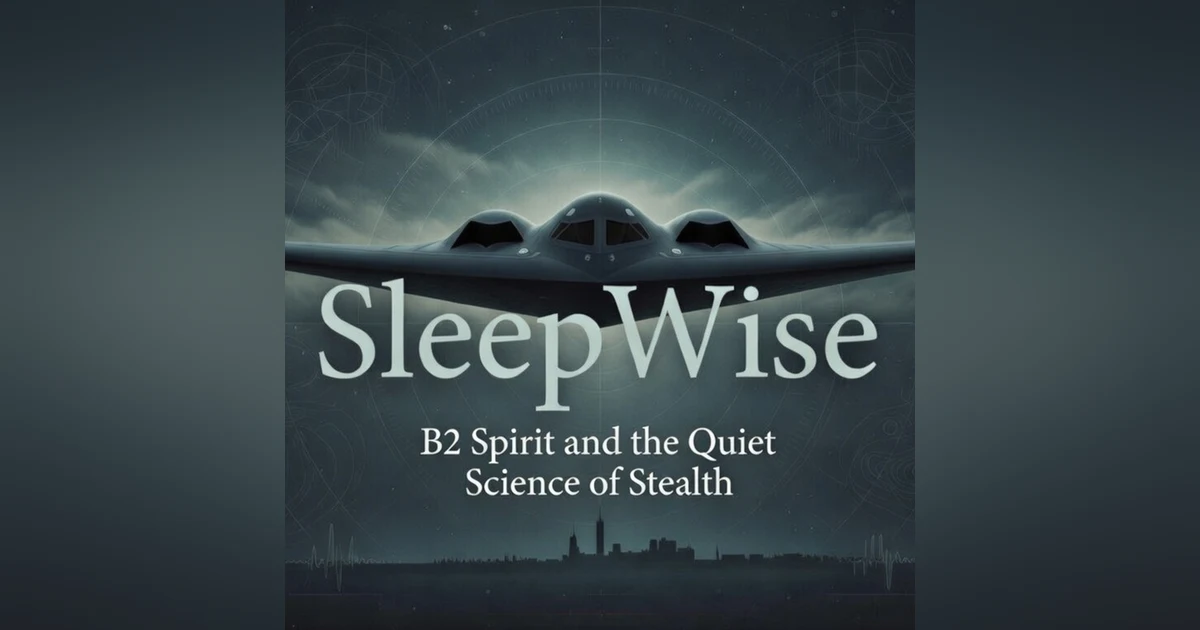


Tonight, we drift into the story of the B2 Spirit… the rare flying-wing stealth bomber that became one of the most extraordinary engineering spectacles of the modern age. In this calm SleepWise episode, we move through the aircraft’s remarkable design, from radar and stealth to materials science, aerodynamics, mission endurance, and the quiet logic of a machine built to leave behind as little trace as possible. Softly told for curious minds ready to unwind, this is the story of the B2 Bomber not just as a military aircraft, but as a masterpiece of shape, discipline, and hidden complexity.
https://www.sleepwise.studio/----SleepWise, Sleep Stories, Bedtime Stories, Guided Sleep, Relaxation, Mindful Sleep, Calm Narration, Science for Sleep, ASMR Sleep, Deep Relaxation, Falling Asleep, Sleep Meditation, Guided Meditation, Sleep Podcast, Soothing Voice, Peaceful Storytelling, Night Routine, Sleep Aid, Mindfulness, Restful Night, Relaxing Audio, Gentle Storytelling, Sleep Channel, Meditation for Sleep, SleepWise Podcast, Sleep Narration, Calming Stories, Rest and Relaxation, Sleep Help, Tranquil Nights
0:00 Good evening and welcome back to Sleepwise. Tonight we drift into the story of one of the most unusual aircraft ever built, the B2 Spirit, often known simply as the B2 bomber. It is a machine of immense strength, extraordinary cost and rare engineering ambition. A flying wing designed to cross vast distances, carry tremendous force and approach the most defended places on earth with a presence meant to be noticed as late as possible before we settle in. A small favor for this quiet corner of the Internet. If Sleep Wise helps you unwind at the end of a long day, consider following the channel.
0:59 And if you know someone who might enjoy learning gently while drifting towards sleep, feel free to share this episode with them. Now let's begin. At first glance, the B2 Spirit barely seems like an airplane at all. There is no tail, no long cylindrical body, no familiar arrangement of wings attached to a central tube. Instead, the B2 bomber appears as one continuous shape, broad, smooth and dark.
1:39 Seen from below, it can feel less like a machine and more like an absence, A silhouette so clean and unusual that the mind takes a moment to understand what it is seeing. And yet this quiet shape is one of the most formidable aircraft of the modern age. The B2 Spirit was built for missions of extraordinary reach. With aerial refueling, it can travel across oceans and remain aloft for astonishing lengths of time. Inside its sleek body, it can carry heavy payloads in internal bays, preserving the smooth outer form that helps define its stealth.
2:28 Only a small fleet was ever built, and each aircraft came to represent an extreme level of refinement. Its cost became part of its legend. The B2 bomber was so ambitious, so specialized, and so difficult to produce that it became one of the most expensive aircraft programs in aviation history. Vast sums were devoted to shaping, coding, testing and refining an aircraft that could move through defended airspace while remaining exceptionally difficult to track. But tonight our story is not really about destruction. It is about engineering.
3:18 It is about the strange idea that a machine so large could be designed to leave so little trace. It is about air flowing over a flying wing, radar waves meeting angled surfaces, special materials absorbing energy and computers making constant corrections to keep an unusual shape calm in flight. The B2 bomber is in many ways an engineering spectacle disguised as a shadow. So tonight we follow that shadow. We begin with the aircraft as it appears to us now, powerful, rare, and quietly mythical. Then, as the night deepens, we move backward into the longer story behind it, into the dream of the flying wing, the pressures of the Cold War, and the quiet science that tried to teach a very large airplane how to almost disappear. The world slows, and so do we, and far above the clouds, a dark wing begins its silent journey.
4:39 When we left the B2 spirit, it was already in motion. A dark wing high above the clouds, carrying the reputation of an aircraft that feels both modern and mythical at once. Even now, long after the Cold War that shaped it, the B2 bomber remains one of the most unusual machines ever built. It is flown by only two crew members, a pilot and a mission commander, yet the US Air Force lists its unrefueled range at roughly 6000 nautical miles. Its wing stretches about 172 feet from tip to tip, and inside its smooth body are internal bays designed to carry large payloads while preserving the clean outer form that helps define its stealth.
5:43 Those details matter because the B2 spirit was not designed to be merely large, fast or dramatic. It was designed to solve a harder problem. How do you build an aircraft that can go very far, carry serious force, and still arrive with as little warning as possible? That question is what makes the B Do bomber feel so different from ordinary images of strength? Most machines built for power announce themselves. They roar and demand attention. The B2 spirit does something stranger. Its strength is wrapped in silence, hidden in geometry and softened by the dark smoothness of its form. Part of its aura comes from rarity. Only a small fleet was produced, and because the aircraft was so ambitious and expensive, each one came to feel less like a standard platform and more like an engineering artifact. Its cost became part of its legend. By the 1990s, official estimates for the program had climbed into the 10s of billions of dollars,
7:17 making the B2 Spirit one of the most expensive aircraft efforts in history. And because of that combination of range, stealth and payload, the B2 bomber still returns to public attention when especially demanding missions arise. It disappears for long stretches, then suddenly reappears in headlines, reminding the world that it was never designed for ordinary visibility. It was designed for rare moments and difficult tasks. But for us tonight, these modern examples are not the destination. They are only the doorway.
8:06 Because if the B2 spirit still feels uncanny now, it's deeper story began long before its first flight, long before stealth became a familiar word, long before computers grew powerful enough to steady unusual shapes in the sky. To understand why the B2 bomber looks the way it does, we have to go backward, into older dreams of flight, into experimental shapes that seemed too radical for their time, and into the imagination of designers who wondered whether the cleanest airplane might be the one that seemed to have almost no body at all. So the night stretches gently behind us, and the story turns slowly toward its first beginnings. So now we drift backward, away from the polished secrecy of the modern B2 spirit and into a much older dream. The shape of the B2 bomber did not appear suddenly in the 1980s.
9:26 Its roots reach back into the early decades of aviation, when designers were still learning what an airplane truly needed to be. Most aircraft became familiar to us in a certain way. A body in the middle, wings attached to the sides, a tail at the rear to provide stability. It is such a common arrangement that it can feel almost inevitable. But engineers have long known that the usual shape is not always the most efficient 1 Every separate surface on an airplane creates drag.
10:11 Every tail, fin and junction between body and wing adds complexity to the flow of air. And so from early on, some designers imagined a cleaner possibility. An aircraft that was almost all wing, a flying wing. In theory, it was elegant. If the wing is what provides lift, why not let nearly the whole aircraft become lifting surface? Why not reduce extra structure, smooth the airflow, and create something that moves through the sky with greater efficiency? That idea attracted serious engineers, and among the most important was Jack Northrop.
11:02 In the 1930s and 1940s, Northrop and his teams worked on tailless designs that looked futuristic even by the standards of their own time. These aircraft seemed less like conventional planes and more like glimpses of a future that had arrived too early. The promise was real. A flying wing could be efficient, graceful and powerful, But it also brought difficult problems. Traditional tales help keep an aircraft stable. Remove them, and the airplane may become more sensitive and more demanding to control. What looked simple from a distance became complicated in the air.
11:53 So the dream advanced, then slowed. It fascinated engineers, but the technology of the time was not always ready to support it. Before modern computing, keeping an unusual shape stable could be a serious challenge. The flying wing remained part brilliance, part puzzle, admired, tested, remembered, but not yet fully realized on a grand scale. And yet ideas and engineering have a long memory. Even when they seem to fade, they rarely vanish completely. They weighed in notebooks, wind tunnel data, unfinished prototypes, and the minds of people who suspect that an abandoned concept may simply have arrived before the world knew how to build it.
12:56 That is part of what makes the Bo spirit so interesting. It is not only a product of stealth and Cold War urgency. It is also the heir to a much older aerodynamic hope, the belief that one day a great wing, almost pure in its shape, might cross the sky with unusual efficiency and uncanny beauty. So before the B2 bomber became a stealth aircraft, it was also the continuation of a dream, a dream that had slept for decades and was waiting for its night to return.
13:40 By the time that older dream returned, the world around it had changed. The B2 spirit was shaped not only by aerodynamics but by the Cold War, that season of tension in which planters worried less about open skies and more about networks of radar, missiles and defended borders. The problem was no longer simply how to fly far. It was how to fly far into places that were watching that changed everything. In earlier eras, A bomber might rely on speed, altitude or sheer numbers.
14:26 But as air defense systems became more sophisticated, those older comforts grew less certain. Radar could search wide regions of sky. Missiles could reach upward with frightening precision. So engineers began asking a different question. What if survival did not depend mainly on outrunning defenses, but on being harder to notice in the 1st place? This is where the story of the B2 bomber takes on its modern character. Because stealth, despite the almost magical way the word is often used, is not magic at all.
15:18 It is a patient argument with physics. Radar works by sending out radio waves and listening for what comes back. If those waves strike a shape that reflects them strongly toward the transmitter, the object becomes easier to detect. A large, ordinary aircraft with vertical tails, engine faces, and many exposed surfaces can return a strong signal. It stands in the invisible landscape like a bright echo. The B2 spirit was designed to be something else, not invisible, because true invisibility belongs more to myth than engineering, but quieter, harder to interpret, less eager to send radar energy back in the direction from which it came. That meant shape mattered profoundly smooth blending between surfaces mattered.
16:25 Edges mattered. Open cavities mattered. Even heat and sound mattered, because detection is not limited to a single sense. A stealth aircraft must think not only about radar but also about infrared, acoustic and visual signatures. And so the challenge became broader than building an airplane. It became an effort to manage attention itself, to shape an aircraft so that the sky would speak less clearly about its presence. That was the deeper Cold War problem, the beat Obama was born to address.
17:10 Not simply how to carry force, but how to move through a world of sensors and defenses without announcing too much, too soon. By now, the old flying wing idea had found a new purpose. A broad tailless form removed some of the surfaces that might otherwise reflect radar more strongly. And this is how separate streams of history began to merge. An old aerodynamic dream, a new strategic fear, and a growing sense that the most remarkable aircraft of the late 20th century might not be the one that looked strongest in daylight, but the one that gave away the least in the dark.
18:05 The night deepens and the B2 spirit starts to take form, first as an answer to a question and then as an answer to an era. Once that problem was accepted, the engineering became both subtle and relentless. The B2 spirit would have to be shaped with extraordinary discipline, not simply to fly, but to control what the world could learn from illuminating it with radar and waiting for the echo. This is why the BS bomber looks so unlike ordinary aircraft.
18:48 On a conventional airplane, many details stand proud of the surface. Vertical tails, exposed engine faces, cavities, right angles and protruding structures can all become little invitations for radar energy to bounce back. The B2 spirit tries to offer fewer of those invitations. Its broad flying wing blends body and wing into one continuous form. Its edges are carefully aligned. Its openings are controlled. Its weapons are carried inside the aircraft rather than hang beneath it, because external stores would disturb both airflow and signature.
19:38 Even its engines are buried within the wing, helping shield some of the most revealing parts of the aircraft from direct view. Here, stealth begins to feel less like a single technology and more like a culture of restraint. Do not expose what can be hidden. Do not interrupt a surface without reason. Do not let one careless detail betray the logic of the whole. But shape alone is not enough. The B2 spirit also depends on materials, including composites, special coatings and surfaces designed to help reduce how strongly radar energy is returned.
20:29 Some details remain classified, and that secrecy is part of the aircraft's mystique. Yet the broad idea is clear enough. Stealth is not a cloak thrown over an ordinary machine. It is a machine designed layer by layer around the management of signatures. And that management extends beyond radar. A modern aircraft can also be noticed by heat. Engines produce it, exhaust carries it. So the B2 bomber had to think about infrared as well as radio waves, about what a sensor might notice not only in shape but in temperature. This is one reason the aircraft feels so holistic in its design. Each choice touches many others.
21:26 Aerodynamics, structure, propulsion, maintenance and observability all meet in the same quiet argument. Change one feature, and several other features may need to change with it. That kind of engineering is demanding. It leaves little room for casual decisions. It asks designers to think not only about what helps the airplane fly, but about what helps it remain unreadable. So as the B2 bomber moves through the night, what matters is not only what it is, it is also what it refuses to say. It refuses the obvious tale.
22:19 It refuses the exposed payload. It refuses the easy radar echo. And in that refusal, the aircraft begins to reveal its deeper character, deliberate, controlled and patient. The shape grows clearer now, the engineering grows quieter, and the dark wing continues on, carrying its secrets within the smooth curve of the night. By now, the B2 spirit has begun to reveal its central illusion. It is often spoken about as though it can vanish, as though it enters the sky and simply ceases to exist. But the truth is more subtle and in some ways more impressive. The B2 bomber does not become literally invisible. It does not escape the laws of physics. Instead, it does something quieter. It reduces what can be noticed.
23:33 It manages what can be measured. It lowers, softens, scatters and delays the signals that might otherwise announce its presence too clearly. That distinction matters because the achievement of the B2 spirit is not that it defeats reality, it is that it works with reality so carefully that detection becomes more difficult, more ambiguous, and less certain. Imagine hearing a distant sound in another room.
24:16 If it is sharp and close, you recognize it at once, but if it is faint, softened, and broken apart by walls and distance, your mind hesitates. You notice something, but not clearly enough and not early enough. Stealth works in a similar way. Radar sends out energy and listens for what returns. Infrared systems search for heat. Human eyes rely on light, contrast, and shape. A stealth aircraft does not erase all of those traces completely.
25:01 What it tries to do is reduce them enough that the aircraft becomes harder to identify, harder to track, and harder to engage with confidence. And that is a profound challenge because every aircraft naturally wants to reveal itself. Metal reflects, engines glow with heat, edges catch light, openings and cavities become invitations for attention. Every practical requirement of flight creates new opportunities for detection. So the B2 bomber had to be designed as a patient argument against obviousness.
25:49 Not a machine that shouts, but a machine that whispers. This is why stealth is never just one trick. It is not one coating or one angle that solves everything. It is a philosophy carried through the aircraft from its largest outline to its smallest details. The B2 spirit lowers radar returns through shape. It manages heat through engine placement and exhaust design. It hides payloads inside the body rather than hanging them outside. It asks every part of the airplane the same question. How much attention do you attract, and can that attention be reduced?
26:41 When enough of those reductions are combined, the result becomes extraordinary. Not invisibility. Something more disciplined than that, a machine that remains real and measurable, yet somehow seems to leave behind less evidence than something so large has any right to leave. That is the quiet triumph at the heart of the B2 spirit. So as the aircraft moves onward through the dark, we begin to understand its deeper magic. It is not the magic of breaking the rules. It is the magic of knowing them so well that you can bend their consequences into silence.
27:36 And once the engineers accepted that principle, not invisibility but reduction, the shape of the B2 spirit began to make deeper sense. Because shape in stealth is not decoration, it is language. Every surface tells radar energy where to go. Every edge becomes a choice. Every angle can either return attention toward its source or send it elsewhere into the sky. And so the B2 bomber was shaped not only for aerodynamics but for conversation with invisible waves. This is one reason the aircraft appears so calm. A conventional airplane often looks busy. Tails rise upward.
28:34 Wings branch from a central body. Engine inlets sit exposed. Weapons, tanks and pods may hang beneath the wings. It is practical and often effective, but it creates A crowded outline full of corners, cavities, and surfaces that can reflect energy in many directions. The B2 spirit turns away from that visual clutter. It smooths, it blends, it removes. The body and the wing become almost the same thing. There is no vertical tail standing up like a bright reflector.
29:20 There is no obvious fuselage tube interrupting the broad continuity of the form. The aircraft stretches outward as one great curved wing, a silhouette that seems simple from afar but grows more complex the longer you study it. Its leading edges and trailing edges were not drawn casually. Their alignment matters. Their relationships matter. The view from above is part of the stealth logic itself. Some edges are arranged so that radar energy is more likely to scatter away rather than return strongly to the emitter.
30:09 The result is a shape that appears graceful to the eye, but is really the product of mathematical discipline. Even the decision to carry payload internally belongs to this same logic. On most aircraft, hanging stores beneath the wings is direct and practical. But to the B2 bomber, external stores would interrupt the clean outer surface and create fresh opportunities for reflection. So the aircraft keeps its payload inside, preserving the smoothness of the outer form. This makes the B2 spirit feel almost architectural. Every line belongs to a larger order. Nothing wants to protrude without reason. Nothing wants to break the silence of the shape. And yet, for all its restraint, the B2 bomber never feels fragile.
31:17 Its form has weight, presence, a broad and deliberate mass that somehow appears both heavy and effortless. That is part of its strange beauty. The B2 spirit does not look powerful in the ordinary way. It does not rely on exposed machinery or dramatic fins to communicate strength. Its power is quieter than that, more geometric, more patient. It suggests that the highest form of engineering confidence may not be to add more visible complexity, but to remove everything unnecessary until only the most disciplined shape remains and the B2 spirit continues forward, speaking softly to the invisible waves around it and telling them wherever possible to go elsewhere. But a shape alone, however elegant, is never enough. If the B2 spirit were built only from ordinary materials, shaped only by clever geometry and nothing more, it would still reveal too much.
32:41 Radar would still find stronger returns. Whether and where would slowly change the surfaces. Tiny imperfections would begin to matter, and so the story of the B2 bomber moves from outline into skin. This is where stealth becomes even more patient. The aircraft surfaces are not merely there to cover the structure beneath, they are part of the strategy. Composites, specialized materials, carefully treated edges, and radar absorbing layers all help reduce how strongly energy is sent back. Some details remain classified, but the broad truth is clear enough.
33:34 The B2 spirit depends on more than design. It depends on material science, and material science is a quiet art. It asks what happens when invisible waves strike a surface. Are they reflected, absorbed, scattered, softened? It asks how a coating behaves in rain, heat, cold and repeated flight. It asks whether a surface remains reliable after long exposure to sun, moisture, maintenance crews, and ordinary fatigue.
34:14 For the B2 bomber, this matters enormously, because stealth is not simply something achieved once and then forgotten. It must be preserved, maintained, protected. A stealth aircraft is not like a basic tool that can be left alone and expected to remain unchanged. It is closer to an instrument that must be kept in tune. The surfaces must remain disciplined, The seams must remain controlled. Tiny inconsistencies can have consequences larger than they appear to the eye.
35:01 This gives the B2 spirit an almost paradoxical character. From afar it can look smooth and effortless, as though it emerged naturally from a single idea. But up close, that calm outline depends on inspections, repairs and refinements. What looks simple is supported by complexity. What looks silent is supported by labor. And this too, is part of the engineering spectacle, not merely that the B2 bomber was created, but that it could be sustained. The ideal of stealth had to live not only in designed studios and wind tunnels, but in hangers, maintenance routines, specialized facilities, and the long work of people whose job was to preserve the aircraft's disciplined exterior. In a sense, the outer skin of the Bidoo spirit is not just a surface, it is a promise.
36:15 A promise that the logic of the aircraft will be respected down to the finest detail. That the geometry will not be betrayed by carelessness. That the materials will continue doing their quiet work long after the aircraft leaves the runway. So as the dark wing moves through the night, we begin to understand that stealth is not only a matter of flying unseen, it is a matter of being built and rebuilt with extraordinary devotion.
36:56 The surface of the B2 bomber tells no loud story, but in its silence there is chemistry, precision, discipline, and time. And then there is heat. Heat is one of the oldest signatures in engineering because nearly every powerful machine produces it. Engines burn fuel. Exhaust rushes outward. Friction and motion leave traces. Even in darkness, warmth can speak. So if the B2 spirit hoped to reduce attention in the sky, it had to think not only about radar, but about temperature. This is one of the most fascinating parts of the aircraft's design.
37:48 Because heat is difficult to hide completely, it is a natural companion to propulsion. The stronger the machine, the more carefully that strength must be managed. On an ordinary aircraft, engines may stand out in obvious ways. Their inlets can be visible. Their exhaust can create strong hot signatures. Their placement may serve thrust and maintenance well, but do little to quiet what infrared sensors might notice. The B2 bomber takes a different path. Its engines are buried within the body of the wing rather than hanging openly outside.
38:36 That arrangement help shield some of the most revealing features from direct view. The aircraft's upper surfaces, inlets and exhaust treatment all reflect the same intention to reduce the clarity of what sensors can see. Again, this is not perfection. It is management reduction, an effort to make the aircraft less obvious than its size and power would normally suggest. This balance is delicate because propulsion cannot simply be hidden away without consequence.
39:19 Engines need air. Air flow must remain stable. Heat must be controlled without sacrificing performance. Every choice made for stealth presses against another requirement of flight. That is part of what makes the B2 Spirit such an achievement. It is not one brilliant trick repeated over and over. It is a series of compromises handled so skillfully that the final machine appears seamless. And the same is true beyond heat. Sound matters, though not always in the ways people imagine.
40:03 Visual contrast matters too, especially against changing skies and light conditions. Even the way an aircraft is perceived by human eyes becomes part of the wider question of observability. The B2 bomber answers all of this not by becoming absent, but by becoming restrained, less exposed, less reflective, less revealing. It moves through the sky, trying not to offer more information than necessary. There is something almost philosophical in that most powerful things announce themselves. The Beho spirit does not.
40:56 It suggests that power can be expressed through concealment, that sophistication can look like simplicity. So heat still exists, sound still exists, the aircraft remains physical and real. Yet the engineering works patiently to soften each clue, to dim each signal, to make the whole machine harder to read. And in that discipline, the B2 spirit becomes more than a bomber. It becomes an object lesson in how advanced design can turn force into quietness and motion into mystery.
41:45 By now, the B2 spirit may seem almost too composed to be difficult. Its shape is so smooth, its movement so serene, that it is easy to imagine it was always meant to fly this way, that the broad wing simply belongs in the air, calm and effortless. But that calm is deceptive, because the flying wing, for all its elegance, brings a serious challenge with it. Remove the traditional tail surfaces of an aircraft and you remove some of the natural stability that pilots and designers have relied upon 4 generations. The very shape that makes the B2 bomber so efficient and stealthy also makes it less naturally well behaved. This is one of the great quiet tensions inside the aircraft. The ideal aerodynamic form is not always the easiest one to control.
42:59 Conventional airplanes use vertical and horizontal tails to help maintain stability in pitch, Yaw, and other motions. These surfaces act almost like the feathers on an arrow, helping the aircraft settle into a predictable path. But the B2 spirit gives up much of that arrangement in order to preserve the purity of its flying wing. The result is an aircraft that depends on much more active management. And this is where the story turns from pure shape into computation.
43:39 The B2 bomber is stable not simply because the air wishes it to be, but because computers are continually helping it remain so. Flight control systems make tiny adjustments, often too subtle and too rapid for any person to perform by hand, smoothing the aircraft's behavior and translating the pilot's intentions into a constant choreography of control. Without that digital assistance, a large tailless aircraft of this kind would be far more difficult to fly with confidence.
44:22 This does not make the B2 spirit less impressive. It makes it more so because now the aircraft is not only an achievement of aerodynamics and materials, but of systems engineering. Its grace in the sky is partly natural and partly computational. Part wing, part logic, part air, part software. There is something very modern in that arrangement. Older aviation often celebrated machines that were visibly mechanical. The B2 bomber belongs to a later age 1, in which some of the most important engineering is invisible code. Sensors, processors, control laws, quiet mathematical decisions happening every moment. That hidden activity is what allows the aircraft to feel so still, not because it is simple, but because immense complexity is being managed successfully.
45:38 So when the B2 spirit glides through the night, we are seeing more than an elegant wing. We are seeing an agreement between design and computation, a shape that would once have been too demanding, made practical by digital systems that never sleep. This is how the aircraft holds its poise, how it turns instability into calm, how it takes a radical idea, one that once belonged to unfinished dreams, and makes it durable enough for the long distances of the modern world. By now, the B2 spirit has carried us through shape, silence and control.
46:32 And inside that great dark wing, another remarkable fact waits quietly for our attention. For all its size and for all the complexity folded into its skin and structure, the B2 bomber is flown by only two people, a pilot and a mission commander. That alone gives the aircraft a strange intimacy. From the outside, the B2 spirit can seem almost abstract, a moving shadow, a machine made of mathematics and night.
47:14 But within it sit 2 human beings, enclosed in a cockpit, responsible for guiding one of the most extraordinary aircraft ever built, across enormous distances and through missions that may last well over a day. There is something humbling in that contrast. A vast machine and a tiny crew. So the engineering of the B2 bomber is not only about stealth and aerodynamics. It is also about endurance, about what it means to ask two people to remain alert, coordinated and calm while crossing oceans, managing systems, monitoring fuel, communicating with support networks, and preparing for long stretches in which the cockpit becomes its own small world. The B2 spirit was built for global reach, and global reach places unusual demands on the human body. Time begins to blur.
48:25 Darkness and daylight may arrive out of sequence. Fatigue becomes something to be managed with discipline. The mission is not only technical, it is physiological. So the cockpit had to reflect that reality, not as a place of luxury, but as a place of function over time. Space is limited, yet everything essential must be within reach. Instruments must remain readable, workflows must be clear, The environment must support concentration even when the body begins to notice the length of the journey.
49:12 This is one of the quieter forms of engineering human factors. How do you arrange a machine so that the people inside it can do difficult things reliably? How do you reduce confusion, strain, and the little frictions that become larger when fatigue accumulates? How do you make sure a cockpit is not only advanced, but livable enough for the demands placed upon it? The B2 bomber answers those questions with discipline. The crew is small because the aircraft systems are sophisticated and automation carries part of the burden. Yet small crews also mean great responsibility. There are fewer voices in the cabin, fewer pauses in the rhythm of work.
50:12 So inside the silent aircraft, two people carry an immense chain of tasks with them. They watch, they verify, they endure. And in that endurance, the B2 spirit becomes more than a technological spectacle. It becomes a reminder that even the most advanced machines still depend at the final point on human calm. Far above the sleeping world, the cockpit remains softly lit and two people continue onward through the long dark.
50:54 If two people could carry the B2 spirit across such distances, then the aircraft itself had to become a companion to patience. Because one of the defining facts of the B2 bomber is not only that it is stealthy or rare or expensive, it is that it can go very far. That phrase can sound almost ordinary until you pause and let the scale of it settle in long range. Here means oceans, continents, the ability to depart from one part of the world and influence events in another, then return again across immense expanses of darkness and sky. Distance becomes part of the aircraft's identity, and distance in aviation is never just a matter of fuel alone. It is planning, it is routing, it is weather, it is timing. It is coordination with tankers, support assets, airspace. The farther an aircraft goes, the more the flight becomes a choreography rather than a straight line. This is why aerial refueling matters so deeply to the story of the B2 spirit.
52:25 Without it, range is already impressive. With it, the aircraft becomes something more unusual, a machine whose practical reach extends far beyond what its internal fuel alone might suggest. Refueling in the air turns the bomber into part of a larger system linked to other aircraft and crews. There is a quiet beauty in that idea. A stealth bomber is often imagined as solitary, a lone dark wing disappearing into the night. But in reality, such long missions depend on networks of support, timing and trust. Even the most self-contained aircraft is still part of a wider architecture of logistics and coordination. And yet, from the perspective of the crew, the experience may still feel solitary.
53:30 Hours pass. The sky changes slowly. Instruments glow with the same patient light. The mission unfolds not in bursts of excitement, but in long, sustained attention. There are procedures to follow, systems to monitor, choices to make. This is why the Be a Bomber feels in some ways less like a conventional airplane and more like a vessel for endurance. It crosses not only space, but time. It asks its crew to remain mentally steady through durations that turn flying into a form of persistence.
54:18 And from an engineering point of view, that persistence has to be designed for fuel. Efficiency matters. Reliability matters. Systems cannot merely work in the first hour, they must continue to work in the 15th, the 20th, the 30th. The aircraft must remain stable and predictable even when the journey has become long enough to test human concentration. So range is not just a specification, it is a philosophy, a way of building an aircraft so that distance becomes normal to it and endurance becomes part of its character.
55:08 The B2 Spirit was built to reach farther than most machines ever need to. And so somewhere over the earth, while cities dim and oceans pass beneath, the dark wing continues onward. Patient enough to treat distance as part of a single night, and carried within that long endurance is another crucial choice. The B2 Spirit keeps its payload inside itself. That fact may sound simple, but it touches almost every part of the aircraft's identity. On many airplanes, external stores are ordinary weapons. Tanks, pods and equipment can be mounted beneath the wings or fuselage, where they are accessible and practical. But the B2 bomber was never built around ordinary visibility.
56:16 External stores interrupt airflow. They create drag. They add clutter to the outline, and for a stealth aircraft, they create new surfaces, shapes and edges that can reflect radar energy more strongly. So the B2 Spirit takes a different path. It carries its payload inside internal bays, preserving the smoothness of its outer form. This is one of those choices where engineering logic becomes almost philosophical to protect the silence of the shape the aircraft hides its burden within. Nothing hangs beneath the wing to announce capability from afar.
57:08 Nothing disturbs the calm continuity of the exterior until the moment a mission requires those internal spaces to open. The result is an aircraft whose outer appearance says very little about what it carries. That is part of what makes the B2 bomber feel so composed. Its power is concealed rather than displayed, and that inwardness requires discipline of its own. Internal bays must be carefully integrated into the structure. Doors must open and close reliably at speed and altitude. The arrangement of internal components must balance space, weight, safety, and flexibility.
58:02 What looks clean from the outside often means greater complexity inside. So once again, the Bo spirit reminds us that simplicity in appearance usually rests on difficulty in design. The smooth surface is not the absence of complexity, it is complexity organized well enough to become quiet. By carrying its payload internally, the aircraft preserves not only stealth but a kind of visual restraint. It remains to the eye a single continuous wing, almost abstract in its purity, the machine refuses the temptation to advertise itself through exposed hardware. In that sense, the B2 bomber reflects a very particular engineering ethic.
59:08 Do not reveal more than you need to. Do not disturb the whole shape. For the sake of convenience, let the exterior remain calm, even if the interior must work harder to make that calm possible. This same ethic appears again and again throughout the aircraft. It is there in the buried engines, in the blended body, in the controlled edges, in the maintenance of the surface, and here too, in the decision to place force behind closed doors. The B2 spirit is built to keep its intentions quiet for as long as possible, so the wing remains smooth, the outer form remains disciplined. And within the dark body of the aircraft, hidden spaces wait silently, part of the design that taught the B2 bomber how to remain so visually calm.
1:00:16 When an aircraft is built around such discipline, manufacturing becomes almost an extension of thought for many machines. Precision is important for the B2 spirit. Precision becomes something closer to destiny because a stealth aircraft cannot rely only on broad ideas. It cannot be merely approximately smooth, approximately aligned, approximately controlled. Tiny variations matter, small mismatches, matter, seams, edges, tolerances, surface treatments, all of the matter.
1:01:04 More when the purpose of the aircraft is to reduce what the world can learn from touching it with energy and waiting for the echo. This is why the Bo bomber belongs not just to aerodynamic history, but to the history of advanced manufacturing. To build such a machine is to enter a world where geometry must be executed faithfully, where materials must behave consistently, and where design intent has to survive contact with real factories, tools, workers and time. It is one thing to imagine a stealth aircraft in drawings and models.
1:01:52 It is another to build it again and again in physical form, without losing the discipline that gave the design meaning. That is not glamorous work, but it is beautiful in its own way, because it asks for a special kind of care. Not the care of improvisation, but the care of exactness, the beat whose spirit could not be treated like a rough instrument. It demanded careful fabrication, assembly and finishing. The shape had to remain true. The surfaces had to remain controlled. The aircraft had to be built in a way that preserved not only flight performance but observability management. And what is true in production remains true later in maintenance.
1:02:51 A machine built with narrow tolerances does not stop asking for discipline after it leaves the factory. It carries those expectations forward into the rest of its life. It asks technicians, engineers, and crews to respect the design continuously. In this way, the Beetle bomber becomes a kind of long relationship between concept and care. That relationship is part of what people mean when they call it expensive. The cost was not only in materials or labor hours, it was in the intensity of precision required, in the challenge of turning a radical idea into repeatable reality, in the difficulty of making the aircraft not once, but well. There is a quiet lesson here about engineering more broadly. The boldest ideas often depend on the humblest consistency. A grand vision can fail because of a careless seam, a warped panel, an imperfect fit.
1:04:16 In advanced machines, greatness is often protected by attention to the smallest things. So when we look at the B2 bomber, we are not only seeing the triumph of design, we are seeing the triumph of execution, a thought made exact enough to fly. And where such uncommon care exists, secrecy often gathers around it. The B2 spirit emerged from a world of restricted knowledge, compartmentalized work and patient programs that were not meant to be fully seen while they were still becoming real.
1:05:05 That atmosphere shaped the Bo bomber as surely as aerodynamics did for the public. Aircraft like this often appear suddenly, almost mythically. One day they do not exist in ordinary conversation, and then one day there is an image, a dark wing, strange and unlike familiar planes, carrying the weight of years of work that had been happening quietly beyond public sight. It makes the B2 spirit feel less like a normal product launch and more like the lifting of a curtain. But secrecy in engineering is rarely only theatrical. It has practical purposes.
1:05:56 When a machine is built around sensitive capabilities, every revealed detail can matter. Shape, materials, manufacturing methods, maintenance procedures and performance characteristics can all become meaningful to people trying to understand how the aircraft works and how it might be countered. So silence became part of the system. Not absolute silence, of course. Enough was revealed for the aircraft to enter public knowledge and debate, but much remained protected. And that selective visibility is part of what gives the B2 bomber its enduring mystique.
1:06:44 It is known, yet not fully known, seen yet not fully explained. We are drawn to objects that hold back a little, things that suggest great complexity without fully unfolding it. The B2 spirit carries that quality naturally. It is physically large and publicly famous, yet still wrapped in a certain distance. It tells us just enough to deepen our curiosity. And the culture of secrecy around such programs also shapes the people who build them. Work is divided.
1:07:28 Knowledge is controlled. Teams solve parts of a puzzle without always seeing the entire picture. Many minds contribute to a machine whose full meaning may be visible to only a smaller number. That too is an engineering spectacle, not only the aircraft itself, but the structure of trust, process and guarded knowledge required to bring it into existence. So when the B2 spirit finally entered the public imagination, it arrived with more than novelty.
1:08:11 People were not only looking at a new aircraft, they were looking at something quietly prepared in the dark. Perhaps that is why the B2 bomber still feels so nocturnal, even when seen in daylight. It belongs to night not only in appearance but in origin, a machine shaped in secrecy, then offered to the world as a dark wing with very few words around it. The night around us grows deeper now, and the story of the B2 spirit, once hidden in guarded rooms and silent hangars, settles gently into view.
1:08:58 Not fully, not completely, but enough for us to keep following its shadow. By the time the B2 spirit entered service, it had become more than an aircraft. It became proof. Proof that a strange old aerodynamic dream, revived under Cold War pressure and supported by modern computing, could be turned into an operational machine. Proof that stealth was not merely A laboratory concept, but something that could be carried into missions, planning, and doctrine.
1:09:39 And proof that the be a bomber, for all its unusual form, belonged not only to theory but to the demanding world of practical use. That transition matters because many great engineering ideas remain beautiful but incomplete. They impress in prototypes, wind tunnels, drawings, and experiments. Yet the real test comes later, when a machine must be flown, maintained, trusted and sent into the uncertain world beyond the test range.
1:10:22 The B2 Spirit crossed that threshold. It became an aircraft that crews would train in, that planners would think with for missions requiring rare combinations of stealth, distance and precision. It entered the long life of service, where engineering no longer lives only in design decisions, but in routines, upgrades, inspections and experience. And that service life gave the B2 bomber a peculiar kind of authority. Unlike A purely experimental aircraft, it knew repetition.
1:11:05 It knew the discipline of returning to the runway, being evaluated, prepared again and sent out once more. It carried not only technical meaning but institutional memory. People learned its strengths. They learned its demands. They learned how the aircraft behaved, not in a single moment of brilliance but over years. That is a quieter kind of success than a dramatic unveiling. It is the success of durability, of proving repeatedly that the improbable machine can keep doing what it was built to do. For us tonight, this matters because it changes the way we see the aircraft.
1:11:57 The B2 spirit is not only a symbol of ambition, it is also a working object, absorbed into the rhythms of operations and maintenance. It has had to live with weather, distance, fatigue, budgets, cruise and time. It has had to remain relevant, not just once, but again and again. And relevance in advanced systems is hard to sustain. Technology moves, sensors improve, strategic needs shift, new systems emerge.
1:12:39 Yet the B2 bomber endured as a serious instrument long after its first appearance, which says something important about the depth of its original design. It was not merely novel, it was substantial enough to remain useful across changing decades. So this part of the story is not about spectacle alone. It is about confirmation, the quiet confirmation that the dark wing was not just a vision in secret rooms. It was a machine that could enter the world, carry its burden and return. A thought made real, a radical shape made dependable. And in that dependability, the B2 spirit gained something rarer than mystery.
1:13:36 It gained trust, and yet no aircraft, However remarkable escapes argument. The B2 spirit has always carried with it a second story running beside the first. One Story speaks in the language of engineering, wonder, stealth, flying wings, range, precision, advanced materials and digital control. The other speaks in the language of cost, priorities, trade-offs and national choice. The B2 bomber lives where those two stories meet.
1:14:19 This, too, is part of the truth. Because extraordinary machines are rarely simple. They ask more than admiration. They asked whether the effort was justified, whether the expense matched the need, and whether the world required an aircraft so specialized, so rare, and so difficult to build. Those questions followed the B2 spirit from early in its life. Its cost became part of its legend for a reason. The aircraft was ambitious in shape, ambitious in materials, ambitious in secrecy, ambitious in the precision required to produce and sustain it. Such ambition does not come cheaply, and when a project reaches that scale, it inevitably becomes more than a technical program.
1:15:22 It becomes a public and political question how much should be spent to gain a certain advantage? How much uncertainty should a nation be willing to fund in pursuit of a capability that may prove decisive only in particular moments? What is the value of being able to do something that very few others can do? These are not engineering questions alone, yet engineering's bound up inside them. The B2 bomber makes that clear because it sits at the edge where mathematics meets policy. A few degrees in a surface angle may affect radar returns. A few decisions in materials may affect maintainability. A few program choices may change cost by enormous amounts. The machine is technical, but its consequences spread outward into strategy and budgets and public debate. And perhaps that is fitting.
1:16:32 The larger the engineering spectacle, the larger the conversation around it tends to become. A bridge, a dam, a power grid, a spacecraft, A stealth bomber all eventually face the same quiet scrutiny. Not only can it be built, but should it? Not only is it impressive, but what is its place in the wider order of priorities. There is no need tonight to settle those questions. Sleep wise is gentler than that, but it is worth acknowledging them because they belong to the full silhouette of the B2 spirit.
1:17:19 To admire the aircraft honestly is not to ignore the debate around it. It is to understand that some of the most fascinating human creations emerge from tension between imagination and restraint, between possibility and cost, between fear and ingenuity. So the Be a Spirit remains what it has always been. A triumph, yes, but also an argument. And perhaps many great machines. Or both. As the decades moved on, another quiet shift began.
1:18:04 The B2 spirit, once the strange future, slowly became part of aviation history even while it remained active. That is one of the oddest things about modern engineering. A machine can still be flying, still be relevant, still be carefully maintained, and yet already belonged to an earlier chapter of imagination. The B2 bomber lives in that space. Now it stands between eras. Behind it lies the Cold War world that gave it urgency, radar networks, nuclear deterrence, layered defenses, long range strategic anxiety, and the patient secrecy of late 20th century military research. Ahead of it lies a newer generation of systems, sensors, software and aircraft shaped by lessons learned over decades. This makes the Bedo spirit feel almost like a bridge drawn across time.
1:19:15 It carries Jack Northrop's old flying wing dream into a modern stealth age. It carries analog fears into digital control. It carries the culture of black programs into an era of faster information and wider public visibility. It is at once a product of its own time and a messenger to the next. That is part of why the B2 bomber remains so interesting, even beyond its missions. It shows how one major machine can gather together many different currents of history and hold them in a single form. Aerodynamics, computing, materials science, manufacturing precision, strategic doctrine, human endurance, secrecy, maintenance cost, myth.
1:20:14 All of these threads meet inside the same dark wing, and no engineering object lasts forever. At the center of events, sooner or later, every flagship machine feels the arrival of what comes next. New designs inherit old lessons. New programs promise to do certain things more efficiently, more flexibly, perhaps more quietly still. In that sense, the future never really displaces the B2 spirit with contempt. It studies it, learns from. It carries part of it forward.
1:20:59 That is how engineering lineage works. A radical design does not disappear when another aircraft follows it. It becomes part of the vocabulary of what engineers now know. It leaves traces in methods, assumptions, and confidence. It expands what people believe can be done. So when we think of the B2 bomber now, we can think of it not only as a solitary marvel, but as a hinge, a turning point, a machine that gathered older ideas, proved them at a very high level, and then handed some of their lessons onward into the future. There is a softness in that thought. Even the most advanced object becomes, with time, both presence and memory.
1:21:54 The B2 spirit is still here, still flying, still shadowed, still rare. But it also belongs to the lineage of things that changed the shape of possibility. And somewhere in that lineage, another wing is already forming in the dark. If we step back from all the details now, from the radar waves and surface coatings and flight control computers, the B2 spirit begins to look like something more than the sum of its parts. It becomes a study and paradox. The aircraft is enormous, yet built around the ambition of leaving only a faint trace.
1:22:41 It is immensely expensive, yet visually restrained. It carries great force, yet presents itself as a smooth, quiet wing. It depends on vast systems of logistics, planning, maintenance and strategy. Yet from a distance it seems almost solitary. Few machines hold so many opposites so calmly together. That may be why the B2 bomber lingers in the imagination. Not simply because it is powerful, but because its power takes such an unusual form. We are used to strength appearing in obvious ways. Thick armor, loud engines, visible excess, dramatic shapes that announce themselves.
1:23:37 The B2 spirit suggests another possibility, that a machine can be formidable precisely because it has been taught not to reveal too much. There is something deeply modern in that, and perhaps something deeply human, too. Again and again, our species has tried to solve difficult problems by adding layers of sophistication until complexity becomes quiet enough to disappear behind the surface. We do it in architecture, in medicine, in computing, in energy systems. The best engineering often ends up looking less complicated than it truly is.
1:24:28 It hides effort behind elegance. The B2 bomber belongs to that family of creations. It conceals work behind calmness. It conceals computation behind pores. It conceals strategic weight behind a silhouette so clean it almost seems abstract. And because of that, the aircraft can feel strangely beautiful even to people far removed from aviation itself. Not beautiful in a naive sense, and not innocent of the world that called it into being, but beautiful as an example of disciplined thought made visible.
1:25:15 Beautiful because so many hard problems were gathered together and answered with one dark wing. That does not erase the tension around it. If anything, it sharpens it. The B2 spirit is a reminder that engineering brilliance does not arrive in a vacuum. It is often borne from fear, rivalry, urgency, and the long shadows of history. Human ingenuity can be noble, unsettling, magnificent, and morally complicated all at once. Perhaps the Beehoo bomber teaches that as clearly as anything, A machine can be extraordinary and uneasy at the same time, a marvel and a question, a spectacle of intelligence and a reflection of the anxieties that made intelligence work so hard.
1:26:19 So as we move toward the close of this story, the aircraft remains above us, not simply as a bomber, nor simply as a stealth platform, but as a mirror of a certain kind of human ambition. To master the air, to out think detection, to make sighs feel like silence, to shape uncertainty itself. And now, as the night grows softer, we can let the B2 spirit recede a little into the distance, not disappearing completely, just becoming once again what it has seemed to be from the beginning of our story, a dark and deliberate wing moving quietly through a high, cold sky. We have followed it across many layers of meaning. We began with the modern image of the B2 bomber, rare, powerful, costly, and still capable of drawing the world's attention when it appears.
1:27:34 Then we move backward, into the older dream of the flying wing, into the Cold War pressure that made stealth feel necessary, into the physics of radar and heat, into materials manufacturing, endurance and the patient labor of people who kept such a machine real. And through all of that, one thing has remained constant. The B2 spirit never quite stops feeling improbable. It still seems unlikely that something so large could be shaped into such visual restraint, Unlikely that a machine so complex could appear so calm. Unlikely that an old aerodynamic dream, sleeping for decades could return in such a refined and consequential form. Perhaps that is why the aircraft stays with us, not only because of what it can do, but because of what it represents. It represents the strange heights engineering can reach when mathematics, materials, patience, secrecy, and imagination are all asked to work together at once. It represents the human desire
1:29:08 to solve problems so thoroughly that the solution begins to look almost effortless. Of course, nothing about the B2 bomber was effortless. Its story was built from enormous cost, careful choices, debate, maintenance, training, and time. It was shaped by history and by the tensions of the age that demanded it. Yet when all of that effort finally gathered itself into form, what emerged was not noise, but quietness. A broad wing, a smooth outline, a machine designed, in essence to say as little as possible while doing something immensely difficult. There is something very sleep wise in that the world often celebrates what is loudest, flashiest and easiest to notice. But sometimes the most remarkable achievements are the ones that speak gently, the ones that hide difficulty behind grace, the ones that remind us that discipline can be more powerful than display.
1:30:30 So tonight, as the B2 spirit continues its silent passage across our imagination, we leave it where it belongs, in the upper dark. Part engineering object, part symbol, part shadow. And perhaps that is the most lasting image of all. Not the headlines, not the cost, not even the secrecy, But the silhouette, the idea of a machine so large and so carefully shaped that it taught power how to move like a whisper.
1:31:15 The sky is wide, the wing is steady, the mind grows quiet, and somewhere far above the clouds, the B2 bomber goes on through the night. Good night.