Story of Sheikh Zayed and the UAE | A Calm Bedtime Story
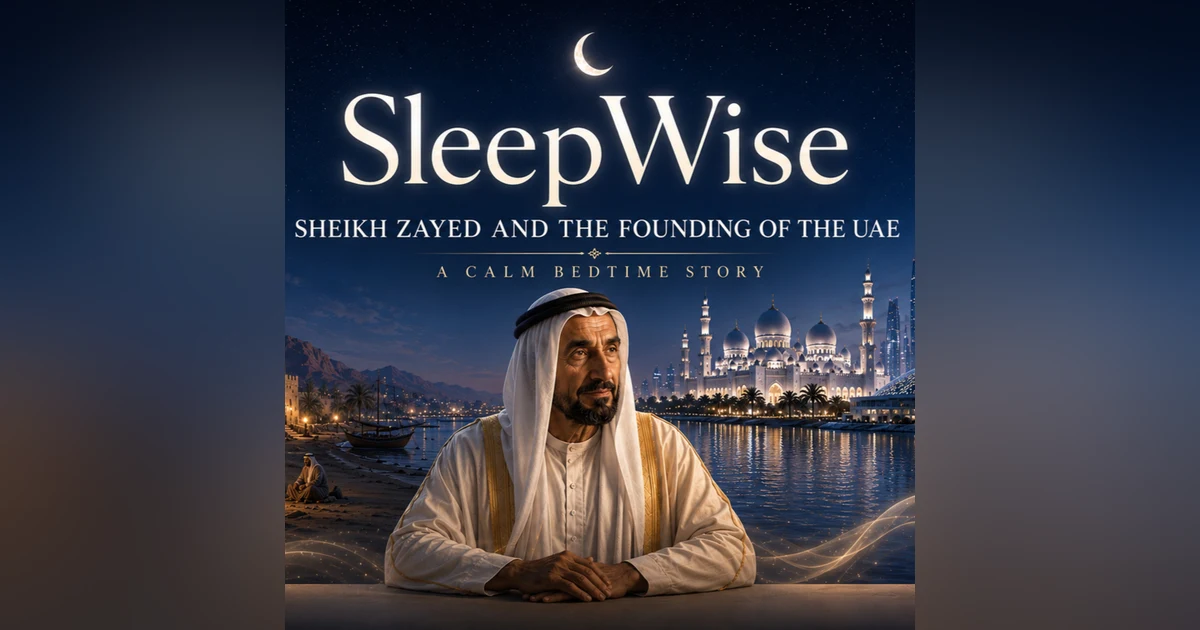


Tonight on SleepWise, we drift into the long life of Sheikh Zayed bin Sultan Al Nahyan, the founding father of the United Arab Emirates. Born on a coast that the wider world barely noticed, Zayed grew up among falcons, oases, and Bedouin tribes before guiding seven small emirates into one of the most remarkable national foundings of the twentieth century. This is the story of how patience, persuasion, and a deep belief in his people built a country out of the sand.
The journey carries us from the pearling years of the old Trucial Coast through Zayed's early governorship at Al Ain, the discovery of oil beneath the Arabian Gulf, and the long conversations that brought the UAE into being in nineteen seventy-one. We follow him as he greens the desert, founds the sovereign wealth that would invest for generations, builds schools and hospitals across the new federation, and quietly shapes a foreign policy of humanitarian aid and careful diplomacy. The story closes with the succession of his sons, Sheikh Khalifa and Sheikh Mohamed bin Zayed, and the federation's enduring strength as the truest measure of what he built.
SleepWise is a calm, gently educational bedtime storytelling series for adults. Each episode pairs factual depth with slow, lyrical narration, designed to help curious minds unwind while learning something new. The pacing is steady, the imagery quiet, and the tone reverent without being heavy — well suited to falling asleep, or to a long evening when the day asks to be set down.If these quiet journeys help you rest, follow SleepWise for more bedtime stories about history, science, philosophy, and the lives that shaped the world. Share with someone who might enjoy drifting into sleep while learning something new.
Official Website: https://www.sleepwise.studio/----SleepWise, Sleep Stories, Bedtime Stories, Guided Sleep, Relaxation, Mindful Sleep, Calm Narration, Science for Sleep, ASMR Sleep, Deep Relaxation, Falling Asleep, Sleep Meditation, Guided Meditation, Sleep Podcast, Soothing Voice, Peaceful Storytelling, Night Routine, Sleep Aid, Mindfulness, Restful Night, Relaxing Audio, Gentle Storytelling, Sleep Channel, Meditation for Sleep, SleepWise Podcast, Sleep Narration, Calming Stories, Rest and Relaxation, Sleep Help, Tranquil Nights, 100 hashtags focused on the topic — Sheikh Zayed, the UAE, its history, geography, people, programs, and the broader Gulf/Arab context. No sleep or format tags.#SheikhZayed, #SheikhZayedBinSultan, #ZayedBinSultan, #ZayedBinSultanAlNahyan, #SheikhZayedAlNahyan, #FatherOfTheNation, #FoundingFatherUAE, #UAEFoundingFather, #UAE, #UnitedArabEmirates, #UAEHistory, #UAEHeritage, #UAEStory, #UAELegacy, #UAEUnion, #UAEFederation, #UAEFlag, #UAEPresident, #UAENationalDay, #SpiritOfTheUnion, #YearOfZayed, #AbuDhabi, #Dubai, #Sharjah, #AlAin, #RasAlKhaimah, #Fujairah, #Ajman, #UmmAlQuwain, #TrucialCoast, #TrucialStates, #ArabianGulf, #PersianGulf, #BaniYas, #AlNahyan, #AlMaktoum, #SheikhRashid, #SheikhKhalifa, #SheikhMohamedBinZayed, #MBZ, #SheikhaFatima, #MotherOfTheNation, #SheikhZayedGrandMosque, #GrandMosque, #QasrAlHosn, #UnionHouse, #Liwa, #LiwaOasis, #SirBaniYas, #ArabianOryx, #Falconry, #ArabianFalcon, #DesertHeritage, #BedouinCulture, #BedouinHeritage, #ArabianHeritage, #EmiratiHistory, #EmiratiHeritage, #Emirati, #EmiratiCulture, #ArabianHistory, #ArabHistory, #MiddleEastHistory, #GulfHistory, #HistoryOfTheUAE, #FoundingOfUAE, #NationBuilding, #VisionaryLeader, #PatientLeadership, #ArabLeaders, #OilDiscovery, #UmmShaif, #BabField, #PearlingHistory, #DhowSailing, #AflajSystem, #DatePalm, #DesertGreening, #GreeningTheDesert, #GhafTree, #UAEEnvironment, #UAEWildlife, #ADIA, #AbuDhabiInvestmentAuthority, #Mubadala, #SovereignWealth, #UAEEconomy, #UAEArmedForces, #UnionDefenceForce, #GCC, #GulfCooperationCouncil, #AbrahamAccords, #UAEDiplomacy
0:00 Good evening and welcome back to Sleep Wise. Tonight we'd drift into the long life of a man born among dunes and Falcons, who would go on to build a country out of seven small Emirates along a quiet stretch of coast. His name was Sheikh Zayed bin Sultan Al Nahyan, and the world he was born into looked very little like the world he would leave behind. That may sound like a story of rapid change, of skylines rising where there had been only sand, and it is, in part. But it is also a slower story, the kind that asks for patience. Tonight we will not rush across the decades. We will move at the pace of the desert itself, where shadows lengthen across the dunes and the wind carries small adjustments rather than great alarms. Before the oil, before the Federation, before the towers and the highways and the sovereign wealth that now stretches across continents, there was simply the coast, a long, pale shoreline curving
1:30 along the southern edge of the Arabian Gulf, with purling boats slipping out at first light and dows returning at dusk. Date palms stood heavy in the inland Oasis and camels picked their way along caravan paths older than memory into this world. Around 1918, a child was born inside the walls of a low Fort in Abu Dhabi called Qasr Al Hossen. He was the youngest son of a ruling family, the AL Nahyan, who led one of the great Bedouin confederations of the region. No one watching that birth could have known what the child would become.
2:19 They could not have foreseen the federation he would help create, or the institutions he would build, or the long patience with which he would do it. But a few of the materials of his future were already present in the room. The Falcon, the Oasis, the gathering of elders called the majlis, and the water drawn from underground channels called falaj. There was also the quiet authority of a leader who listened far more than he spoke, and who took counsel before decision.
3:02 These habits would remain with him through every later transformation. Even at the end of his life, in a country of glass towers and global investments, he kept the Falcon on his wrist. If you have ever stood at the edge of a desert at twilight, you may already know the mood his story belongs to. The light softens, the horizon flattens, and the day's heat releases into something gentler. There is no urgency in such a place, only the long companionship of land and time to night.
3:48 We will follow a single life across that landscape, from a Fort in Abu Dhabi to the Oasis of Al Ain, from the discovery of oil to the founding of a nation, from the greening of the sand to the careful succession of his sons. There is much to tell, but there is no need to hurry. Settle in. Let the room grow soft around you. The desert is patient, and so are we. To understand the world Zaid was born into, we must first set aside the modern image of glass towers and broad highways. The coast he knew in childhood went by a different name. In the wider world, it was called the Trucial Coast, after a series of maritime truces signed with the British Empire across the 19th century, agreements that ended the older era of raiding at sea.
4:59 These truces did not make the coast a colony. They made it a quiet protectorate in which seven small Shaktams continued to govern themselves while Britain handled defence and foreign affairs. Abu Dhabi was the largest area. Dubai, Sharjah, Ras Al Khaimah, Ajman, um Al Khwain and Fujairah completed the seven. For most of the people living along their coast, however, the great empires of the world felt very distant.
5:40 Daily life turned on the rhythms of sea and sand. In summer, the men of the coast climbed aboard wooden dows and sailed out to the Pearl beds of the Gulf, sometimes for months at a time. The pearling industry had supported the region for generations. A diver would slip into the water with a stone tied to his foot, descend on a single breath and gather what he could before being hauled back to the surface. The puller waded above with the rope.
6:24 Together they were called Gawas and Saib, and entire economies depended on what they brought up from the sea bed. The AL Nahian family into which Zayed was born, LED one of the largest tribal confederations in the region, called the Baniyas. They had ruled at Abu Dhabi for generations since well back into the 18th century. A cousin branch, the AL Mak Tomb, had broken away in earlier years to establish themselves at Dubai. Both families would later sit together at the founding of a nation, though that day was still distant. But the world that shaped Zayed's earliest years would not stay quiet for long.
7:21 In the 1920s, two pressures arrived almost together. Japanese inventors had perfected the cultured Pearl, flooding the world's markets with cheap alternatives. Then the Great Depression collapsed the demand for luxury goods altogether. The pearling economy never recovered. Within a few short years, the foundation that had sustained the coast for centuries simply fell away. The 30s and early 40s became known as the Lean Years, a time of hunger, hardship and quiet endurance. Children of Zayed's generation grew up watching their parents and elders adapt to scarcity.
8:15 There was no oil yet, no federation, no foreign investment of any kind. There was only the desert, the sea, the family and faith. It was, in many ways, the world from which his lifelong instincts would be drawn, and it was the world he would, in time, transform almost beyond recognition. The Fort where Zayed had been born, Qassar Al Hossan, was not large by the standards of palaces elsewhere. It had begun in the 18th century as a simple watchtower of coral and gypsum, built to guard the freshwater well that gave Abu Dhabi Island its earliest reason for being. Over the years it had grown, but it remained a working Fort rather than a grand residence.
9:17 When Zayed was still a small child, his father, Sheikh Sultan bin Zayed Al Nahyan, was killed in a family dispute. The rulership passed quickly through other hands, and within a few years it had settled on Zayed's elder brother, Sheikh Shahbut bin Sultan, who would go on to rule Abu Dhabi for nearly four decades. Zayed himself was not raised for the throne. He grew up in the inland Oasis of Al Ain, far from the politics of the coast.
9:59 There, among date palms and folage channels, his real education began. Much of that education came from the desert itself. Zayed travelled widely with the Bedouin tribes who lived between the oases, learning the names of plants, the readings of dunes, the locations of wells, and the histories of the families who moved across the sands. He learned to ride camels for long distances, to track game, and to read weather from the color of the sky. Falconry was a particular passion and 1 he would carry to the end of his life. The training of a Falcon takes patience, gentleness and a kind of mutual trust between bird and handler. Zayed would later say that falconry had taught him as much about leadership as any book.
11:05 He also studied within the Islamic tradition that shaped daily life across the region. The Quran, the sayings of the Prophet, the ethics of the desert and the marketplace all became part of his foundation and he learned above all by sitting in the majlis, the open gathering where elders, tradesmen and travellers brought their disputes and ideas to be heard. This was not formal schooling. There were no examinations, no diplomas, no university halls.
11:47 But it was a deep education in human nature, in patience and in the careful weighing of competing claims. When Zayed was a young man, not yet 30, his brother Shockbot made him the ruler's representative in Al Ain, the governor, in effect, of the Eastern Region. It was an enormous responsibility for someone so young, and the territory he was given to oversee was not easy. There were tribal tensions to manage, water shortages to address and disputes that had simmered for generations.
12:33 But Zayed brought to the work the same qualities he had been gathering since childhood, the patience of a Falconer, the listening of the majlis. There was also the Bedouin understanding that survival in such a landscape depended on Co operation more than command. He would govern Al Ain for the next 20 years, and in those quiet decades, the man who would one day build a nation began very slowly to be seen. Al Ain sits inland from the coast in a string of oases that have been inhabited for thousands of years.
13:23 The water there does not arrive by rainfall in any reliable way. It is drawn instead through an ancient system of underground channels called aflage, a network of gently sloping tunnels that carry water from the foothills down to the date palms and gardens of the towns. The aflage are remarkable feats of engineering. Many of them are centuries old, hand dug by generations of workers who knew how to find a buried current and lead it where it was needed.
14:04 They functioned entirely by gravity, without pumps or external power. But by the time Zayed arrived as governor, many of the channels had fallen into disrepair. Some were silted, some were collapsing. The water that did flow was unevenly distributed, and disputes over rights to it had become a constant source of friction between families and farmers. Zayed treated the Aflage as a priority. He walked the channels himself, inspected the collapsed sections and ordered the repairs to begin.
14:50 He also abolished the water taxes that had grown up around the system, declaring that water was a gift that should not be taxed by any ruler. This decision was unusual for its time, and it earned him a quiet loyalty among the farmers of Al Ain that would last for the rest of his life. Word travels far in oases. A ruler who restored the water and refused to tax it was a ruler people remembered. The Bahraini region in which Al Ain sat was also the subject of a larger and more delicate dispute.
15:37 Bahraini was a cluster of 6 Oasis, 3 controlled by Abu Dhabi, 3 by the Sultanate of Omen. In the early 50s, Saudi Arabia, backed in part by American oil interests through Aramco, sent a force to occupy one of the Omani oases and claimed wider territorial rights across the region. What followed was a slow, careful confrontation that lasted 3 years. There were negotiations, arbitrations and quiet diplomatic maneuvers. Eventually, the crucial Omen Scouts, a British officered force, expelled the Saudi position without major bloodshed.
16:30 Zayed throughout had represented Abu Dhabi's interests in the dispute. He travelled, met with tribal leaders, and held the line on his family's historical claims. He learned in the process that the work of a leader was not only about water and agriculture. It was also about the long, patient, defensive place against forces much larger than oneself. In the years that followed, his reputation spread well beyond Al Ain. The Marjlies he kept was known across the crucial coast for its fairness. People travelled days to bring their disputes before him, trusting that they would be heard. He was still only a governor, not a ruler. But the qualities that would later define a nation were already quietly taking shape across the same decades in which Zayed was tending the aflag at Al Ain. Something extraordinary was happening offshore. The waters of the Arabian Gulf, long known for pearls, were also concealing one of the great oil deposits of the world. The first major discovery came in the late 50s at a field called Umm Shaif, beneath the
18:05 sea bed about 40 miles north of Abu Dhabi Island. Onshore drilling soon followed with a significant find at Bob. Within a few short years, the first tankers of Abu Dhabi crude were being loaded for export. For a place that had known scarcity for a generation, this was a transformation almost beyond imagining. The revenue began to arrive in modest amounts at first, then in larger ones, then in flows that no one in the region had ever before had to plan for.
18:49 Sheikh Shak Boot, Zayed's elder brother and the long serving ruler of Abu Dhabi, watched the new wealth arrive with deep caution. He had lived through the lean years of the pearling collapse, and he did not entirely trust the world that oil money promised. He preferred to hold the revenue carefully. Sometimes, it was said, in cash kept under the bed. His instincts were not foolish. Shock Boot had seen too many easy fortunes evaporate, and he wanted to be sure that his people would still have something when the boom passed.
19:35 But the cautious approach also meant that schools were not being built, hospitals were not being founded, roads were not being paved. Within the family and within Abu Dhabi's broader leadership, a quiet conversation began to form. There was a brother at Al Ain who had governed for two decades with a different temperament. Who had spent on water, built where he could, and drawn around himself a reputation for using whatever resources he had on behalf of the people he led. In the summer of 1966, after months of careful discussion within the family and with the consent of the senior members of the AL Nahian, the rulership of Abu Dhabi was peacefully transferred.
20:37 Shahbut departed without bloodshed, and Zayed became the new ruler. The transition was agreed upon and almost entirely free of the violence that often accompanied such moments in the region. Zayed's first decisions reflected everything his years that Al Ain had taught him. He began to spend, not lavishly but purposefully, on the things a country needed in order to live. Roads were planned, schools were commissioned, hospitals and clinics were drawn up across the territory.
21:19 Housing was built for families who had spent generations in tents and palm frond shelters. The oil revenue, he made clear, was not a private fortune. It belonged, in his understanding, to the people of Abu Dhabi and through them, to whatever shared future could now be built. That future was about to grow much larger than Abu Dhabi alone. An announcement from London, soon to come, would change the shape of the entire Trucial Coast. For more than a century, Britain had occupied a particular role along the Trucial Coast.
22:06 It did not govern in the usual sense and it did not raise taxes or settle disputes within the Emirates. But it handled defence, and it managed the foreign affairs of the region in dealings with the outside world. This arrangement had been comfortable for everyone. The British found it inexpensive. The rulers found that it kept larger powers at Bay for generations. The truce had simply held. Then, in early 1968, an announcement arrived from London that changed everything. The British government declared that it would withdraw its military presence east of Suez within three years. The crucial coast, along with Bahrain and Qatar, would have to find its own way.
23:05 The deadline was firm. By the close of 1971, the British forces and their treaty obligations would be gone. Whatever came next would have to be in place before that moment, or the region would face the future alone and unprepared. The announcement was not made out of hostility. Britain was simply economizing in the wake of its own difficulties. But for the rulers along the Gulf, the implications were enormous. The seven Trucial Shaktams were small.
23:47 Some were very small, with populations numbered in the thousands rather than the 1,000,000. Without British protection, they would stand alone in a region where larger neighbors had long held interests of their own. Iran, just across the Gulf, had claims it had never relinquished to Bahrain and to several small islands near the Strait of Hormuz. Saudi Arabia held long standing territorial ambitions in the South, including memories of the Bahraini dispute that had ended only a dozen years earlier.
24:31 The Cold War shifted the political ground in other directions. Still, into this uncertain moment, Zayed brought a particular kind of clarity. He understood, in a way that not every ruler around him fully shared, that the smaller the state, the more vulnerable it would be. 7 separate Shaktams could each be picked apart, courted or pressured, but seven Shaktams together, bound into a single federation, might hold their ground. They might also build something larger than themselves, a country in the modern sense, with the capacity to plan, to invest, and to speak with a single voice.
25:24 This idea was not obvious to everyone. The rulers of the Trucial Coast had governed independently for generations. Each had his own family, his own history, his own relationships with tribes, traders, and faraway powers built up over the course of a lifetime. Federation would mean giving up some measure of that independence. Zayed knew the difficulty, but he also knew that the alternative fragmentation would leave his people exposed for decades to come.
26:06 From the announcement of British withdrawal onward, he set out to do something patient and difficult. He set out to talk. The 1st and most important conversation took place in the desert, just weeks after the British announcement. Zayed and Sheikh Rashid bin Sayed Al Maktoum of Dubai met at a place called Argoob al Sedira, a stretch of border land between their two Emirates. They met as cousins of long acquaintance, but also as the two rulers whose agreement would determine whether anything larger was possible. Argoob Al Sedira was not a grand location. It was simply a quiet patch of sand where the territories met, chosen for its symbolic neutrality. Neither ruler was visiting the other seat of power, and both were equally at home in the open desert. Abu Dhabi and Dubai were the two largest sheikhdoms on the coast. They were also, in many ways, very different. Abu Dhabi held most of the oil wealth and most of the land. Dubai was smaller, but had built
27:39 its reputation through trade, through the patient working of its Creek, and through Rashid's instinct for opening the city to merchants from across the region. If Zayed and Rashid could not agree, no federation would form. If they could, the others might be persuaded to follow. The two men were not identical in temperament. Zaid was the desert man, the Falconer, the long listener. Rashid was the merchant Prince, the builder of harbours, the calculator of margins and currents.
28:23 But they shared something important. Each had inherited A Shaktam too small to stand alone, and each understood that the time had come for something larger. They also trusted each other in a way that is sometimes possible only between cousins with shared memory. At Argub al Cedera, the two rulers agreed on the principle. Their Emirates would join in a federation and the other crucial states would be invited. So would Bahrain and Qatar, the larger neighbors to the West. For a time, the proposal was for a union of nine. That ambition would not, in the end, hold. The talks that followed stretched over more than three years.
29:23 There were meetings in Dubai and meetings in Abu Dhabi, gatherings at Majlis and visits to other capitals. There were quiet dinners, careful gifts and the patient work of building trust among rulers who had governed independently for generations. Zayed brought a particular tool to those conversations. He had begun even before the federation existed, to share Abu Dhabi's oil revenue with the poorer Emirates, paying for projects in Sharjah, in Ras Al Qaimah and in the others without asking for anything in return.
30:09 It was an act of quiet generosity that did much to soften the path to union. Bahrain and Qatar eventually chose their own paths to independence, both becoming separate states. But the seven Trucial Shaktams continued to talk, and at the heart of those conversations were Zayed and Rashid. Federation, in their understanding, was not to be imposed. It would be persuaded into being one conversation at a time.
30:50 After more than three years of conversations, the moment finally came. The British presence was due to lift at the end of 1971 and the rulers of the Trucial Coast knew they could not wait until the last day to act. On the 2nd of December that year, in a building that would come to be called Union House, 6 rulers gathered in Dubai. They came from Abu Dhabi, Dubai, Sharjah, Ajman, Umm Al Qawain and Fujairah. Each had governed his own emirate, each had his own people to consider and each had spent years weighing this moment in private.
31:40 The 7th Ras Al Qaimah was not yet ready to join. Its ruler had concerns about the structure of the Union and the share of representation his emirate would receive. He chose to remain outside for the moment, and the others respected that choice. The day was quiet by the standards of national foundings elsewhere in the world. There were no great parades, no foreign dignitaries packed into the hall, no orchestras. There were rulers, their advisers, and the work that had brought them to that table in the hall. At Union House, the six rulers signed the provisional constitution of a new state.
32:32 They declared the formation of the United Arab Emirates. Zayed was elected the 1st President. Rashid was named the 1st Vice President and Prime Minister. The flag of the new country was raised that day. It carried 4 colors, red along the staff with horizontal bands of green, white and black beside it. The colors drew on the long Arab tradition of flags that combine the same 4 hues, red for unity, green for fertility, white for peace, and black for strength. For Zaid, the moment was the culmination of everything the years that Al Ain had taught him about patient governance. He had not seized this federation by force, and he had not bought it with oil money.
33:32 He had built it, conversation by conversation, until enough of the rulers had agreed that union was worth more than independence. Ras Al Qaimah's hesitation did not last long. Within a few months, its ruler reconsidered, drawn by both the practical benefits of the union and the assurances the others were able to give. By the early part of the following year, the 7th Emirate had joined and the federation was complete. 7 Sheikhdams, once separate, were now one country. The Trucial Coast, with its old name borrowed from 19th century treaties, had given way to something the rulers themselves had chosen. the United Arab Emirates existed. The flag was up, the signatures were dry. What lay ahead was the harder part. A flag and a constitution are not yet a state. The institutions, the laws, the daily work of governing 7 Emirates has one country.
34:51 All of it had to be built almost from nothing in the years that followed. But for one quiet day at Union House, the country existed simply because its rulers had decided that it should. A federation written on paper is not yet a federation in practice. In the weeks and months after the founding, Zayed and the other rulers face the practical work of turning a declaration into a country. The provisional Constitution provided the architecture. It assigned certain powers to the federal government, defense, foreign affairs, currency, immigration, and major infrastructure.
35:45 It left other matters, including land, natural resources, and many internal affairs to the individual Emirates. This balance was important. Each ruler retained meaningful authority over his own emirate, but the federation could speak, plan and act as a single state in matters that affected all of them. Abu Dhabi became the capital. Zayed, as president, formed the first Council of Ministers, drawing its members from across the seven Emirates.
36:28 The early ministries were modest by modern standards, small offices with limited staff and few presidents to draw on. A federal National Council was established as a consultative body. Its members were appointed by the rulers of the Emirates, with seats divided according to the size and weight of each member state. The council reviewed legislation, raised questions and brought concerns from the wider society into the federal conversation. A federal court system was created to handle matters that crossed emirate lines.
37:17 The country adopted a new currency, the UAE Durham, replacing the older Gulf rupees and Bahraini dinars that had circulated in the region. A central bank was eventually established to manage that currency and oversee the country's emerging financial system. Each of these institutions began small. The federation had almost no civil service to inherit. Most of those who staffed the new ministries had been trained abroad, often in Egypt, Kuwait or the United Kingdom.
38:03 They brought with them a mixture of expertise and uncertainty. Zayed encouraged them. He visited offices, met with junior officials and listened to their proposals. He understood that institutions like our flage channels needed careful tending in their early years if they were to flow reliably later on. The federation was also fragile in ways that would not always be visible from the outside. There were disputes between Emirates over budgets, over representation, over the boundaries of federal authority.
38:47 There were moments when the union seemed to strain, but Zayed held the center. He did not punish disagreement. He did not seek to dominate the other rulers, even though Abu Dhabi held most of the wealth. He understood that a federation built by persuasion would only endure if it continued year after year to be governed by persuasion. The institutions grew slowly at first, then more quickly. By the end of the 70s, the United Arab Emirates was beginning to look like a country in the fuller sense.
39:32 Zayed had a particular conviction about wealth, formed during the lean years of his childhood and refined across the decades at Al Ain. He believed that oil revenue did not belong to the ruler personally. It belonged to the people, and the ruler was its trustee. This was not a theoretical position. It became the operating philosophy of the new federation. As the oil revenues grew through the 70s, Zayed directed them toward the things he believed his country most needed free education for every citizen.
40:22 Was among the first commitments. Schools were built across the Emirates, in coastal towns and inland oases alike. Children who would once have learned only from family and from the Koran could now attend primary and secondary schools without cost. Health care followed the same principle. Hospitals and clinics were established throughout the country, and citizens did not pay for their care. The hospitals admitted both rich and poor without distinction, and the federation covered the cost. Housing was perhaps the most visible transformation. Many families had spent generations in tents made of woven palm fiber or in simple coral stone houses. Within a few years, the government was building permanent homes for citizens who needed them, modest at first, then larger, then organized into entire neighborhoods served by power and water.
41:36 Water and electricity were extended into corners of the country that had never known either. Desalina tion plants began to turn the sea into drinking water on an industrial scale. Power lines crossed the desert to reach villages that had previously relied on oil lamps and small generators. Roads connected Emirates that had once been hours apart by camel. Bridges crossed creeks and inlets. Ports were built or expanded. Mina Zayed in Abu Dhabi, Port Rashid in Dubai, to handle the goods of a country newly open to the wider world. None of this happened evenly or without difficulty. There were debates about pace, about priorities, about the proper balance between federal and Emirates spending, but the direction was clear.
42:37 The wealth was being used, not hoarded, and it was being used on behalf of the people. Zayed himself remained personally austere by the standards of oil rich rulers elsewhere. He kept his Falcons, kept his modulus, and spent on his country rather than on himself. In other parts of the world, sudden wealth from natural resources had hollowed out societies, breeding corruption and dependency. In the Emirates, under Zayed's guidance, the transition was not perfect, but it carried A deliberate intention that many resource booms have lacked.
43:27 The wealth that arrived from beneath the sand was being turned patiently into the foundations of a country. The greening of a desert is not a metaphor. In the United Arab Emirates, it was a deliberate project, undertaken across decades that turned vast stretches of arid land into orchards, parks, plantations and forests. Zayed had begun this work even before the federation was founded. From his years at Al Ain, he had carried a particular conviction that agriculture was not merely about food but about civilization itself.
44:17 He was once heard to say that if you gave him agriculture he would give you civilization. This was not a passing fancy. The greening became one of the great priorities of his rule, and the resources of the Federation were turned toward it on an enormous scale. Trees were the first ambition. The gaff tree, native to the region, was already familiar across the Arabian sands, a Hardy desert tree whose roots reach far below the surface and whose shade has rested travellers and their camels for centuries.
45:03 Under Zayed's direction, millions of Goff trees were planted across the Emirates alongside palms and other species suited to the climate. The date palm received particular attention. Date palms had grown in the oases of Al Ain and Liwa for centuries, sustaining families through the long pre oil generations. Under the new programs, the country expanded its palm plantations until the Emirates became one of the great date producers of the world. Water was the central challenge in a land where rainfall was scarce and unreliable.
45:53 Every tree required irrigation. The government invested in vast networks of desalina tion plants, water pipelines and treated wastewater systems, all of which made the greening possible. Forestry stations rose at the edges of the desert, growing seedlings by the millions to be planted along roads, in parks and across previously empty stretches of sand. The work was slow and demanding. Trees that survived their first summer were celebrated quietly, and those that did not were replaced.
46:38 Alain itself became known as the Garden City of the Emirates. Its public parks, its leafy streets, and its restored of flage channels offered visitors a different impression of what an Arabian city could be. Zayed visited often, walking among the plantings with the same attentiveness he had once shown to Falcons and water channels. Wildlife was not forgotten on the island of Sir Banayas off the western coast. Zayed established a private reserve that grew over the years into a sanctuary for Arabian oryx, gazelles and other species that had nearly vanished from the region. He invited researchers, and the populations slowly recovered. The greening was sometimes criticized on environmental grounds.
47:42 Maintaining forests in a desert requires energy and water. But for Zayed, the project was never simply about appearance. It was about reclaiming land, restoring habitats, and demonstrating that a country built on patients could grow what the desert had withheld. Education was at the heart of everything Zayed did with the new wealth. He had been raised in a world where formal schooling barely existed in the Trucial Coast, and where most of his peers learned what they knew from family, from the desert and from the Koran. He understood, even before the federation, that no country could grow without educated citizens. The schools that the government built in the 70s and 80s spread across the entire country.
48:48 They reached the smallest inland villages and the most distant coastal towns. Primary and secondary education were free for every citizen, and overtime attendance approached the universal. In the inland Oasis where Zayed had once governed, the country's first university was founded. UAE University in Alain opened with a few 100 students and grew over the following years into a major institution. It offered training in medicine, engineering, the humanities and many other fields. Other universities followed in time, including a network of technical colleges and a university bearing Zayed's own name.
49:45 Students who wished to study abroad were often supported by government scholarships, traveling to universities in Egypt, the United Kingdom, the United States, and elsewhere. Many returned to take up positions in the federation's growing institutions. Perhaps the most significant transformation occurred in the education of girls and women. In the pre oil generations, formal schooling for girls had been rare in the region. The new schools admitted both boys and girls and Zayed encouraged families to enroll their daughters with the same seriousness as their sons.
50:37 In this work Zayed had a particular partner. His wife, Shekha Fatima bint Mubarak, became one of the most influential figures in the country's social development. She founded the General Women's Union and became known with quiet affection as the Mother of the Nation. Sheikh of Fatima worked to expand women's literacy programs, to support working mothers, and to open new fields to women across the federation. Within a generation, women were attending universities in greater numbers than men.
51:23 In some programs, they were entering medicine, law, engineering, and government service. The traditional teachings were not abandoned. Quranic education, religious studies and the customs of family and marchless remained central, but they were now placed alongside modern curricula in classrooms where the daughters and sons of Pearl divers, Bedouin tribesmen and Oasis farmers learned together. For Zaid, this transformation was not separate from the building of the country.
52:07 It was the building of the country. A nation of schools, in his understanding, would last far longer than a nation of roads alone. The institutions that he and Sheikha Fatima nurtured would carry the country forward long after their own generation had passed. Among Zaid's quieter and more consequential decisions was the one that turned to the future. He understood, even as the oil revenues were transforming his country, that the wealth would not last forever.
52:49 Oil reserves are finite, prices fluctuate, and the world's energy markets can shift with little warning. A nation that lived only on the wealth of its present moment, he believed, would one day find itself diminished. A nation that thought further ahead, by contrast, could preserve some part of its prosperity for the generations to come. In the mid 70s, this principle took institutional form. The Abu Dhabi Investment Authority was founded as a means of investing the Emirates surplus oil revenue across the wider world.
53:39 It was given a simple mandate to preserve and grow the long term wealth of Abu Dhabi for the benefit of future generations. The structure was deliberately patient. The authority invested in equities, in bonds, in real estate and in infrastructure projects across many countries, building a portfolio that was global and diversified. It did not seek the quick returns that sometimes drew other investors into trouble. It sought instead the steady and disciplined accumulation of value over decades.
54:24 The early years were modest. The world's financial markets did not always Co operate, and the authority worked carefully through its first investments before scaling up. But the discipline held. Over the years, the authority grew into one of the largest investment institutions of any kind in the world. Its precise assets were not publicly disclosed, but estimates placed them in time in the hundreds of billions of dollars. The wealth it managed was not for Zaid, nor for any single family, nor for the present generation alone.
55:12 It was held in trust for the children and grandchildren of Emiratis who had not yet been born. This was an unusual idea in resource rich states. Many oil producing countries had struggled with what economists later called the resource curse, sudden wealth, corrupting institutions and leaving little durable behind. Zayed's approach attempted to plant the wealth in soil that would still hold value. When the wells eventually ran dry, the trees of the greening programme would grow above ground. The investments of the authority would grow elsewhere in markets far from the desert, building a kind of second harvest that the country could draw upon for a long time to come. Other funds would later join it.
56:17 Mubadala established year. A country that wishes to endure must also be able to defend itself. Zayed understood this from the earliest days of the Federation, and the building of armed forces became one of the steadier projects of his rule. The starting point was small. In the years before independence, the British officer Truchel Omen Scouts had handled most security matters on the coast. When the Federation was declared, this force became the basis of what was first called the Union Defence Force. It was a modest beginning.
57:06 The Union Defence Force had limited equipment, a small officer corps, and many of its commanders had been trained by the British. Its purpose in the early years was internal security and basic defense against potential threats from neighbors. Within a few years, the Federation moved toward a more unified structure. The various emirate level military units that had developed alongside the federal force were brought together, and the Federal Armed Forces of the United Arab Emirates were formerly established. Equipment was acquired, training programs were expanded, and partnerships were developed with allied countries. The approach Zayed favored was distinctive. He did not seek a military that was disproportionately large for the country size, nor one that would invite confrontation. He sought instead a capable force that could defend the country's interests without seeking conflict. This balance was tested by the conditions of the wider Gulf. The Iran Iraq war of the 80s cast a long shadow across the region.
58:38 The Iraqi invasion of Kuwait in 1990 brought the threat closer still, and the federation contributed forces to the international coalition that restored Kuwait's sovereignty in the months that followed. Throughout these periods, Zayed kept a steady hand. He maintained quiet diplomatic relations, even with countries the Federation disagreed with. He did not allow the country to be drawn into adventures that were not its own. He also placed deep trust in members of his own family in matters of defence.
59:24 His son, Mohammed bin Zayed, who would later become an important figure in his own right, was given increasing responsibilities in the armed forces. Other sons and senior officials shared in the broader work of national security. The federation built strategic partnerships with the United States, the United Kingdom and France, among others. These partnerships brought modern equipment. Training programs and intelligence cooperation. They also placed the country within a wider framework of regional and international relationships. But the deeper principle remained Zayed's own A country built by persuasion at home would also, where possible, be defended by patients abroad.
1:00:31 Force, when needed, would be used, but it would not be the first resort. And, in keeping with everything else he had built, it would be balanced, prepared and held in trust for future generations. Foreign policy in the United Arab Emirates was, from the beginning, an extension of Zayed's temperament. He preferred to act quietly, to build relationships, and to use the federation's resources for help rather than influence. The country's voice in the wider world began modestly. The Emirates joined the Arab League and the United Nations after the founding.
1:01:24 It established embassies in many countries, and it took its place alongside other small states on the international stage. But Zayed's particular contribution was something else. He directed an enormous share of the federation's wealth toward humanitarian aid, both within the Arab world and far beyond it. Hospitals were funded in Sudan, schools in Bosnia, and mosques and clinics in dozens of countries. Far from the resources Zayed had been entrusted with, the Palestinian cause held a particular place in his commitments.
1:02:13 From the earliest years of the federation, he supported Palestinian refugees through education programs, housing assistance, and political solidarity. He believed that the dispossession of Palestinians was a wound that had not been allowed to heal, and he gave both quiet and public support to efforts toward a just resolution. Within the Gulf, Zayed worked to build Co operation among the smaller states. The Gulf Co Operation Council, founded in the early 80s, brought together Saudi Arabia, Kuwait, Bahrain, Qatar, Omen and the Emirates, and Zayed was one of its founding figures.
1:03:11 He understood that just as seven Emirates had been stronger together than apart, 6 neighboring states could speak with greater weight as a group than as individuals. The Council never became a federation in the deeper sense, but it provided a steady framework for cooperation across the Arabian Gulf. The federation also became a destination of last resort for many people who had nowhere else to go. Refugees from conflicts across the wider region, from Lebanon, from Somalia, from the former Yugoslavia, from Iraq, were quietly admitted, often without the public attention that surrounded such matters elsewhere. Zayed had not forgotten the lean years of his own childhood. He remembered what it meant to belong to a small place that the wider world might overlook.
1:04:21 The Emirates, under his guidance, made it a point not to overlook others in a region often defined by conflict. The Federation became known for something else. It was known for the quiet check, the unannounced hospital, the school that opened without ceremony in a place that needed one. This was not naivety. Zayed understood power, and he could be a careful and shrewd defender of his country's interests. But he also understood that influence built through generosity tended to last longer than influence built through pressure. A federation that had been persuaded into existence was in its foreign affairs also a federation that preferred persuasion to the alternatives.
1:05:24 Even as the federation grew larger and more modern, Zayed remained in many quiet ways the same man he had been at Al Ain. The threads of his early life ran unbroken through the years of his presidency. Falconry stayed with him until the end. He kept his birds throughout his rule, and he understood them as well as any traditional Falconer in the region. Even in his later years, when matters of state filled most of his days, he found time to handle his Falcons and to take them out into the desert as he had done since boyhood. The Lewa Oasis, deep in the southern desert, held a particular place in his life.
1:06:21 It was the ancestral home of the Bani Yas, the long ago starting point from which his family had moved N to the coast. Zayed returned to Liwa often, sometimes for several days at a time, sleeping in tents and travelling among the people of the dunes. These were not vacations in any modern sense. They were continuities. They reconnected him to the desert that had taught him his earliest lessons in governance. The majlis remained his preferred form of governance. Each day when he was in Abu Dhabi, his majlis was open. Citizens could come with concerns, complaints, requests for help or simply to be heard.
1:07:14 He listened, often without interrupting, in the manner of the elders he had once watched as a boy. He dressed plainly in the traditional kandura that any Emirati man might wear. He moved among his people in their gatherings and in his own, with a courtesy that struck many visitors as remarkable for head of state. One of his most ambitious personal projects was a mosque. The Sheikh Zayed Grand Mosque, designed to stand at the heart of Abu Dhabi, was commissioned during his lifetime and ground was broken in the mid 90s. He wanted a place of worship that would honor the Islamic tradition while welcoming people of all backgrounds to consider its beauty.
1:08:15 The mosque took more than a decade to complete. Its scale was vast white marble from Macedonia, carpets woven by Iranian Craftsman, chandeliers from Germany. The materials came from many countries, and the artistry drew on Islamic traditions across the entire region. Zaid would not live to see the mosque finished, but its foundations were laid in his time, and the building rose slowly, year by year. In the city he had done so much to shape. It would eventually become one of the most visited places in the country.
1:09:03 The man who had begun his life in a small Fort of coral and gypsum had ended it, preparing a marble mosque large enough to hold 10s of thousands of worshippers. The arc of his outward life had stretched enormously from a coral Fort to a marble mosque. But the inner threads, the Falcon, the majlis, the liwa, the morning prayer had remained. In the autumn of 2004, after a long life and many years of declining health, Sheikh Zayed bin Sultan Al Nahyan passed away. He was by then somewhere in his 80's. The exact year of his birth had never been formally recorded, and like many men of his generation, he had measured his life by seasons rather than calendars. The news reached the country in the early hours and a period of mourning began.
1:10:12 Across the Emirates, 40 days of state mourning were declared, with flags lowered to half staff on government buildings. The federation he had built, and many places far beyond it, paused in remembrance. What happened next was, in its own quiet way, a tribute to everything he had done. The federation did not falter. The Federal Supreme Council, composed of the rulers of the seven Emirates, met to elect a new president. Their choice was Sheikh Khalifa bin Zayed Al Nahyan, Zayed's eldest son.
1:11:01 Khalifa had been the Crown Prince of Abu Dhabi for many years, and he had served as deputy ruler under his father across most of the federation's early decades. The succession was orderly. It was peaceful. It carried none of the turmoil that has sometimes accompanied transitions of power in the wider region. In many countries, the death of a founding leader has been followed by uncertainty, factional struggle or worse. The Emirates passed through their first such moment with the steadiness that owed everything to the institutions Zayed had patiently built. The Federal Supreme Council, the Council of Ministers, the constitutional procedures all held. The army he had built remained loyal. The Investment authority continued its work. The schools opened the next day as they always had. The ports continued to receive ships, and the desalina tion plants continued to push water through the long pipes of the country.
1:12:25 This was perhaps the deepest proof that the Federation was real. A country that depends entirely on a single man cannot survive his death. The Emirates survived Zayed's, and they survived it without missing a step. That was perhaps his deepest gift to the people he had LED. Khalifa was not his father. He had a different temperament, more reserved, more inclined to delegation. But he was a son of the Federation in the deepest sense, and he understood his task to be the careful stewardship of what had been built.
1:13:17 The man who had spent decades persuading other rulers, planting trees, founding institutions and quietly investing for the future had finished his work. The country he had built now belonged to its citizens and to the rulers who would come after him. His funeral was attended by leaders from across the Arab world and beyond. He was buried near the rising walls of the Grand Mosque that bore his name. Sheikh Khalifa would serve as president for nearly 18 years.
1:13:59 His task, as he understood it, was not to remake the country but to maintain its direction. The institutions his father had built were sound, and he saw his role as their steady continuation. The early years of his presidency continued the patterns Zayed had established. Federal spending on schools, hospitals and infrastructure kept growing, and the sovereign wealth funds continued their long horizon investments. The armed forces continued their professional development. Dubai's transformation accelerated during these years. The neighboring emirate, under the leadership of Sheikh Mohammed bin Rashid Al Maktoum, had become a global hub for trade, tourism and finance.
1:15:03 New towers rose along its skyline, including what would eventually become the tallest building in the world. Then came the test in the global financial crisis of 2008, the rapid growth of the region met a sudden international reversal. Many over leveraged projects across the Gulf were exposed and Dubai, which had borrowed extensively to fund its expansion, found itself unable to meet its debts. Abu Dhabi stepped in. Khalifa authorized A substantial financial package to support Dubai through the crisis, in the spirit of the federation his father had built.
1:15:58 It was the kind of moment that tested whether the union was real or merely formal. The federation passed the test. The two Emirates that had begun the union together had now stood beside each other through one of the great financial storms of the modern era. In recognition of the assistance, the world's tallest building, then nearing completion in Dubai, was renamed the Burj Khalifa. Health concerns marked the later years of his presidency.
1:16:40 Khalifa suffered a stroke that limited his public role, and from that point forward much of the daily governance of Abu Dhabi and the federation passed to his half brother, Sheikh Mohammed bin Zayed Al Nahyan, the Crown Prince. This was not unusual in the Federation's tradition. Rulers had long delegated to trusted family members, and the AL Nahyan understood succession as a gradual matter rather than a sudden 1. The institutions continued to function smoothly. Khalifa passed away in the spring of 2022. His presidency had spanned nearly 2 decades, during which the country had moved through global financial shocks, regional conflicts, A pandemic, and a steady continuation of the modernization Zayed had begun.
1:17:52 He left behind a country that was, in many ways, exactly what his father had hoped it would become. It was stable, wealthy, connected to the wider world and quietly confident in its own future. The man who had carried the weight of his father's expectations for so many decades had now in turn, completed his own chapter. When Sheikh Mohammed bin Zayed Al Nahyan became the 3rd President of the United Arab Emirates, he had already been in practice one of its principal leaders for many years. The transition in the spring of 2022 was like the one before it, smooth and orderly.
1:18:46 The Federal Supreme Council met and the choice was unanimous. Mohammed was a son of Sheikh Zayed and a half brother of Khalifa. Separated by years and temperament, he had been educated at military academies, including the Royal Military Academy at Sandhurst in the United Kingdom. He had served in the armed forces and risen through their ranks before becoming deputy supreme commander. As Crown Prince of Abu Dhabi, he had spent decades preparing for leadership.
1:19:28 He had overseen the modernization of the armed forces and the development of new economic sectors beyond oil. His approach was more direct than that of his father. Sheikh Zayed had been a man of patient persuasion, of long modulus sessions and slow consensus. Mohammed, while respecting those traditions, was more often a planner and a strategist. He set ambitious targets for the country. He pushed for economic diversification away from oil, for advances in technology, for the development of nuclear power and renewable energy, and for the strengthening of the country's diplomatic position across the wider region. The country took on a more visible role in regional affairs during these years.
1:20:29 The Emirates participated in interventions in Yemen, brokered the Abraham Accords with Israel, and developed deeper partnerships with the United States and with neighboring states. Some of these positions drew criticism and others were praised. Muhammad himself, often known by his initials, became a figure who attracted both admiration and disagreement abroad. This was a different kind of presidency from his father's. The Emirates was now a significant regional power, and the choices its leaders made carried weight beyond its borders. But certain continuities remained. The wealth was still treated as a trust. The sovereign wealth funds continued their long horizon work, and the institution's Sheikh Zayed had built remained in place even as new ones were added beside them. The Mars mission, which placed an Emirati probe in orbit around the Red Planet, was emblematic of the new ambition. So was the Baraka nuclear plant, the first peaceful nuclear power facility in the Arab world.
1:22:01 So was Expo 2020 in Dubai, which welcomed millions of visitors from across the globe. The 3rd chapter of the Federation had begun. It was being written by a leader who had grown up alongside the country itself, who had watched the trees take root, who had seen the institution strengthen, and who now held the responsibility for what came next. The seven sheikhdums that had once met in the desert had become, by his presidency, a small but consequential modern state.
1:22:48 So now the journey can grow quiet. We began with a child born in a low coral Fort on a coast that the wider world barely noticed. We followed him through the lean years of the purling collapse, through the falconry of his Bedouin education, through the patient work of governing an Oasis at Al Ain. We watched him become a ruler and then a founder. He persuaded 6 other rulers to join with him in something larger than themselves. He directed the wealth of the desert towards schools, hospitals and homes. He planted forests where the maps had shown only sand. He prepared for the future through institutions designed to outlast him.
1:23:44 He built a careful defence without seeking confrontation. He gave generously to people far beyond his borders. 2 of his sons followed him in turn, each adding his own chapter to the Federation he had imagined. The work continues, as work in any country must, with successes and difficulties woven together. And yet the strangest part is how gentle the long arc of this story feels when approached slowly. Building a country is often presented as a tale of conquest or ambition. Zayeds was something else.
1:24:35 It was a tale of listening, of trust extended carefully and patience held through long seasons, of treating water as a gift, wealth as a trust, and power as a responsibility one tries not to abuse. Tonight, perhaps, that is the feeling to keep. Not the details, not every name and place, not the exact order of treaties and oil fields and councils. Only the mood of it. The sense that countries can be built by persuasion, that desserts can be made green, that a falconer's patience can shape institutions strong enough to outlive their maker.
1:25:31 Outside the room, the earth turns through the long night. The Arabian Gulf lapse quietly at coasts that once knew nothing but daows and Pearl beds. Somewhere in the dunes near Liwa, the Goff trees stand at their patient watch. Somewhere in Abu Dhabi, the marble of the Grand Mosque catches the moonlight. Somewhere in the desert, a Falcon sleeps on its perch, waiting for morning. Somewhere along the coast, the lights of seven cities glow softly against the dark. This is one of the quiet gifts of history. It enlarges the world without making home feels smaller, and it tells us that places we may never visit have been built slowly by people who took their time. So let the clocks continue their little ticking. Let the Falcons rest.
1:26:40 Let the desert keep its long patience. You do not need to build a country to night. You only need to drift within one that someone, somewhere built for the love of his people, with the desert at his back and the future in his thoughts. The work continues as it must, but to night is not your part of it. The world slows, and so do we. Good night.