Story of Spartacus, Softly Retold for Sleep | A Calm Bedtime History for Adults | SleepWise
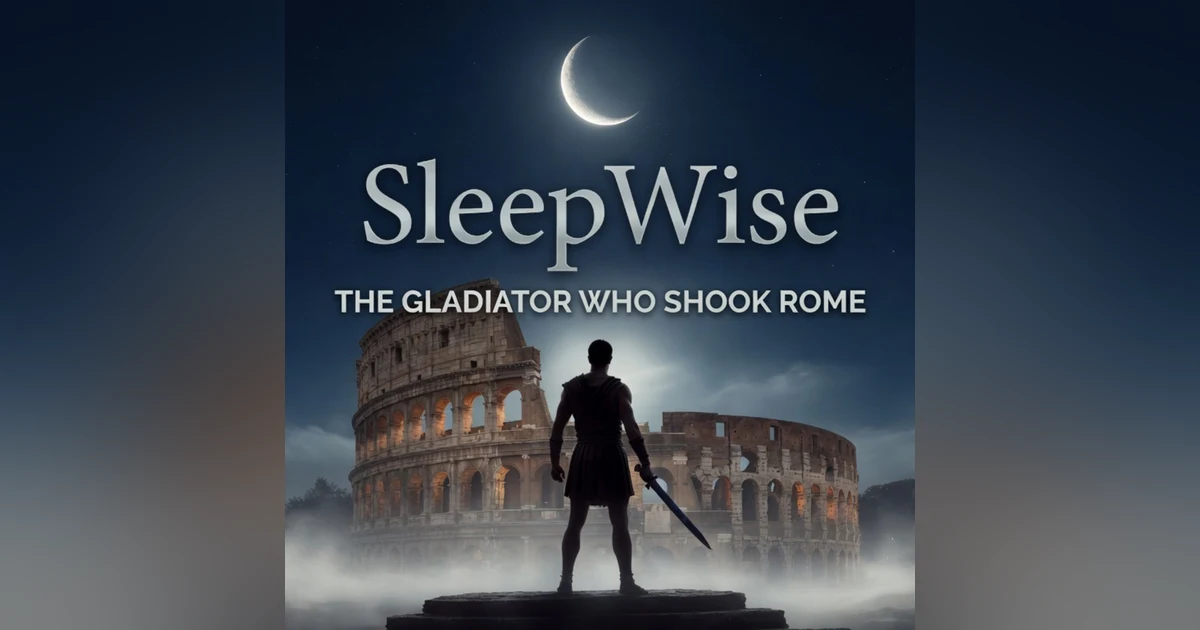


A calm bedtime story for adults about Spartacus, the Thracian gladiator who led the largest slave revolt of the Roman Republic. Drift back two thousand years to ancient Italy and follow him from the gladiator school of Capua, down the green slopes of Mount Vesuvius, and across the long spine of the peninsula, all the way to a final stand in the hills of Lucania.
Along the way, you'll move gently through the world of late Republican Rome, the long history of Roman slavery, and the rise of figures such as Crassus and Pompey, all told in the soothing, gently educational style that defines SleepWise.
There is nothing to follow and nothing to remember, only a road to walk softly into the past. Dim the light, settle in, and let the long road from Capua carry you toward sleep.
Follow SleepWise for more sleep stories about history, science, and quiet ideas. Share this episode with anyone who likes to fall asleep while learning something new.
—-
https://www.sleepwise.studio
—-
#SleepStory, #SleepStories, #BedtimeStory, #BedtimeStories, #AdultBedtimeStory, #SleepWise, #SleepPodcast, #SleepMeditation, #FallAsleepFast, #StoriesForSleep, #StoryForSleep, #CalmStory, #RelaxingStory, #SleepAid, #SleepHelp, #Insomnia, #InsomniaHelp, #CantSleep, #Relaxation, #RelaxingVoice, #CalmVoice, #SoftSpokenStory, #ASMRStory, #ASMRSleep, #SleepNarration, #NightTimeStory, #LateNightStory, #DeepSleep, #DeepSleepStory, #SleepyTime, #GoodNight, #SleepHistory, #HistoryForSleep, #HistoryBedtimeStory, #CalmHistory, #RelaxingHistory, #EducationalSleepStory, #LearnWhileYouSleep, #BedtimeHistory, #Spartacus, #SpartacusStory, #AncientRome, #RomanHistory, #RomanRepublic, #RomanEmpire, #Gladiator, #Gladiators, #SlaveRevolt, #ServileWar, #ThirdServileWar, #Crassus, #Pompey, #JuliusCaesar, #Capua, #MountVesuvius, #Vesuvius, #Thrace, #AncientHistory, #AncientWorld, #ClassicalHistory, #Antiquity, #HistoryPodcast, #HistoryLovers, #HistoryBuff, #HistoryNerd, #StorytellingPodcast, #NarrativeHistory, #PodcastForSleep, #YouTubeSleep, #SpotifySleep, #SleepChannel, #NightRoutine, #WindDown, #UnwindAndRest, #PeacefulMind, #quietstories
0:00 Good evening and welcome back to Sleep. Wise to Night. We drift back across 2000 years into the long, warm afternoons and lamp lit evenings of ancient Italy. We will follow the story of a man whose name has reached us from a world that is otherwise mostly silent. He was born somewhere in Thrace, in the rolling lands north of Greece, and he died on a battlefield in southern Italy. Between those two facts lay a brief, extraordinary rebellion that shook the most powerful Republic of the ancient world. His name was Spartacus.
0:49 The story is not only his, it belongs also to the 10s of thousands of unnamed people who walked beside him out of slavery into the open countryside, and to the Rome that pursued them across mountains, rivers and seasons. We will not need to remember every name or every battle. We will move slowly, letting the shape of the tail rise softly out of the dark. War passes through this account as war pass through the time we are visiting, but we will not linger over its edges. We will linger instead over endurance, over the strange order of a Republic built on unfree labor, and over the way a single revolt grew large enough to alarm the masters of the Mediterranean.
1:47 To meet Spartacus, we should first sit for a while with the Rome that made him possible. Picture a city of marble temples and red brick tenements, of crowded fora and quiet country villas. By the early 1st century, before the Common Era, Rome had already become the master of an immense world. It had defeated Carthage in three long wars. It had absorbed Greece and Macedonia. Its legions had marched through Spain and along the shores of Asia Minor.
2:28 Its senators argued in chambers whose decisions could move fleets across the sea. Yet beneath that grandeur lay a quieter strain. The Republic, which had begun centuries earlier as a careful balance of magistrates and assemblies, was bending under its own weight. Generals returned from distant provinces with personal armies and vast fortunes. Old families competed not only for honors, but for survival and the work of empire. The planting and harvesting and building, the carrying of stone and water and grain, rested largely upon the backs of people who had not chosen to do it to night.
3:18 We will follow the revolt of one of those people. We will trace his path from a gladiator school in Capua into the open countryside, his strange and luminous campaign through the Italian peninsula and the long quiet that followed. We will move through ancient cities and across Green Mountains. We will sit beside small fires in the camps of escaped slaves and listen for a while to the heavy considerations of senators in distant marble rooms. As we settle in, let your thoughts loosen a little. There is nothing here to solve, only a road to walk gently into the past where one figure still moves quietly through the warm air of southern Italy.
4:21 Before we meet our wanderer, we should sit for a while with the institution that shaped him. Slavery in the ancient world was not unusual. It existed across the Mediterranean and far beyond, in Egypt and Persia and Greece, long before Rome rose to dominance. But by the late Republic, Roman slavery had grown into something on a scale unseen before. Some modern historians believe that by the 1st century, before the Common Era, perhaps one in every three people on the Italian peninsula was enslaved.
5:08 The exact figures cannot be known with certainty, but the impression of an immense unfree population is consistent across the ancient sources. Most of these people had been captured in war as Roman armies pushed outward. Defeated populations were often sold in great markets. The conquest of Empirus alone in the 2nd century before the Common Era was said by ancient writers to have produced 150,000 slaves in a single season, though such numbers should always be held lightly. Pirates added to the supply, raiding coasts and selling captives at busy ports such as Delos. In the Aegean, children born to enslaved women remained enslaved themselves, and debt and exposure could thread a few unlucky free people into the same condition. The lives of the enslaved varied enormously. Some served in city households, where they cooked, taught, copied books, dressed hair, accompanied children to school, and sometimes earned the affection of the families they served.
6:35 A few rose to remarkable positions, managing estates or businesses, sometimes accumulating savings and one day buying their own freedom. To be a Freedman in Rome was a recognized status, and the descendants of freed slaves could, over generations, fully enter Roman society. But many others lived under far harder conditions. On the greatest states of southern Italy, the latifundia, gangs of enslaved laborers work the fields, the vineyards and the olive Groves. They were often housed in barracks at night, sometimes chained, watched by overseers who themselves answered to distant landlords.
7:28 Mining, far from the eyes of cities, could be still grimmer. The work was long, the air was poor, and the men who entered such places often did not see another life. Roman law recognized slaves as property. They could be bought, sold, given, inherited, and disciplined with a degree of severity that varied from household to household. Yet they were also very obviously people they thought, dreamed, loved and remembered the lives they had lost. That uneasy knowledge ran beneath the surface of Roman society like an underground river. Most of the time it stayed hidden, but every so often, somewhere along its length, the river would break open into the daylight.
8:29 The revolt of Spartacus did not come without warning. Twice in the previous century, Sicily, the great bread basket island just South of Italy, had erupted into prolonged slave uprisings. These earlier conflicts are often called the 1st and 2nd Servile Wars, and although their details are blurred by time, they remained vivid in Roman memory long after their fires had been put out. The first began around the year 135, before the Common Era. A Syrian born slave named Eunice, said by ancient writers to be a kind of Mystic and showman, claimed visions and miracles, breathing what looked like fire from his mouth through a hidden trick with kindled walnut shells.
9:28 Around him gathered other enslaved laborers, especially those held in chained gangs on the great Sicilian estates. They rose against their owners and seized the town of Enna, an ancient city perched on a high plateau at the heart of the island. Yunus took the title of king, modelled in part on the Hellenistic kingdoms of the eastern Mediterranean. He was joined by another leader, Cleon, who commanded a separate force in the South. For several years, this strange Kingdom held parts of Sicily against repeated Roman armies. Slaves from across the island reportedly flocked to its banner.
10:22 The fighting was uneven and slow, and the Republic lost more than one general before the consul Publius Rapilius finally crushed the revolt. Yunus died in captivity. The numbers given by ancient sources, sometimes as high as 70,000 or 200,000 rebels, should be taken as impressions rather than precise counts. The point is that the rising had been very large and the trauma to Roman pride had been deep. A generation later, around the year 104, before the Common Era, Sicily rose again. This time the central figure was Salvius, who took the royal name Trifon and his ally Athenian.
11:15 Once again, vast estates emptied. Once again, Roman armies struggled in the rough Sicilian countryside. Once again, the revolt was eventually broken, this time by the consul Manius Aquilius. The survivors were sent to face wild beasts in the arenas of Rome, although tradition recorded that some, refusing to provide a spectacle, took their own lives instead. By the time we approached the year 73 before the Common Era, the memory of these earlier wars had faded somewhat from public conversation, but it had not been forgotten.
12:02 Roman planters in the South still feared the possibility, however distant, of another. Rising Roman generals still understood that a slave army, if allowed to gather and to learn, could become formidable. So when far from Sicily, in the city of Capua on the Italian mainland, a small group of gladiators began to whisper among themselves, the dry leaves of an old danger were already lying ready, waiting only for a careful spark. Among all the institutions of Roman life, few have remained as vivid to later imagination as the gladiator. The image of armored men fighting in a sand floored arena while crowds of citizens cheered or jeered above them has travelled through paintings, plays, novels and films across 2000 years.
13:08 The reality, like most realities, was both more ordinary and more strange than the image suggests. Gladiatorial combat in Italy began as a private custom, not a public spectacle. Its earliest recorded form was a funeral rite said to have entered Roman practice during the 3rd century, before the Common Era. When a wealthy man died, his heirs sometimes arranged for armed combat to be staged at his tomb, perhaps as a relic of older sacrificial customs. Over time, these private funeral games drifted toward public entertainment.
13:56 Magistrates and ambitious politicians began to fund larger and more elaborate displays, partly to honor relatives and partly to win the favour of the Roman crowd. By the late Republic, gladiatorial games had become a recognized feature of public life. Specialized schools called ludi had grown up to train the fighters. The largest were in Capua, the chief city of Campania, where the climate was warm, the land was rich, and the market supplied a steady flow of weapons, oils and bodies. A successful school could sell or rent its fighters to magistrates planning games, and a particularly skilled gladiator might become known by name.
14:51 Across several cities. Most gladiators were enslaved. Some were captives of war, others were criminals condemned to the arena, and a smaller number were free men who, for reasons of debt or desperation, had sold themselves into the trade. Their lives in the schools were strict and physical. They trained daily with wooden weapons, learned specific styles of combat and were fed carefully, sometimes on a diet rich in barley and beans. Surviving skeletons of gladiators examined by modern researchers suggest a body conditioned for endurance rather than spectacle. More wrestler than warrior.
15:44 The fights themselves did not always end in death. Many bouts concluded with the surrender of the loser and the decision by the sponsor of the games, often guided by the mood of the crowd. A skilled gladiator was a valuable possession, and his owner had little wish to see him destroyed without cause. Yet death was always near. The career of a gladiator was usually short. The wounds were real, and the sand of the arena absorbed many quiet endings. The men who walked back to their cells at the end of a day's training carried with them the knowledge that the next time the gates opened to the public might be the last morning they would see.
16:40 It was within this world, behind the high walls of a school at Kapua, that the story of Spartacus truly begins. He had not chosen the trade, and the trade did not choose to release him. The origins of Spartacus are known to us only in fragments. Roman writers who composed their accounts after his death, and not always with sympathy, agreed that he was a Thracian. The Thracians were a people who lived in what is now roughly Bulgaria, northeastern Greece, and the European edge of modern Turkey.
17:23 They were known to the Greeks and Romans as fierce horsemen, skilled metal workers, and worshippers of older gods, including a great rider deity who appears on many surviving carvings. Their land lay along the Borderlands of empires, often crossed by armies and traders. The historian Plutarch, writing roughly 150 years after the events, described Spartacus as a man of intelligence and dignity, more cultivated than one might expect from his condition and gentle in his bearing. Another writer, Appian, called him brave and strong. These portraits were composed long after his death and surely shaped by hindsight, but they suggest that even his enemies recognized something unusual in him. According to one tradition, Spartacus had once served as a soldier in the Roman auxiliary forces. The auxiliaries were units recruited from non Roman peoples to support the legions, and many Thracians with their reputation for horsemanship were drawn into such service. If the tradition is accurate,
18:53 then he would have known something of Roman military life from the inside. He would have understood how legions camped, how they marched, how they fought. He would have seen, perhaps, the discipline that made them so formidable, and also the moments when that discipline could fray. How he passed from Roman service into Roman captivity is unclear. Some accounts say he deserted. Some suggest he was on the wrong side of a frontier conflict. What is recorded is that he was eventually sold into slavery and trained as a gladiator.
19:39 The school where he ended his journey was the Lutus of Lentilus Batiatus in Capua, where the gladiators were drilled in various combat styles for the games. There was also in the tales handed down to us a companion. Plutarch wrote that Spartacus was accompanied by a Thracian woman. Said to have been a priestess of Dionysus, the wine God in his older, Wilder form. According to the story, she once observed a snake coiling itself peacefully around the sleeping head of Spartacus and interpreted it as a sign that his fate would be remarkable, both great and grave. We need not weigh whether this happened literally. Such omens were a familiar feature of ancient biography, woven around important figures to give shape to the strangeness of their lives.
20:48 What the story tells us is that even in his own time, those close to him sensed that he carried something more than the ordinary weight of a slave. The city of Capua, where Spartacus would soon become legend, SAT in the warm plain of Campania, north of the Bay of Naples. It was old and proud, with ancient temples and a long history of its own, having once briefly sided with Hannibal during the wars against Carthage. By the time of our story, it had long since returned to Roman authority and become a hub of trade, agriculture, and entertainment. Its weather was mild, its land fertile, and its public works, including a famous Amphitheatre, made it a natural home for gladiator schools.
21:53 The ludus of Lentilus Batiatus stood somewhere within or near the city. Of its physical layout we know little, but we can reconstruct from other surviving schools the general pattern. There would have been an inner training ground, a courtyard ringed by small cells, kitchens and store rooms, and perhaps a modest residence for the owner. Guards walk the corridors. The men trained under specialized instructors called doctores, each teaching a distinct style of combat. Days followed a steady rhythm of drill, meal, rest and drill again.
22:41 For the men inside, life was both ordinary and unbearable. They were fed, clothed, and treated as valuable property, and yet they knew that the months of training LED toward arenas where they would be displayed wounded and possibly killed for the pleasure of crowds who did not know their names. Some accepted this fate with a grim professionalism. Some sought ways to die well or to win their freedom through extraordinary skill. And some began quietly to imagine another future.
23:25 According to Plutarch, around 200 men in the school of Bhatiatus formed a plan to break out. The reason given is simple. They had committed no offense, and yet they were being held to a violent destiny they had not chosen. The plot, however, was betrayed. Word leaked. Perhaps through a careless remark, perhaps through a calculated whisper. The school's owner began to take precautions. Knowing they could not delay any longer, the conspirators acted.
24:07 About 70 of them, perhaps a few more, broke out of the kitchens, snatching whatever they could find. Cleavers, spits, knives, the heavy iron tools of food preparation. They forced their way through the streets of Capua. By chance, on one of the nearby roads, they came upon a wagon carrying gladiator weapons, possibly intended for a coming spectacle. They seized it. Now they were no longer escaped slaves with kitchen tools. They were armed. 70 men with stolen weapons would not on their own threaten Rome.
24:51 But these were not ordinary men. They had trained in arms. They had nothing to return to. And among them, by accounts that came later, were three leaders whose names would soon be known across the peninsula, 2 Gauls, Cryxus and Oenemaeus, and a Thracian whose name was already beginning to gather. A quiet wait. Spartacus. What followed in those first days of freedom must have seemed unreal. The escapees moved through the Campanian countryside, gathering followers as they went.
25:39 Other slaves on the great estates, hearing of the breakout, slipped away to join them. Within weeks, perhaps a few months, what had begun as a small fugitive band had grown into something larger, perhaps several 100 or even a few 1000. Their composition reflected the human geography of Roman slavery, Thracians, Gauls, Germans, men from Asia Minor, men from northern Italy, mixing dialects and customs around shared fires. In those early weeks, there was much that had to be invented.
26:22 As the band moved, they needed food, and so they began to raid the great rural estates whose granaries lay open in the soft Campanian air. They needed weapons, and so they took what they could from villas, from forges, from any traveller who happened to cross their path. They needed a leader's voice, and Spartacus, perhaps along with his Gallic companions, provided one. Decisions had to be made quickly which road to take, which town to leave alone, which valley would shelter them by night.
27:05 Mistakes in any of these choices could end the rebellion before it had truly begun. The chroniclers who rode of the revolt long afterward emphasized one quality more than any other. In this early phase, the rebels showed restraint. According to Plutarch, Spartacus tried to keep his followers from indiscriminate plunder. Knowing that wanton destruction would harden the local population against him, he sought to take what was needed and move on.
27:46 Whether the policy was always followed in practice is another question, but the intent matters. He understood that an army moving through occupied country lives or dies by the goodwill of those it passes. The countryside of southern Italy in those days was full of people whose loyalties were less than warm toward Rome. Many shepherds in the southern hills were themselves slaves, or near slaves, set free upon the land to tend flocks for distant masters. Some were rough men, used to hardship, used to making their own decisions in the empty places. When word came of an army of former slaves moving through the region, more than a few of them simply walked away from their flocks and joined the column.
28:43 Their numbers, their familiarity with the land, and their willingness to fight all strengthened the rebellion. By the end of those first weeks, the rebels were no longer a curiosity. They had become a problem. Local authorities tried to gather forces against them and were repelled. Wealthy land owners began to send their valuables N away from the gathering trouble, and somewhere among the rolling hills of Campania, the leaders of the revolt began to consider where they might make a more lasting refuge, A place high enough and wild enough that the legions of Rome would have difficulty reaching them.
29:34 The first refuge they chose was Mount Vesuvius. To later generations, that name carries a different weight, because in the year 79 of the Common Era, more than 150 years after our story, the volcano would erupt and bury the cities of Pompeii and Herculaneum beneath ash. But in the time of Spartacus, Vesuvius was quiet. It rose green and forested above the plain, its slopes covered in vineyards lower down and dense scrub higher up, with hidden hollows and rocky outcrops near the summit.
30:20 It was a place where a small armed force could disappear into the landscape, watch the roads below, and keep the surprise of higher ground. The Romans initially did not take the matter very seriously. The early Republic had often dispatched small forces to deal with local disturbances, and a band of escaped gladiators on a wooded mountain seemed at first more an embarrassment than a danger. The first detachment sent against them was led by a prater named Gaius Claudius Gleber with about 3000 men.
31:06 These were not full legions. Gleber's force was thrown together quickly, and his soldiers were less seasoned than the gladiators they were chasing. Gleber climbed the mountain with the obvious plan of trapping the rebels at the summit and starving them out. He arranged his troops along the only known path leading up. From below, the situation looked simple. The rebels, hemmed in by sheer cliffs on all other sides, would soon run out of food and have to surrender. Days passed. The Roman camp grew confident.
31:47 Watch fires burned in the lower glades. The siege seemed almost a formality. But Spartacus, according to ancient accounts, had been studying the mountain. He noticed that wild grape vines grew thickly on the cliffs, twisting around the rocks under his direction. The gladiators cut long lengths of vine and braided them together into ropes. By night, while the Roman watch tended its fires below, the rebels lowered themselves down the steep face of the mountain. On these green ladders they reached level ground, crept around the unsuspecting Roman camp, and fell upon it from the rear. The result was a route Glaber's men, surprised in the dark by enemies they had thought safely above them, broke and fled. Roman weapons, baggage and standards passed into the hands of the rebels.
32:57 With one improvised descent, the escaped gladiators had won their first real victory. There is something striking about the imagery of that night. A volcano sleeps. Wild vines grow on its old lava. A handful of men, born in distant lands and brought together by chains, weave away down the Cliff with their own hands. They reached the level fields and turned the careful Roman plan inside out, all in the soft light before dawn. Whatever else the revolt would become, it began with that ingenious descent on a mountain that had not yet learned what it would one day be remembered for. News of the defeated Vesuvius travelled quickly to the Senate in Rome.
33:57 It came as an unwelcome surprise. The Republic at that moment was already absorbed in two distant and difficult wars. In the East, the formidable King Mithridates of Pontus was challenging Roman power across Asia Minor and the Black Sea. In Spain, the rebel general Quintus Sartorius, a former Roman officer turned outlaw, had been holding off Roman armies for years. The very best Roman commanders were fighting on those fronts. The disturbance in Italy was treated at first as a secondary problem. Still, something had to be done.
34:46 A second prater, Publius Verenius, was sent against the rebels with a larger force. Verenius divided his army, hoping to pin Spartacus from multiple directions at once. The plan went badly. Spartacus and his lieutenants moved with surprising speed across the countryside, attacking Roman detachments before they could combine. Subordinates of Verenius were defeated in turn. According to one account, Spartacus even captured horses, lictors, and the personal Insignia of a Roman magistrate, symbols of authority that no escaped gladiator should have possessed. Verenius himself only narrowly escaped. After these victories, the rebel host swelled. Estimates from ancient writers vary widely, suggesting 10s of thousands and rising.
35:51 The figures are imprecise, but there is no doubt that the movement had grown beyond a band of fugitives into a recognizable army. Spartacus seems to have shown an unusual gift for organization. He drilled the new arrivals in basic discipline. He insisted, according to the sources, on a rough sharing of plunder which kept the host together against the temptations of rivalry. He moved his people through the countryside in winter quarters, rested them and prepared for what would come next.
36:33 Around this time, the rebels also began to manufacture their own arms. Captured Roman weapons formed the corps, but iron was gathered from forges and farms, and tools were beaten into spear points and shield rims. Wagons, animals and supplies followed in long columns. The gladiator school had been left far behind. What was emerging was something with the structure, if not the Polish, of a real military force for the people in their path. The experience was complicated. Some great estates were stripped, some towns closed their gates.
37:21 Yet many of the rural slaves, hearing of the host, simply walked away from their masters and joined free. Shepherds from the southern hills drifted in as well. The cultural and linguistic mixture inside the camp must have been astonishing. Latin, Thracian, Celtic dialects, dialects of the German lands and various forms of Greek would have been heard around the same evening fires. A Republic that had once dispatched 3000 men to crush this movement was beginning to understand that the matter required more than that. For a brief time, in the wide spaces of southern Italy, something strange and almost without parallel had come into being. 10s of thousands of people who only months before had been the property of others, were now living together as a kind of mobile community, with their own rules, their own counsels, their own punishments and rewards. It was not a state in any formal sense. It produced no coins, no constitution, no recorded laws. But it functioned for season
38:52 after season, against everything Rome could send against it. Inside this rough polity, the divisions of the old world softened. A man who had been a household slave in a Roman city walked beside a herdsman who had been free in his own homeland. A Thracian who had served in the auxiliary marched next to a gall whose grandfather had fought against the legions. Languages mixed in the kitchens and around to watch fires, a common cause, held them together more reliably than any shared tongue.
39:36 Spartacus seems to have taken some pains to maintain order. He divided the spoils, according to ancient accounts, on a pattern that gave each follower A roughly equal share. He forbade certain kinds of plunder, especially of gold and silver, which he considered useless burdens that would slow the army. There is even a tradition that he tried to limit the use of money inside the camp so that no one could grow rich at the expense of others. Whether this is a later embellishment by sympathetic writers cannot be known, but it is plausible that he understood instinctively. That an army of escaped slaves could only hold together if it did not become too quickly a small Kingdom of its own. There were certainly tensions.
40:37 The decisions of where to March, when to fight, and what to do with prisoners must have produced disagreement. The leaders Co operated, but they did not always agree, and beneath the surface unity ran the natural strain of any large heterogeneous force. Some accounts suggest that Spartacus had a longer view, while others among the leaders preferred immediate plunder and short marches. These tensions would eventually shape the course of the war.
41:18 For the ordinary follower, however, the days had a strange new shape. Where once there had been only the labor demanded by an owner, now there were watches to keep, weapons to clean, formations to learn. Where once there had been the steady fear of arbitrary punishment, now there was the harder but more bearable fear of battle. Where once there had been silence, now there were songs in many tongues told around fires and valleys whose names few of them knew.
41:58 The Romans, observing from a distance, called this band an insurrection, a slave army, a swarm. It was all those things, but it was also briefly and incompletely, something none of them quite had a word for a community of the formerly enslaved walking under their own banners through the heart of the Republic that had once owned them. Among the rebels, Spartacus did not stand alone. The accounts that have come down to us, though incomplete, name two other leaders, especially Crixus and Oenemaeus, were both said to be of Gallic origin, born in the Celtic speaking lands that stretched from northern Italy across modern France and into central Europe.
42:55 They had likely been captured in earlier Roman campaigns, sold into slavery and trained as gladiators alongside Spartacus in Capua. Their names alone tell us something. Crixus is a Celtic word related to ideas of curling or WAVY hair. Oh in Emmaus may have borrowed his name from a figure in Greek mythology, perhaps adopted in the school as a stage identity. The presence of these Gallic leaders matters because it reveals the layered nature of the revolt.
43:36 The Rising was not simply a Thracian rebellion under a Thracian leader, nor purely a movement of Italian rural slaves. It was something more like a coalition. Different peoples, different languages, and different memories of homelands lost moved together, sometimes harmoniously and sometimes with friction. Decisions about where to March and what to do next were not always easy. Some ancient historians, riding centuries after the events, tried to organize the army's behavior into clear factions. According to one tradition, Spartacus wished to lead his followers N toward the Alps in the hope that once they crossed into the Celtic and Germanic lands beyond, those who were Gauls or Germans could return to their homes, while others could disperse into the wide territories of Europe. Crixus, by some accounts, preferred to remain in Italy, raid the richest states of the South, and live on the spoils of the peninsula.
45:02 The accuracy of this neat division is uncertain. Real councils of war among large groups of fugitives are rarely so tidy. But the broad sense that the leaders did not always agree fits the pattern of any large heterogeneous army. What is clearer is that for much of the war the leaders Co operated effectively. They divided forces when necessary. They reunited when threatened. They moved across the Italian countryside with a fluency that surprised Roman commanders trained on more conventional opponents.
45:45 Spartacus seems to have been the principal voice in strategic matters, though his authority rested less on formal title than on the trust of those around him. The composition of the rebel host raises a quiet question that historians have asked ever since. Was this a war for the abolition of slavery? As such, the evidence suggests not, at least not in the form later eras would recognize. Ancient sources do not record any clear program to dismantle the institution.
46:27 The rebels seemed to have wanted, above all to escape their own bondage, to reach freedom for themselves and their companions. That goal was already revolutionary enough in the Roman world. It needed no theory to make it dangerous. By the spring of the year 72, before the Common Era, the Senate had decided that the matter required more decisive action. Two consular armies were dispatched against the rebels. The consuls of that year, Lucius Gelius Publicola and Gnaeus Cornelius Lentilus Claudianus, were experienced men of standing.
47:15 Their soldiers were proper legionaries, not hastily gathered local levees. The intent was clear. The revolt would be crushed before the year was out. The campaign, however, did not unfold as the Senate had hoped. Spartacus, by this point was already moving N toward the Apennines and beyond. He may have hoped to reach the Alps, cross them and dissolve his army into the open lands of Sisalpine, Gaul and the territories beyond. To do so he had to pass between the consular armies before they could combine into a single fist against him.
48:04 It was at this point that the army of the rebels divided. Crixus, who may have preferred a different course, separated from the main host with a substantial force, perhaps 30,000 men, drawn largely from the Gauls and Germans among the followers. The reasons for the split are not entirely clear. He may have wished to remain in southern Italy and continue raiding the richest states there. He may have been left as a rear guard against Roman pursuit. He may have disagreed with the decision to March N toward the cold, unfamiliar mountains. Whatever the reason, the host had divided, and the two halves would now face the consuls separately. Crixus was caught first near Mount Garganus, A wooded promontory jutting into the Adriatic on the eastern coast of Italy.
49:10 The consul Gelius engaged him. The fighting was severe. Crixus and many of his followers were killed in the battle. The defeat was a serious blow to the rebels, both in numbers and in spirit. One of the original gladiators of Capua, who had made the long journey from a single act of breakout to the leadership of an army, was gone. The hills of Garganis, with their old oaks and their view of the Adriatic, kept his last stand to themselves. The news must have reached Spartacus while he was still moving N through the Apennines. We can imagine the silence that fell upon the camp when the messenger spoke.
50:03 A leader who had stood beside him in the kitchens of Bhatiatus, on the slopes of Vesuvius and across the long campaign of the previous year, was no longer in the world. The bond of the original conspiracy was beginning to thin. When Spartacus learned of the death of Crixus, he ordered an unusual ceremony. According to the historian Appian, he selected several 100 Roman prisoners of war and forced them to fight one another as gladiators in honor of his fallen companion.
50:49 The grim symbolism would have been unmissable. The very right that had once been used to entertain Romans at the funerals of their wealthy was now being used by an escaped gladiator to mourn another. Whatever else this gesture was, it was a careful statement. We have not forgotten what was done to us, and we know exactly how to return the form of it. The episode is one of the most striking in the whole story, and also one of the hardest to weigh. We do not know how many prisoners were forced into these combats, nor under what exact circumstances.
51:37 Some modern historians have wondered whether the number was inflated by ancient writers who wished to underline the savagery of the rebels. Others have suggested that the gesture, however severe, was meant in part to discipline Spartacus's own followers, reminding them of what awaited them if Rome won. What is certain is that the symbolism was understood by everyone who heard of it. The arena had been carried out of Capua and into the hills. After this dark rite, Spartacus turned upon the consuls themselves. He met Lentilus, first defeating him in battle, and then Gelius defeating him as well.
52:30 The details of these engagements are lost to time, but their cumulative effect was extraordinary. Within a single campaign season, the rebel leader had defeated the armies of two consuls of the Roman Republic, the highest serving magistrates of the state. Few foreign enemies in Roman memory could claim such a record now. An escaped gladiator leading a multilingual host of former slaves had done it without the resources of any Kingdom behind him. The Senate's mood grew darker. Whatever embarrassment had earlier been felt now hardened into something closer to alarm.
53:21 Speeches in the Curia spoke of the danger no longer as an inconvenience, but as a serious threat to public order. New levees were considered, old allies were called upon. The image of the runaway slave, once a figure of ridicule, took on a sharper edge in the popular imagination. And still Spartacus marched. His great column moved steadily up the spine of Italy, toward the high passes of the north, where the air would soon grow colder and the white walls of the Alps would rise into view. Behind him lay the Adriatic, where Crixus had fallen. Ahead lay mountains he had perhaps known only by report, ridges he must have heard the older soldiers speak of in his auxiliary days.
54:23 Beyond those mountains lay something that, from where he stood, might have looked very nearly like home. By the late summer or autumn of 72, before the Common Era, the rebel host had reached the broad valley of the Poe, the great plain that stretches across northern Italy between the Apennines and the Alps. This was a region of fertile farmland, of growing towns, and of a population that included many Celts whose ancestors had settled there centuries earlier. To Spartacus, it must have looked like the gateway to escape the Alps loomed on the horizon.
55:10 Beyond them lay the wide world of Gaul, Germania and the steppe lands stretching E toward his own birthplace. In this northern country, another Roman army was waiting. Gaius Cassius Longinus, the governor of Sisalpine Gaul, met the rebels near the city of Mutina, modern Modena. The forces he commanded would have been a mixture of regional levees and any veterans available in the province. He intended to block the rebel advance and hold the line until reinforcements could arrive from Rome.
55:55 The battle did not save him. Cassius was defeated. Mutina was the last great obstacle between Spartacus and the foothills of the Alps. With its commander beaten, the rebel host was effectively unopposed. In the north, the road to the mountains lay open, and a careful observer might have thought that the war was about to end as quietly as it had begun, with thousands of men and women slipping over the high passes and dissolving into the lands beyond. We can imagine, although we cannot know, the mood of the camp in those weeks.
56:43 Some among the followers may have been Gauls and Germans whose homelands lay just over the Ridge. They would have known the names of distant rivers, the shapes of their own valleys, the half remembered words of their first language. To them, the Alps were not merely A barrier, but a doorway. The journey of the past year, with all its danger and improvisation, was about to bring them within sight of what they had lost. Others in the Host had no homeland to which they could return. They had been born into slavery, or had spent so many years in it that the memory of any earlier life had grown faint. For them the great mountains promised something simpler and more uncertain, a wide unknown where they might disappear from the eyes of Rome and begin again. Whatever waited beyond the passes, it could not easily be worse than what lay behind.
57:57 For Rome, the moment was tense. If Spartacus crossed the Alps, the Republic would have to live with a vast and humiliating dispersal of fugitives into territories where its arm did not easily reach. Even if his army never returned, the political damage would be considerable. Yet there was little the Senate could do at that moment but watch and prepare for whatever would come next. The mountain passes themselves, indifferent to politics, simply waited under their own slow seasons of snow and wind.
58:42 And then, for reasons that ancient historians never fully explain, Spartacus turned South. This is one of the great puzzles of his story. If his goal had truly been to lead his followers across the Alps and dissolved them safely into the lands beyond, he had reached the moment of decision. His army was at peak strength. His most recent victory had cleared his path. There was nothing immediately stopping him. And yet he turned around, the host wheeled back, and began to March once more down the spine of Italy, away from the mountains, away from escape.
59:32 Various explanations have been offered, each only partial. Perhaps the army itself refused. Many of his followers may have preferred the richest states of the South to the unknown lands beyond the mountains. Perhaps Spartacus believed Rome itself could be threatened, or its rural population could be roused. Perhaps the cohesion of the host depended on continued plunder. Perhaps he calculated that crossing the Alps in late season with women, children, the wounded and so many wagons. Would simply destroy the army by exhaustion. Perhaps the Gauls and Germans among his followers, who would have had the most reason to cross, were fewer in number or less unified than the older sources imply. All of these reasons may have played some part. None of them is recorded in any source we still have. There is a thoughtful kind of mystery in this moment. The leader who had moved his army with such patience across the peninsula, who had defeated praters and consuls, who had refused to let his men be drawn into easy battles, paused at the foot of the mountains and chose,
1:01:06 instead of the long prepared escape, to walk back into the country he had just crossed. Whatever passed through his mind in those days, it has been kept by the silence of 2000 years. What is recorded is the change of direction itself. After the victory at Mutina, the great rebel column reversed and began to move southward again. They followed one slope of the Apennines for some time, perhaps wintering in the plains of Pishnum. Then they continued on through Lucania into the Deep South of the peninsula.
1:01:50 Once again the towns watched them pass with a mixture of dread and confused awe. Once again the rural slaves watched their backs and wondered what came next. For Rome, the turning S was both a relief and a new alarm. The rebel host had not crossed the mountains and dispersed into nothingness, as some had feared. Instead, it was coming back deep into Italy, and the Republic now had to decide who could be trusted to deal with it. The commander so far appointed had failed. Something different was needed, a man who would set aside other ambitions and dedicate himself with whatever means it took to ending the long embarrassment.
1:02:49 The man chosen to face Spartacus was Marcus Licinius Crassus. He was perhaps the wealthiest man in Rome, said to own a large fraction of the city's properties, with extensive interests in mining, trade and real estate. He had built much of his fortune in the proscriptions of the dictator Sulla a decade earlier, when the property of the dictator's enemies had been auctioned off to his supporters. He was politically ambitious, conscious of his lack of a great military reputation, and acutely aware that any general who finally crushed Spartacus would gain immense prestige.
1:03:38 Crassus was given an unusual command, raising 6 new legions to add to the surviving consular forces, perhaps 40,000 men in total when fully assembled. He moved methodically. Rather than rushing to engage the rebels, he first drilled and disciplined his army. He understood that the recent defeats had damaged Roman morale as much as Roman numbers. The legions had to remember how to win. It was during this period that Crassus is said to have revived an old and severe punishment. According to several ancient accounts, when one of his subordinates engaged Spartacus against orders and was defeated, Crassus subjected the offending unit to a procedure called decimation.
1:04:40 The soldiers were divided into groups of 10 drew lots, and one in every 10 was put to death by his comrades. The practice was old, terrible, and rare. Its purpose was to restore discipline by making the price of disobedience unbearably visible. Whether this happened in exactly the form recorded is debated by modern historians, but the substance of the story that Crassus chose to enforce traditional Roman severity at the start of his command fits everything else we know about him. The lesson was meant to travel through the army faster than rumor could carry it.
1:05:30 From that day forward, Roman legionaries fighting under Crassus would be more afraid of their own commander than of the strange wandering host they had been sent to destroy. It was a hard calculation. It was also, in the cold accounting of Roman warfare, an effective one. Around the same time Spartacus had reached the southern tip of the Italian peninsula, he brought his army to the region of Brutium, the toe of Italy, near what is now Calabria. There, across a narrow Strait, lay the island of Sicily.
1:06:15 To Spartacus, this geography offered one last great possibility. Sicily was the site of the earlier slave wars, the place where Eunice and Salvius had ruled briefly over restless thousands. If he could cross to Sicily, he might rouse the rural slaves of the island, build a new base, and continue the war from across the water. The plan was bold, but no bolder than the road that had brought him this far. For the second time in his great campaign, the rebel leader stood before water, looking outward to make the crossing to Sicily Spartacus open. Negotiations with Solution pirates, the sea born Raiders who at that time roamed the eastern and central Mediterranean almost at will.
1:07:13 The Solutions had been a serious power for generations, controlling sea lanes from their bases on the rocky southern coast of Asia Minor. They sometimes even traded with Roman cities and sometimes raided them to an army at the edge of the sea. They were the only realistic ferry. According to the accounts that have come down to us, the pirates agreed to carry his men across the Strait in their light ships. Payment was made, plans were laid, the sails were promised for a particular shore on a particular night.
1:07:59 Then the pirates sailed away to make ready, and they never returned. Whether they had been bribed by Rome or simply preferred to keep the gold already in hand, the exact reason has not survived whatever lay behind it. The agreement was broken. The wading army on the shore would have to remain in Italy. When Crassus learned that Spartacus was now caught in the toe of Italy, he saw an opportunity that few Roman commanders had ever enjoyed. The peninsula at that point narrows considerably, and the natural geography forms a kind of corridor with the sea on either side. Crassus decided to seal off the entire neck of land. His soldiers built a great defensive line, a ditch and a wall stretching from coast to coast, perhaps 50 kilometers or more in length.
1:09:05 The work was extensive, methodical, and very Roman. It turned a difficult landscape into a closed enclosure. Behind that wall, Spartacus and his followers found their freedom of movement suddenly taken from them. The countryside was finite, supplies could not arrive easily, and the season was turning toward winter. What had once been a fluid host, capable of ranging across hundreds of miles, was now compressed into a single region, watched and waited upon by a patient Roman army.
1:09:47 The siege, of a strange and elongated kind, lasted through the cold months. Skirmishes were fought along the line. The rebels tried at various points to breakthrough, and were turned back. Crassus, for his part, was content to wait. Time was on his side. Hunger could do what swords had not. There is something quietly devastating about that line. It was not a great battle, not a stroke of genius, not a heroic stand. It was simply earth and stone, dug and piled by ordinary soldiers, drawn carefully across a narrow piece of land.
1:10:35 Yet behind it, slowly, the long campaign that had carried so many thousands of people from Coppua to the PO Valley and back again was being pressed toward its conclusion. The geography of Italy, which Spartacus had used so freely, had finally been made to enclose him. Yet Spartacus had reserves that Crassus did not entirely understand. By night, in the dead of a winter storm, the rebels chose a section of the line and went at it with concentrated force. They threw earth branches and the bodies of slain horses into the ditch to fill it, and they pushed their column across. The line was breached.
1:11:28 By morning, perhaps 1/3 of the rebel host had broken out into the open countryside again. The rest, less fortunate, would be cut off behind them. For Crassus, this was a serious set back. The neat trap had been turned into a leak. He set out in pursuit, his legions moving quickly along the same paths. He knew now that Spartacus was not going to be ground down passively. The escape forced him to fight in the open once more. Word of his predicament also began to reach Rome, where there was now a new concern.
1:12:12 The Senate, growing impatient with the prolonged campaign, had considered recalling other commanders to assist Pompey. The brilliant young general who had been campaigning in Spain against the rebel Sartorius, had concluded his work there and was on his way home. There was talk of granting him part of the command against Spartacus. Crassus, jealous of the glory he had spent so much money and discipline to earn, now had two enemies at once, the escaped slaves ahead of him and the rival approaching from behind.
1:12:55 The pursuit through the Deep South of Italy quickened. Roman columns and rebel columns wound through valleys and along old shepherd tracks, sometimes meeting in sharp, unplanned engagements, sometimes glimpsing one another at a distance through the winter trees. The land itself, the rolling Lucanian hills with their oaks and beaches, the small streams that turn to ice in the mornings, became a slow witness to the closing chapter of the war.
1:13:35 As the spring of 71, before the Common Era began to soften the landscape, the rebel army was no longer the unified force that had crossed Italy two years earlier. Some of those who had broken out of the wall had taken separate paths. Skirmishes wore down the host. A force led by lieutenants, whose names sometimes reach us as Castus and Ganicus, was caught and defeated in a fierce battle, with great losses on both sides. The careful coordination that had carried the rebels through so many earlier victories was beginning to fray.
1:14:23 Spartacus himself remained at the center of the main host. He understood, as everyone in his army must have understood, that the great campaign was nearing some kind of conclusion. His scouts brought him news of Roman columns drawing closer. His counsels must have been heavy with the awareness that the wide spaces of Italy were narrowing around them. One last battle would surely come, and he was now preparing in his quiet and resolute way to meet it.
1:15:04 According to the surviving accounts, on the eve of that final battle, Spartacus performed A striking gesture. He had a fine horse brought before him, perhaps the best in his camp, with his soldiers watching. He killed the animal himself, declaring that if victory came, he would have all the horses he wished from the Roman side, and if defeat came, he would no longer need any. It was the kind of theatrical moment that ancient writers loved to record, and like the snake omen of his beginning, we cannot be sure that it happened in exactly the form described.
1:15:57 Yet the gesture, real or polished by tradition, captures something essential a leader who would not lighten his own fate by holding back a means of escape. The battle itself took place somewhere in Leukania, in the rugged interior of southern Italy. Crassus's legions met the rebel host on open ground. The fighting was hard. Spartacus, said to have sought out Crassus directly in the line, fought with great energy and is reported to have killed 2 centurions before being struck down. His body, according to one account, was never positively identified afterward, lost among the many fallen, there was no triumphal display of his head.
1:16:59 No captured leader paraded through Roman streets. He seemed simply to have vanished into the Press of bodies on a southern field. The rebel army was largely destroyed. Some who survived the field tried to flee northward, only to be intercepted by Pompey, who was returning from Spain at that very moment. Pompey wrote to the Senate that while Crassus had defeated the slaves in the open, he himself had cut down those who escaped and so deserved to be considered the man who finished the war.
1:17:48 Crassus did not forget the slight. The aftermath was severe in the cold Roman style. 6000 prisoners captured from the rebel army were crucified along the Appian Way, the long Roman Rd. that ran from Capua, the city where the revolt had begun to roam itself. The bodies were spaced along the verge of the road for a distance of perhaps 200 kilometers. They were left as a warning, very Roman in its precision, very unmistakable in its message.
1:18:36 Travellers passing by, including those who had nothing to do with the revolt, would have walked beside that long, quiet line for many days. The scene would not have been gentle. We will not linger on it. It is enough to know that the Republic, once embarrassed, had answered its embarrassment in the harsh language it knew best. The servile War, as it would later be called, was over. The host that had begun with 70 men and kitchen knives, and Capua that had descended Vesuvius on ropes of green vines, that had defeated praters and consuls, that had marched almost the full length of Italy and back again, was scattered.
1:19:37 The wide camps with their many languages were silent. The road once again belonged to Rome. In the months and years that followed, Roman societies slowly absorbed the shock of what had happened. Crassus, having crushed the rebellion, was awarded an ovation, A lesser form of triumph appropriate for victories over slaves. Pompey, despite arriving late, was granted a full triumph for his Spanish campaign.
1:20:19 Their uneasy partnership would later become part of the famous First Triumvirate alongside Julius Caesar that would dominate Roman politics for a decade. Rome did not abolish slavery in response to the revolt. The institution was too deeply woven into Roman economic life for that to even be imagined. But certain quieter shifts may have followed. Roman writers urged greater caution in the treatment of large slave populations.
1:21:03 Some senatorial families reduced the size of agricultural slave gangs on their estates. Others moved toward employing tenant farmers called Colony, who would over the centuries become an increasingly common rural figure. The change where it came was slow, but the memory of Spartacus seems to have nudged it along in places. The figure of Spartacus, meanwhile, began a slow journey through memory. In the immediate aftermath, Roman writers tended to treat him with a mixture of reluctant respect and political distaste. He was acknowledged as brave and able, but the very fact that he had nearly succeeded made him uncomfortable to celebrate openly.
1:22:08 Over the centuries that followed, he faded somewhat into the background of Roman history, mentioned in summaries but rarely placed at the center. It was much later, in the modern era that his name would rise again with new force. 18th and 19th century writers, philosophers, and revolutionaries discovered in him a symbol of resistance to oppression. His story was retold in plays, novels, ballets, and eventually films, often shaped to suit the concerns of the age that retold it.
1:22:58 Whether any of these later portraits would have been recognized by the man himself is impossible to say. He had become by then, more myth than memory. What remains beneath all the retellings is the simple fact of what happened. A group of people who had been told by the world that they could be owned chose, for a brief and luminous time to walk free. They organized themselves. They survived several seasons against the strongest state in their world.
1:23:43 They marched under stars that look much the same to night. And then, like all human things, they passed to night. Perhaps that is the feeling to keep. Not the dates, not the names, not the exact map of every battle, but the quiet weight of endurance. The world Spartacus knew has long since gone. The fields where he camped now belong to other crops, other languages, other lives. And yet, when the lamp is dimmed and the night settles, the long story of those who refuse to be silent still moves somewhere in the patient memory of the world.
1:24:40 The world slows, and so do we. Good night.