The Life of Albert Einstein | A SleepWise Story
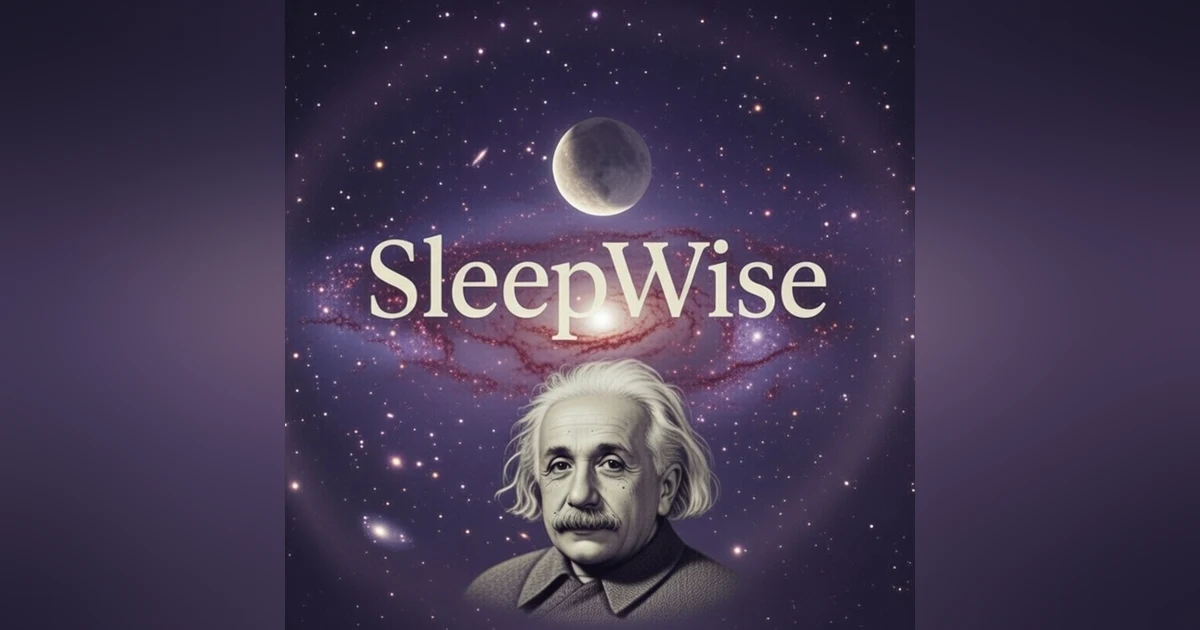


Fall asleep to the gentle life story of Albert Einstein in this calming SleepWise bedtime episode. Tonight, we explore Einstein’s journey in a slow, soothing way—his childhood wonder, his quiet years working at a Swiss patent office, and the famous ideas that helped redefine time, space, and gravity. Everything is explained simply, without technical language, so you can relax and unwind while listening.
This is a sleep story for adults designed to reduce racing thoughts and nighttime anxiety, using soft narration, warm imagery, and peaceful facts from history and science. If you enjoy relaxing biographies, calming educational stories, and quiet explorations of the universe, this episode is for you.
Get comfortable, let your breathing slow, and drift into sleep with a story of curiosity, patience, and starlight.
----
SleepWise, Sleep Stories, Bedtime Stories, Guided Sleep, Relaxation, Mindful Sleep, Calm Narration, Science for Sleep, ASMR Sleep, Deep Relaxation, Falling Asleep, Sleep Meditation, Guided Meditation, Sleep Podcast, Soothing Voice, Peaceful Storytelling, Night Routine, Sleep Aid, Mindfulness, Restful Night, Relaxing Audio, Gentle Storytelling, Sleep Channel, Meditation for Sleep, SleepWise Podcast, Sleep Narration, Calming Stories, Rest and Relaxation, Sleep Help, Tranquil Nights
0:00 Good evening and welcome back to Sleep Wise. If these stories help you unwind, you can follow, subscribe and share Sleep Wise on YouTube, Spotify and Apple Podcasts. So the next gentle episode is always waiting for you. Tonight we will move slowly through a life shaped by curiosity and patience. From a quiet childhood in Europe to years of unnoticed work at a small desk, to ideas that changed how we understand time, space and light. We'll linger with the moments before recognition arrived, touched gently on the weight of fame and responsibility, and end with the softer reflections of an older mind that valued wonder more than certainty.
1:03 There is nothing here you need to remember or master. This is simply a human life unfolding at its own pace, carried by questions rather than answers. Now we begin at the beginning. Imagine a quiet St. in Ulm in southern Germany, where a child was born on March 14th, 1879, as winter loosened its grip and the air smelled faintly of riverstone. Within a year, his family moved to Munich, where his father and uncle worked in the growing electrical industry, A world of wires and lamps just beginning to stretch light into the evenings.
1:58 He was born into a Jewish family that was modern and practical rather than strictly religious, shaped by a Europe that was industrializing quickly even as traditions still lingered. The world around him moved fast, but his own rhythm was slow and careful, and those close to him later remembered that he spoke later than many children in the family home. A small object entered his hands, a compass, its needle calmly turning toward an unseen north, as if the space around it carried quiet instructions. That simple motion mattered because it suggested that invisible forces could shape the world without noise or spectacle.
2:57 Not long after, another presence arrived, a violin tucked beneath the chin, teaching patience, repetition, and the way a single note can soften a room. As you rest, you might imagine lamplight warming wooden floors, the hush of evening settling in and a child listening more than speaking. At school in Munich, discipline and memorization were valued, and he often felt uneasy with answers that arrived too quickly. He was not uninterested, only unwilling to accept ideas that did not feel true when held gently and examined from all sides.
3:46 Even in these early years, a habit began to form. The quiet What if the willingness to imagine a scene so clearly that it becomes real in the mind? Tonight we start here with a slow beginning, a steady compass and the first signs of a life guided not by speed but by wondering. For now, there is nothing you need to follow, only the calm of listening. As the story continues on its own in Munich, the nights could feel industrial even when the street grew quiet.
4:35 Workshops and tram lines cooled down after sunset, and the air held a faint metallic scent. Inside the Einstein home, lamplight softened the walls, and conversations drifted toward practical things. Herman Einstein, Albert's father, and his uncle Jacob worked with electricity in a time when electric power was still a young promise. Cities were only beginning to trade gaslight for bulbs, and many people still found the glow uncanny, as if daylight had learned to stay late. For a child, this meant growing up beside invisible forces that could be switched on and off.
5:29 Not magic, exactly, but something stranger, a rule that you couldn't see, yet could rely on. Around the age of five, while Albert was ill, a small compass was placed in his hand, a story he later remembered clearly. The needle hesitated, then settled, pointing north as if the room contained an unseen Rd. That quiet turning can feel like a bedtime thought even now. It says the world is not only what the eyes can hold. It says there are patterns beneath the surface, steady and patient, waiting for someone to notice. In the 19th century, scientists described magnetism as a field, an influence filling space rather than a push from one object to another.
6:33 The word field would become one of the most important ideas in modern physics, a way of speaking about forces that are everywhere at once. Albert did not know that yet, of course. He only knew the calm certainty of the needle, the way it obeyed something real. And in the background of his childhood, Germany was accelerating into modern life, with new machines, new industries, and a growing pride in order and efficiency. Even his family's Jewish identity was shaped by that modern world present, meaningful but often more cultural than strictly religious. There was also music in the home, and later a violin would rest under Albert's chin, teaching him to return to a phrase again and again.
7:36 He had a younger sister, Maria, often called Maya, who would remain close to him as the years shifted. Family stories said Albert spoke later than many children and that his early manner was careful, as if words should be chosen slowly. Whether or not every detail is perfect, the impression remains. He watched closely. So tonight, let the compass stay in your imagination, not as drama but as a small private turning, a reminder that some forces are quiet, steady and always already there.
8:22 The older Albert became, the more school felt like a narrow corridor. The Lewitt Pole Gymnasium in Munich prize discipline, recitation and the tidy authority of the teacher's desk. Many students learned to survive by repeating the right words at the right speed. Albert instead wanted the inside of an answer, the part that makes it true. He disliked being pushed to accept conclusions without understanding how they were built. Later he described the atmosphere as stiff, almost military, reflecting a Germany that valued order and hierarchy. It wasn't that he refused learning. It was that he refused learning that felt hollow. Outside the classroom, his mind softened and opened. He read on his own, following whatever thread pulled gently at his curiosity, from science to philosophy to stories of discovery.
9:41 In his early teens, he found geometry, and the experience stayed with him. Like a lamp turned on in a quiet room, Euclid's proofs offered something he trusted. Each step grew from the one before, simple and precise, like footsteps across stones. Geometry was not just facts. It was a way of thinking, a calm method for turning confusion into clarity. Around this time, Popular Science books also introduced him to light, heat and electricity, the same invisible themes that lived in his father's work. 19th century physics was still shaped by Isaac Newton's picture of space and time as a fixed stage, a steady backdrop where motion played out.
10:45 Most educated people assumed that time flowed the same everywhere, like a universal river. Albert accepted these ideas the way you accept the air until the day you notice it. At home, ordinary life continued meals, errands, the soft scrape of chairs on the floor, and the gradual awareness that family finances could tighten without warning. His father's business, like many early electrical ventures, faced competition and uncertainty.
11:28 And yet, in the midst of all that, the boy kept returning to the quiet practice of questioning. He still played the violin, sometimes reluctantly, sometimes with sudden tenderness. Music does not demand that you be right. It only asks that you listen and try again and let time pass in a steady line. That may be one reason it remained A refuge for him long after school was gone. There is also a quiet courage in being out of step. Not the loud kind, not the confrontational kind, but the courage to stay with your own sense of truth when the room prefers obedience.
12:26 Tonight, we hold that courage gently. We don't squeeze it, we simply notice it the way you notice your breath returning again and again without needing an audience. In the mid 1890's, the family's life shifted, as families often do, not with a single dramatic turn, but with a series of practical decisions. Herman and Jacob Einstein moved their electrical work away from Munich, searching for better prospects as the industry changed. They eventually headed toward Italy, where opportunities seemed brighter and the air itself felt lighter. Albert stayed behind for a short time to finish school, but the separation did not hold.
13:25 He left the gymnasium and followed S, stepping out of the strict corridor of Munich and into a different rhythm. Italy offered sun on stone, slower streets and a sense that time could widen. For a young man who disliked rigid authority, the change was not only geographic. It was emotional, almost physical, like loosening a tight collar. In 1896, Albert renounced his Vertenberg citizenship, the legal tie that made him German.
14:07 For several years. He was effectively without a nationality, living in a kind of quiet in between. It was partly practical, partly a statement. He did not want to be drawn into a world marching toward militarism. He also aimed for Switzerland, a place known for neutrality and a steadier civic life. He attempted to enter the Swiss Federal Polytechnic in Zurich, today called 8th Zurich, by taking its entrance exam. His results showed a clear pattern.
14:48 He excelled in mathematics and physics, the subjects that felt like home, but in other areas, languages, some humanities, he did not perform as well and he did not pass the full requirement. This was not an ending, it was a pause. The school advised him to complete his secondary education 1st, and so he went to AA Rao, a small Swiss town with a more open, humane approach to learning. There, in a calmer environment, he studied and matured, and he began to imagine the world in scenes rather than statements, A person moving a beam of light, travelling a clock, keeping time.
15:40 These private imaginings would later become his signature method, the thought experiment. Albert lived with the local family, the Wintlers, and their household offered warmth, conversation, and a sense of belonging. He completed the Swiss Matura there, the qualification that would open the door to higher study. In a short essay from this period, he described wanting a life devoted not to power but to understanding and usefulness, as if a mind should serve something larger than itself.
16:23 That idea can feel soothing at night, so let a row be a resting place in the story. A small town, a softer school, and a young thinker learning that uncertainty is not a threat. Sometimes it is simply space. With the Matura completed, the path reopened in 1896. Albert entered the Polytechnic in Zurich, a serious institution training teachers and engineers. Set beside a lake that could look like glass at night, Zurich felt different from Munich.
17:06 There was structure, yes, but also a quieter civic atmosphere, a little more room to breathe. Albert studied mathematics and physics officially, preparing to teach unofficially. He was building a private relationship with nature, asking what the world was doing beneath the surface of appearances. His approach was uneven in the way many curious minds are uneven. He could be brilliant, but he did not always respect lectures, especially when they felt like memorization wrapped in authority.
17:52 He often read on his own instead, trusting his instincts, sometimes at the cost of pleasing professors. Among his classmates was Marcel Grossman. Careful, organized and generous with his notes, Grossman's steadiness complimented Albert's wandering style, and that friendship would matter later in ways neither of them could yet see. Albert also met Mileva Marich, a fellow student from the Balkans, one of the few women in the program. She was serious and intellectually ambitious, and their relationship grew through study, conversation and long letters.
18:44 These were years of becoming not only learning formulas, but learning people walking by the lake, arguing gently about ideas, trying to imagine a future that would hold both love and work. Albert graduated in 1900, but the next step did not arrive smoothly. Academic assistantships were competitive, and Albert's independent manner had not made him a favorite of every professor. So he took temporary teaching jobs and kept searching, sending applications, waiting, hearing little back in the background of this struggle, Europe's universities were still deeply formal.
19:35 To belong, you often needed the right patron, the right relationship, the right tone of deference. Albert was not naturally fluent in that language. And yet the waiting did not stop his thinking. If anything, it sharpened it. When the outer world feels uncertain, the inner world sometimes becomes clearer. You can imagine him in a small rented room. Winter pressing at the window, the city quieting early, paper on the desk, a pencil worn down, and the strange comfort of thinking without interruption. He was learning even then to trust solitude without becoming lonely, to let questions keep him company. And perhaps that is why his later ideas would feel so wide, because they were first practised in silence. Byrne was smaller than Zurich and quieter in its ambitions. In 19 O2, Albert Einstein found steady work at the Swiss Patent Office, a place that examined inventions with careful, practical eyes.
21:05 His title was modest, and the work was ordinary, reading claims, checking descriptions, judging whether an idea was new. But ordinary work has a secret gift. It gives the mind a rhythm, and when the day is predictable, imagination can wander without fear. In the Patent Office, Einstein met a constant parade of devices, machines meant to measure time, transmit signals, move energy from one place to another. He learned to ask again and again, a question that sounds simple but is quietly powerful. What exactly is being measured here? A patent must be precise, and precision has its own calm. You can picture him at a desk, ink on paper, the soft scratch of a pen, the daylight turning pale on the window glass. Outside, the modern world was quickening. Telegraphs stitched cities together, railways insisted on timetables, and electricity continued to spread, making now feel more synchronized than ever. Yet in physics, something was
22:37 unsettled. Scientists had strong laws for motion and force, and strong laws for electricity and magnetism, but the two did not fit together smoothly. James Clerk Maxwell's equations described light as an electromagnetic wave moving at a fixed speed. If that speed was truly fixed, then time and space could not be as simple as most people assumed. Einstein did not have a grand laboratory. He had thought experiments, the kind you can do with your eyes half closed. What if you rode beside a beam of light? What if two clocks tried to agree? What if a train carried a flash and two observers watched from different places?
23:39 At night he walked with friends by the Arai River, speaking softly about ideas and then returning home to the same quiet room. He married Maleva Marich in 19 O3, and their first years together were filled with work, worry, affection and the small pressures of money. And still the questions kept arriving, gentle but persistent. He also formed a tiny discussion circle with friends, sometimes called the Olympia Academy, where they read philosophy and science and tried to think clearly.
24:27 The room would fill with cigarette smoke and laughter, then empty again, leaving only the echo of questions, because in those margins, in the spaces no one applauds, Einstein was preparing the year that would change his life. For now, we stay with a steady lamp on the desk and the river moving in the dark, and the feeling that the world can be remade quietly. In 1905, Einstein was 26, still employed at the Patent Office, still living far from the grand halls of famous universities. And yet, in that one year, he published a series of papers that would later be called his Miracle Year. The papers were written in plain, careful language, as if he were explaining something to a thoughtful friend rather than performing for a crowd.
25:35 One of them dealt with light in a strange way. Physicists knew light behaved like a wave, spreading out and interfering like ripples on water. But certain experiments suggested that in some situations, light acted as if it arrived in small packets of energy. Einstein proposed that light could be thought of as quanta, what we now call photons, each carrying energy tied to its frequency. He used this idea to explain the photoelectric effect, where light striking a metal can free electrons.
26:23 The gentle lesson here is that brightness is not the only thing that matters. Color matters, too, because higher frequency light carries more energy per photon. Another paper explained Brownian motion, the jittery dance of tiny particles suspended in liquid. For decades, people debated whether atoms were real or merely convenient concepts. Einstein showed that the random motion could be understood as countless invisible collisions, A statistical fingerprint of atoms and molecules.
27:12 It was a quiet argument for a hidden reality, not a shout, just a steady demonstration that the unseen can leave traces. 1/3 paper, the most famous, was called On the Electrodynamics of Moving Bodies. This is where special relativity appeared, not as a mystical revelation, but as a clean rethinking of assumptions. Einstein began with two simple ideas, that the laws of physics should look the same for observers moving at constant speeds, and that the speed of light in a vacuum is the same for all such observers.
28:02 If both are true, then time cannot be universal. Clocks in motion tick differently. Lengths contract along the direction of motion. Events that seem simultaneous to 1 observer may not be simultaneous to another. It can sound unsettling, but it is also oddly soothing. It means the universe is consistent, even if our everyday intuitions are not. And then there was one more brief result, almost a whisper. At the end of the year. E equals AMC squared.
28:47 It's said that mass and energy are not separate categories. Mass is a concentrated form of energy, and energy has weight. In the world Tonight, you don't need to hold the formulas, you can hold the feeling instead. A young man at an ordinary desk, sending papers into the world like folded letters, not knowing how far they would travel. Outside his window, burn continued to be burn. The river flowed, the street lamps glowed, and the great shift began without fanfare.
29:32 After nineteen O 5, the world did not instantly change. For Einstein, ideas can be like seeds. They fall into the soil quietly, and for a while, nothing seems different. Einstein stayed at the Patent Office, continuing his careful evaluations, continuing his walks, continuing the small routines of a young family. But in physics circles, the papers were being read, argued over, and slowly absorbed. To understand special relativity gently, it helps to picture the world as a set of agreements.
30:21 We agree on what we mean by now. We agree that clocks can be synchronized. We agree that distances are the same for everyone. Einstein showed that these agreements depend on how you move. Imagine a train gliding smoothly through the night. Inside, someone flashes a light from the middle of a carriage to a passenger. The light reaches the front and the back at the same time to an observer on the platform, the train is moving, so the front is drifting away and the back is drifting toward the flash. The light must still travel at the same speed in all directions, so the timing changes. No one is wrong, they are simply measuring time from different states of motion.
31:19 This is the heart of relativity. The laws remain steady, but time and space adjust so the laws can stay steady. The strange effects time dilation and length contraction are not tricks. They have been measured in the behavior of fast moving particles and in the tiny differences between clocks carried in different conditions. Modern navigation systems like GPS even account for relativistic effects to keep their timing accurate. Yet the beauty of the idea is not only in technology, it is in the calm honesty of it. Einstein was saying, in essence, that nature does not bend to our habits of thought.
32:15 Our habits must soften, like a hand relaxing its grip so we can hold the truth more gently. During these years, Einstein also began to correspond with other physicists, and his circle widened. He and Mileva had two sons, Hans Albert and Edouard. Though family life carried its own complexities and strains, at times the household felt crowded with worry, and at other times it felt bright with possibility.
32:56 You can imagine late evenings, papers spread on a table, the quiet sound of the city fading, and a mind returning again to the same patient questions. Not for applause, not for power, just for the feeling of coherence, the sense that the universe, however vast, might still be understandable to night. Let the train glide on. Let the clocks tick with their different rhythms, and let your own mind loosen, as if time for you could become a little softer, too. In 19 O 7, still at the Patent Office, Einstein had another quiet insight, one that arrived like a simple sentence. He called it his happiest thought. If a person is falling freely, they do not feel their own weight.
34:00 In free fall, gravity seems to disappear. From that gentle observation grew the equivalence principle that the effects of gravity and the effects of acceleration can resemble each other. It is the kind of idea you can sense with your body in an elevator that suddenly rises, Your feet feel heavier in an elevator that drops, your stomach lifts and your weight seems to fade. Einstein began to wonder whether gravity might not be a force pulling at a distance, but something tied to the shape of space and time themselves. This would become general relativity, but it took years of work, and at first it was only a soft direction, a compass pointing toward a new N.
35:01 Meanwhile, his career finally began to shift. In 19 O 9, he left the Patent Office to take an academic position in Zurich. Then came posts in Prague and back again in Zurich, each move bringing him closer to the center of European physics. The miracle Year papers were no longer just interesting, they were changing what colleagues felt was possible. Einstein's style remained unusual. He often worked by intuition, first building a picture in the mind and then searching for the mathematics that could hold it firmly.
35:49 For general relativity, he needed heavier mathematical tools than before, and he leaned again on friendships, especially Marcel Grossman, who helped him navigate the geometry that would become essential. The story here is quietly comforting. Even the most original minds need help. Even the brightest insights still require patient craft and the willingness to learn what you do not yet know. As these years passed, Europe itself was tightening. Nationalism sharpened, alliances formed, and the political air grew tense.
36:38 Einstein, who disliked militarism, found himself watching the continent with a kind of inward unease. And beneath it all, the same steady question persisted If gravity can be felt away in free fall, then what is it, really? In 1911, he even suggested that gravity could bend light, a prediction that sounded almost like poetry at the time. Light, the straightest thing. We know my curve when it passes a massive body. The universe, he sensed, was not rigid. It was pliant, like fabric under a gentle hand. Tonight you can let that question rest in your mind like a Pebble in a pocket.
37:35 Not heavy, Just present. By 1914, Einstein was invited to Berlin, the heart of German science, with a prestigious position and the promise of time to think. He accepted, and the move marked a turning of the story. The city was larger, louder, more official, and the political atmosphere was growing darker. That same year, Europe slid into the First World War. Borders hardened, letters were delayed, friends ended up on opposite sides of new lines, and the mood of the continent shifted from curiosity to survival. Einstein, who remained committed to pacifism, felt increasingly out of step with the public enthusiasm for war in Berlin. His personal life also strained.
38:38 His marriage to Mileva was already fragile, stretched by distance, money worries and the quiet injuries that accumulate over years. Soon Mileva returned to Zurich with their sons, and Einstein stayed in Berlin, alone with his work and the long shadow of history. And yet, in the midst of war and loneliness, his most ambitious idea finally took shape. He had been chasing a new theory of gravity, guided by that happiest thought about free fall. Now he needed to express it with mathematical clarity. Over years of drafts and false starts, he arrived at a startling picture.
39:35 Gravity is not a force in the usual sense, but the curvature of space-time. Mass and energy tells space-time how to curve, and curved space-time tells matter how to move. It is a sentence that sounds almost simple, but it carries an entire universe inside it in November 1915. Einstein presented the final field equations of general relativity. He was exhausted, underfed and working with an intensity that made time blur, as if his own days were being stretched and compressed. General relativity explained a small anomaly in Mercury's orbit that had puzzled astronomers for decades. It also predicted that light would bend near the sun and that time would pass a little differently in strong gravity. These are effects we now measure gently but precisely in modern technology and in the behavior of stars. But at the time, the theory was still fragile in the world's imagination.
41:00 It was beautiful on paper, yet waiting for the sky to confirm it. Tonight we can pause on that image. A man in a crowded city during a crowded war, finishing a theory about curvature and light. And beneath all the complexity, the simple sleep wise truth remains. Great changes are often made in quiet rooms, one line at a time, while the world outside keeps moving. So let the room grow still, let the idea rest without effort, and let your own thoughts curve gently toward sleep. In 1919, the confirmation arrived from the sky, and it arrived gently, as if the universe preferred understatement.
41:59 A total solar eclipse gave astronomers a rare chance to test Einstein's prediction that Starlight would bend as it passed the sun. During an eclipse, the sun's glare is masked and stars near it can be photographed their apparent positions compared to where they should be. Expeditions travelled to observe the eclipse, and when the measurements were analyzed, the results broadly supported the idea that gravity bends light. The effect was small, but the meaning was enormous. A theory written during war time in a room full of paper and worry had reached all the way into the heavens and found agreement.
42:54 News spread quickly, and the newspapers did what newspapers do. They turned a complex idea into a simple headline and a thoughtful man into a symbol. Einstein became famous almost overnight, not just among physicists but among ordinary people who might never read an equation. His face, his hair, his quiet eyes. They became shorthand for genius, a word too heavy to be comfortable. He travelled, gave lectures and met crowds that wanted not only understanding but reassurance that the world still held meaning after war. Europe was exhausted.
43:47 The First World War had ended, but the peace was uneasy and the grief sat in the background of daily life like dust that never foolish settles. Einstein's fame carried an odd contradiction. His work suggested a universe of elegant order, yet his era felt fractured, fragile and unpredictable. Still, he kept speaking for peace, for international cooperation, for a world that did not mistake nationalism for purpose. He also became involved in Jewish cultural life and the growing idea of a homeland in Palestine, though his relationship to religion remained more philosophical than devout. If you imagine him now, imagine a man stepping onto a platform, lights in his eyes, applause like weather inside. The same mind that once held a compass in a quiet room, the same mind that preferred a slow walk to a loud celebration to night.
45:07 Let fame pass by like a train in the distance. You do not need to climb a board, you can simply hear it fade and return to the softer truth underneath. A human life is still made of ordinary evenings, gentle doubts and the steady comfort of wondering. Fame did not simplify Einstein's life, it complicated it in the way bright light can complicate a room, revealing corners you didn't know were there. After years of strain, his marriage to Mileva ended in divorce in 1919, and later that same year he married his cousin Elsa, who became a steady presence amid the noise of public life.
46:03 His family's story held tenderness and difficulty at once. He loved his sons, yet distance and circumstance shaped their relationship, and the weight of adult choices does not always fall evenly in the public world. Einstein's name travelled far beyond physics. He became a figure people argued about, sometimes with admiration, sometimes with suspicion, sometimes with anger. Some criticisms were scientific, which is normal and healthy.
46:46 Others were political nationalist and openly anti-Semitic, reflecting a Germany where resentment was rising in the aftermath of war and economic hardship. Einstein responded in his own way, not with theatrical confrontation, but with clear statements and a refusal to be intimidated. He continued to work on physics too, exploring how light interacts with matter, thinking about quantum theory, and debating the meaning of probability and uncertainty. He accepted that quantum ideas described real experiments very well, yet he disliked the feeling that nature at its core might be fundamentally random.
47:42 His discomfort was not stubbornness for its own sake. It was a preference for coherence, for a universe that could be described as something more than chance. In the 1920s, he travelled widely across Europe, to the United States and even to Asia, giving talks and meeting leaders, artists and scientists. He was welcomed in many places, yet he often seemed happiest and simpler moments, a quiet conversation, a walk, a letter written carefully.
48:26 In this period, he also received the Nobel Prize, announced for 1921 and awarded in 1922, not for relativity but for his explanation of the photoelectric effect. It is a small reminder that recognition often arrives through surprising doors. The prize came from work about light releasing electrons, a subtle phenomenon that helped anchor the emerging quantum world. As you listen, you can let these years feel like a long journey.
49:10 Trains, ships, hotel rooms, speeches, and the steady tug of an inner life that still wanted silence and beneath it all, a simple bedtime truth. Even when the world applauds, the mind still Longs Forrest. So tonight, let the applause soften into distance, let it become the sound of far off surf, and let the story keep walking slowly towards the next turning. By the early 1930's the air in Germany was changing in a way that could not be ignored.
49:56 Economic strain, political violence and propaganda thickened the public atmosphere, and the danger for Jewish citizens and outspoken thinkers grew sharper each year. Einstein, already a target of anti-Semitic attacks, understood that the ground beneath him was no longer stable. In 1933, as Adolf Hitler came to power, Einstein was abroad, and he chose not to return to Germany. He resigned from the Prussian Academy of Sciences and began the process of building a new life elsewhere.
50:46 It was not a neat relocation. It was a kind of exile, the quiet heartbreak of watching a homeland become unfamiliar. He eventually settled in the United States, taking a position at the Institute for Advanced Study in Princeton, NJ. Princeton was calmer than Berlin, quieter in its streets and slower in its pace. There were trees, broad lawns and a sense of sheltered focus. Einstein became an American citizen later, but he also kept his Swiss citizenship.
51:31 Still drawn to the idea of neutrality and wary of the heavy pull of nationalism in Princeton, he developed a routine. He walked often alone, sometimes with colleagues. He worked in an office that felt plain, almost humble, where blackboards carried the marks of patient effort. He wrote letters constantly answering questions from strangers, speaking against tyranny and supporting refugees fleeing Europe. When the Second World War began, the world tightened again.
52:16 Einstein, a lifelong pacifist, found himself in a painful moral landscape. He feared Nazi Germany might develop powerful new weapons 1st, and he listened to other scientists who were worried about the same thing. In 1939, he signed a letter to President Franklin Roosevelt, largely drafted by Leo Sillard, warning that uranium research might lead to extremely powerful bombs. Einstein did not work on the Manhattan Project, but the letter became part of the chain of events that helped set it in motion. History is often like that, A small action, a single signature, and then consequences that unfold far beyond what anyone can hold.
53:15 Tonight we hold this moment gently, without forcing emotion into it. A man who loved peace, caught in a century that kept breaking peace. A mind that understood the beauty of light, watching the world use light in darker ways. If you feel the weight of it, let it be brief, like a cloud passing across the moon. Then let it move on, because the story still has quieter rooms ahead, and softer reflections and the slow human work of living with what we have helped create.
53:58 After the war, the world entered a new age, and the word atomic carried a kind of cold brightness. Einstein spoke openly about the danger of nuclear weapons, urging international cooperation and caution. He did not pretend to have easy answers. He simply insisted that humanity needed wisdom equal to its power. In Princeton, his daily life remained surprisingly plain. He wore simple clothes, often without socks, and kept a schedule that valued long stretches of uninterrupted thought.
54:46 He walked through town with hair uncombed, not as a performance but as indifference to appearances. To him, the inner world mattered more than the outer Polish. His scientific focus in these later years turned toward a unified field theory, an attempt to bring gravity and electromagnetism into a single framework. He wanted a deeper unity, a single set of principles beneath the variety of forces. The search was difficult, and he did not achieve the final synthesis he hoped for.
55:31 But the effort itself reveals something tender. A person can be celebrated and still remain unfinished. A person can be admired and still wake up each day with an unsolved question. In parallel, physics was moving rapidly into the quantum era, developing new theories and new tools. Einstein respected the success of quantum mechanics in predicting experiments, yet he continued to feel uneasy with its philosophical implications.
56:13 He became known for the argument that God does not play dice, a phrase that captured his discomfort with fundamental randomness. Even that phrase is better understood as longing rather than defiance, a longing for a universe that can be described as coherent and complete. In letters and conversations, he also spoke about humility. He emphasized that imagination is more important than knowledge in the sense that imagination can reach toward what we do not yet know. He admired the simple pleasure of understanding the moment when confusion turns clear, and he kept returning to the feeling of awe, the sense that the universe is intelligible but never fully possessed.
57:20 As you listen now, imagine an older man at a blackboard, chalk dust on finger tips, the window showing late afternoon light outside, a world hurrying inside, a mind still moving at its own pace. There is a comfort in that. You do not need to finish everything before you rest. You do not need the final answer to allow yourself peace to night. Let the unfinished parts of your own day loosen their grip. Let them become quiet, like chalk erased from a board, leaving only the softest trace.
58:07 In the final years of his life, Einstein became less a maker of new revolutions and more a keeper of certain gentle values. He continued working, writing, and speaking, but the tone of his public voice often turned toward responsibility, compassion, and restraint. He supported civil rights in the United States, spoke against racism, and encouraged the kind of courage that refuses to accept injustice as normal. He also continued to answer letters from strangers, as if curiosity itself deserved respect.
58:54 His health declined gradually, and the body began to insist on limits. Even so, he kept walking when he could. There is something deeply human about a thinker who prefers movement, as if the rhythm of steps helps thoughts settle into place. In April 1955, Einstein died in Princeton at the age of 76. The official cause involved complications from an abdominal aortic aneurysm, a weakness in a major blood vessel.
59:35 He refused surgery that might have prolonged his life, choosing instead a natural end guided by his sense of dignity and acceptance. He had become by then more than a scientist in the public imagination. He was a symbol of intellect, yes, but also of a certain kind of gentle seriousness, Someone who could change the way we see the universe and still speak plainly about peace. Someone who could hold the largest scales, space and time.
1:00:19 And still be moved by a simple mystery. After his death, his legacy continued in many directions. General relativity became the language for black holes, gravitational waves, and the expanding universe. Quantum theory, though not shaped by him in its final form, carried the mark of his early insights about light. Modern technology still relies on precise time keeping, and in quiet ways, relativity touches everyday tools. But tonight we don't need to list accomplishments.
1:01:02 We only need to let the shape of a life settle. A child with a compass, a young man at a patent desk. A thinker imagining trains and clocks and beams of light. An older figure walking under trees, still not fully satisfied, still reaching for unity. And perhaps that is the softest lesson. A good life is not a completed puzzle. It is a continuous relationship with wonder. So as we move forward in the story, we will linger with what remains, the quiet philosophy, the human tenderness, the way curiosity can be a form of peace.
1:01:56 For now, let the room feel still. Let the universe feel wide but friendly, and let yourself drift 1 slow breath at a time, toward rest. After Einstein's death, his ideas did not sit still. They travelled outward, carried by other minds, other instruments, other nights of patient work. General relativity, once confirmed by an eclipse, became a foundation for how we describe gravity in the modern world.
1:02:38 It explains why Mercury's orbit shifts slightly, why light bends near massive objects, and why time passes differently in different gravitational fields. That last point can feel almost like a bedtime metaphor. Time is not a single blanket laid evenly over everything. It is stitched to place in motion, and it changes subtly with the conditions of the world. On Earth, the effect is small, but it is real. Clocks in satellites tick at a different rate than clocks on the ground, because they are moving quickly and also sitting higher in Earth's gravitational field. Navigation systems account for these differences, quietly correcting time so that here can find there. Theory also predicted that accelerating masses could create ripples in space-time, like waves moving through a deep fabric.
1:03:53 A century later, instruments called interferometers were built to listen for those ripples. In 2015, the LIGO observatories announced the first direct detection of gravitational waves caused by two black holes merging far away. It was as if the universe had spoken in a new voice, and the voice matched a sentence Einstein wrote long ago. And yet, even with these confirmations, his work also points to the edges of what we understand. General relativity describes the very large with extraordinary elegance, while quantum theory describes the very small with extraordinary accuracy.
1:04:50 But the two frameworks do not fit together easily, and physics still carries that tension like an unanswered question. Einstein spent many of his later years searching for unity, and in that sense his unfinished work has become part of the inheritance too. To night, we can hold that gently. A life can change everything and still leave something open. A mind can illuminate the sky and still feel a quiet dissatisfaction, not as bitterness but as devotion as you listen.
1:05:34 Imagine a dark field under clear stars. Somewhere 2 black holes spiral together, Somewhere a clock ticks a fraction differently than another clock, and somewhere inside you, the simple relief of not needing to solve anything. Tonight you can let the universe carry its own mysteries. You can rest. Einstein's legacy also lives in the way he thought. He did not only calculate, he imagined. He made small scenes in the mind, Trains, elevators, beams of light, then listened to what those scenes implied.
1:06:23 A thought experiment is not a fantasy. It is a careful rehearsal of reality, done quietly, with attention to the rules. It is a way of asking, if this is true, what else must be true? This habit can feel soothing because it respects the slow pace of understanding. It does not demand instant certainty. It allows the mind to walk around an idea the way you might walk around a tree at dusk, noticing it from different angles. Einstein also had a particular relationship with wonder. He often spoke about the mysterious as the source of art and science, the feeling that something larger is present behind everyday things.
1:07:21 He did not mean mystery as superstition, he meant mystery as humility and awareness that reality is deeper than our current language for it. In his personal philosophy, he valued curiosity, simplicity, and a kind of gentle reverence for nature. He admired Spinoza's view that the divine is not a person who intervenes, but the underlying order of the universe itself. He believed in causality and coherence, which is why quantum randomness troubled him.
1:08:05 Yet he also respected evidence, and he acknowledged when experiments spoke clearly, even when he disliked the implication. There is a softness in that kind of integrity, to prefer one picture but to accept what the world insists upon. Einstein's life also reminds us that intellect does not protect you from being human. He could be warm and humorous, but also distant. He could be generous but also imperfect in relationships.
1:08:47 He could advocate for peace and still be tangled in the painful choices of his century. If you feel the complexity, you do not need to judge it. At night we can simply notice that a life is a bundle of bright threads and frayed edges. And perhaps this is the most sleep wise way to hold him. Not as an icon, not as a myth, but as a person who kept returning to the same quiet practice. To look closely, to ask gently, and to accept that reality is larger than pride. Tonight you can borrow that practice for yourself, not to solve your life, but to soften it. A slow question can be kinder than a fast answer. A calm mind can be a form of peace. When people speak of Einstein, they often speak of genius as if it were lightning.
1:09:59 A sudden bolt, a single moment, a dramatic flash. But his life suggests something different. It suggests endurance, years of thinking in the margins, years of writing and rewriting, years of walking in circles until the circle opened into a path. He spent time outside the gates of academia. He waited for jobs. He watched the world misunderstand him, then celebrate him, then misunderstand him again. And through all of it, he returned to the work with the same steady attention. This steadiness matters because it makes greatness feel less like a miracle and more like a habit. Not a habit of productivity, but a habit of patience, a habit of being willing to be confused for a long time without turning away.
1:11:05 In the history of science, Einstein stands at a hinge. Before him, the universe seemed like a rigid stage of absolute space and time. After him, space and time became part of the drama, responsive to mass and motion. It is difficult to overstate how profound that shift was. And yet, if you hold it gently, it can feel like a simple kindness. The universe is not a cold machine operating against you, it is a coherent whole, and you are inside it, moving with it, never separate.
1:11:52 Even the idea that time can stretch is in a way comforting, because it suggests that the feeling of time rushing is not the only truth. There are scales where time is slow, scales where moments widen into centuries, scales where a heartbeat is a brief sparkle. When you cannot sleep, the mind often behaves as if everything is urgent. Einstein's universe whispers the opposite. It says there are many clocks, many rhythms, many ways to be so tonight, let the bigger rhythm hold you.
1:12:42 Let your to do lists become small in the distance. Let the arguments you had today lose their sharp edges. You do not need to compress yourself into a single standard of on time. You are allowed to move at the pace of rest. Imagine Einstein on a quiet Princeton St. walking without hurry, hands behind his back, the world not demanding anything from him. In that moment. The street lights glow, a window shows a warm room, the night air is cool, and the universe, vast and orderly, keeps turning without needing your attention.
1:13:35 You can let it turn. You can let yourself drift. Now the story begins to dim the way a room dims when you lower the lamp. We have walked from Ulm and Munich to Zurich and Baron, from a patent desk to Starlight, from war to exile, from equations to reflection. And if you notice, the story was never only about physics. It was about the way a mind can be gentle and stubborn at once, the way questions can become a home, the way a person can carry wonder through an era that tries to replace wonder with fear.
1:14:24 Einstein's life invites a quiet kind of courage. Not the courage of conquest, but the courage of attention. To look carefully, to resist easy slogans, to value peace even when peace is unfashionable. To accept that knowledge grows slowly, and that humility is part of learning. His work also offers a soft invitation to scale. Your worries are real, but they are not the whole sky. There are larger patterns moving above and around you, patterns you do not have to manage.
1:15:09 There is the turning of Earth, the steady pull of gravity, the patient travel of light. A photon leaving a distant star might travel for thousands of years before meeting an eye. The star does not rush it. Space does not hurry it. It simply goes. If your mind has been running fast today, you can let it slow to that pace. A pace where nothing needs to happen immediately. A pace where later is allowed. A pace where silence is not empty, only spacious. As you breathe, you might picture the compass needle again, steadying itself without effort. You might picture a beam of light passing quietly through the dark, not struggling, just moving. You might picture a lake in Zurich, the surface barely trembling, reflecting the night.
1:16:20 These images are not lessons, they are comforts. They are reminders that the universe has room for a slow living. And so, as we approach the end, let the story become less like a biography and more like a lullaby. Not a lullaby of ignorance, but a lullaby of trust. Trust that the world can hold itself for a while, so you don't have to. Trust that you can sleep inside a universe that is coherent even when you feel uncertain. Trust that tomorrow will arrive, whether you chase it or not. Tonight, we rest.
1:17:09 The final moments of this story are simple. A quiet room, a quiet mind, a wide night above. Einstein once wrote that the most beautiful experience we can have is the mysterious, the awareness that something deeper stands behind what we can easily name. Tonight you do not need to name anything. You only need to feel the gentleness of being here. Let the day loosen its grip, let your thoughts arrive and pass like faint clouds across an indigo sky.
1:17:54 If one thought returns again and again, you can treat it kindly the way you would treat a child who cannot quite settle. You do not scold it. You do not chase it, you simply notice it and return to your breath. In the background, the universe continues with quiet reliability. Gravity holds you to the bed. The air moves in and out. Time passes not as a threat, but as a soft, steady current. Somewhere far above light travels somewhere in the dark space-time curves around massive bodies, shaping paths without noise, and somewhere in the simple warmth of your room, your body remembers how to sleep.
1:18:53 You have done enough for today. Even if you feel unfinished, you are allowed to be unfinished. You are allowed to rest inside an unfinished world. The story of Einstein is, in the end, a story of patient attention. A compass needle, a violin note, a thought carried gently until it becomes clear. Let that patience become yours for a moment. Let your shoulders soften. Let your jaw unclench, let your eyes rest behind their lids to night. You don't need to understand space or time. You only need to feel the quiet safety of the present. And as the universe turns on without you, you can drift with it.
1:19:51 Good night.