Tucker Carlson After Fox | A Bedtime Story
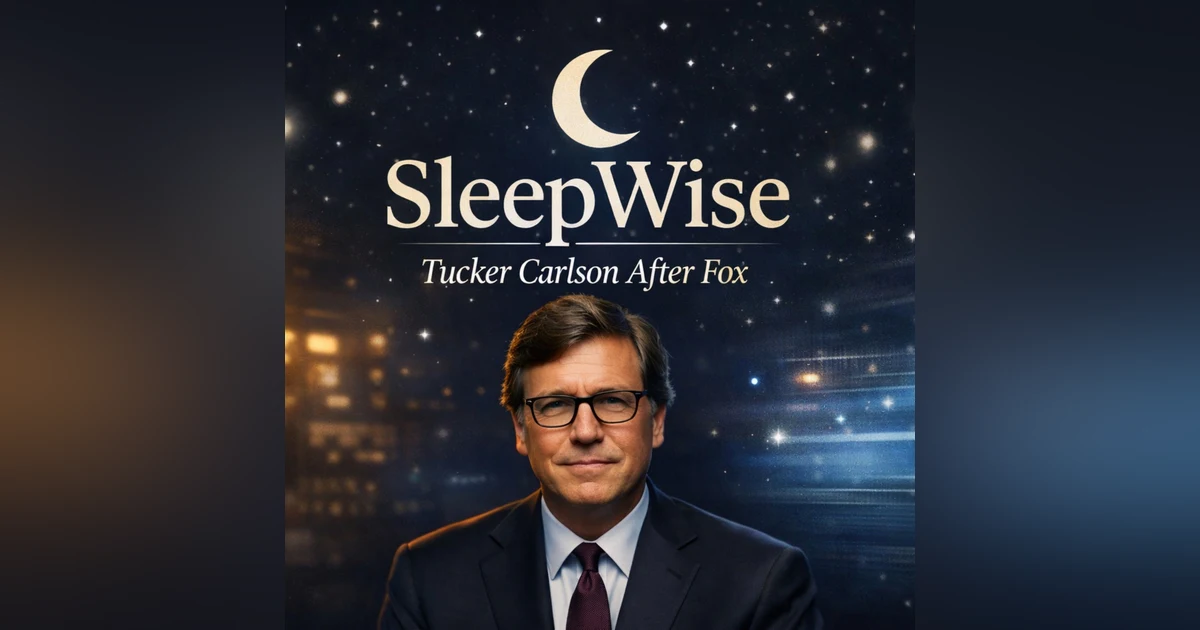


Tonight on SleepWise, we drift through the story of Tucker Carlson After Fox… a calm, thoughtful, and gently told exploration of one of the most controversial and fascinating media reinventions of recent years.
This episode follows Tucker Carlson’s journey from the height of cable television influence, through the shock of his departure from Fox News, and into a new era of direct audience power, long-form interviews, and independent media.
Along the way, we reflect on the qualities that made him so compelling to supporters… his willingness to ask uncomfortable questions, his appetite for controversial conversations, his openness to revising his views over time, his growing skepticism of war, and the moral seriousness that many listeners feel beneath his public voice.
Rather than turning this into a partisan argument, SleepWise approaches the story as a wider meditation on controversy, conviction, public fallout, reinvention, and the changing architecture of influence in the digital age.
Perfect for listeners who enjoy biographies, politics, media history, and stories about public figures who rose again after a very public fall… softly narrated to help curious minds slow down, unwind, and drift into sleep.
#sleepwise, #tuckercarlson, #tuckercarlsonafterfox, #foxnews, #mediareinvention, #independentmedia, #newmedia, #longforminterview, #politicalbiography, #publicfigures, #controversialfigures, #mediahistory, #culturalcommentary, #currentevents, #politicsforsleep, #conservatives, #journalism, #truthseeking, #interviewer, #modernmedia, #digitalmedia, #directaudience, #mediaevolution, #postcable, #cablenews, #politicalstories, #biographyforsleep, #bedtimehistory, #sleepstory, #fallasleeptofacts, #sleepeducation, #calmingstories, #relaxingvoice, #deepsleepstories, #sleepcontent, #sleepchannel, #mindfullistening, #nighttimelearning, #storiesforsleep, #educationalsleep, #curiosityandsleep, #documentaryforsleep, #historicalbiography, #riseandfall, #secondact, #publicinfluence, #audiencepower, #faithandpolitics, #antiwarvoices, #sleepwisestories
0:00 Good evening and welcome back to Sleep Wise to Night. We drift into the story of a man who to some became one of the most compelling interviewers of the modern age, and to others one of its most controversial voices. Before we begin, if Sleep Wise helps you unwind at the end of a long day, please follow the channel and share it with someone whose mind also takes a little longer to grow. Quiet. Oz. Mr. Albea This is not a story about agreeing with every word a public figure has spoken. It is a story about rise, rupture, reinvention, and about what happens when a person loses the institution that made him famous, only to discover that he may be even harder to ignore without it.
1:04 For years, Tucker Carlson belonged to the glowing architecture of cable television, that familiar evening ritual of studio lights, pressed jackets, monologues and certainty. Night after night, he appeared inside a carefully built machine, speaking to millions in a voice that felt conversational, skeptical, amused and often direct. To admirers, that quality felt rare. They believed he was willing to ask questions that others had learned to avoid, to speak aloud the subjects that polite media circles preferred to leave untouched, and to sit with discomfort rather than smoothing it away. To critics, the same qualities looked different. What some heard as candor, others heard as provocation, and what some experienced as truth seeking, others regarded as something more divisive and more dangerous in a tense age. But bedtime stories, like history itself, are not always built from clean verdicts.
2:26 Often they begin in ambiguity, in contradiction, in the strange space where a person can be deeply admired and deeply opposed at the same time. And so tonight we begin not with the heat of argument, but with the quieter shape beneath it. We begin with a broadcaster who became larger than his time slot, larger than his network, and perhaps even larger than the old rules of television itself. Because long before the headlines about exits and reinventions, there was already something unusual about the role he played in American life.
3:13 He never seemed fully at ease inside the polished manners of institutional media. There was always the sense that he was tugging against the curtains a little, peering behind the stage, testing the boundaries of what could be said on air and who could still command public trust. Whether one found that energizing or unsettling, it gave his presence A restless quality. And perhaps that is why his public break would later feel so consequential. When figures built for institutions lose those institutions, they sometimes fade into nostalgia. But sometimes they become freer, stranger and more powerful. Tonight we follow that second possibility, the story of Tucker Carlson and of the curious modern truth that exile in the age of direct audiences does not always diminish influence. Sometimes it transforms it.
4:30 There was, from early on, something unusual in the way he moved through media. Not theatrical, not grand, but unusual in the quieter way of someone who seemed to understand that television was never only about facts. It was also about cadence, timing, implication and the feeling of viewer carried away after the screen went dark. Tucker Carlson, overtime, learned how to do both. He came from a world of letters before he came to a world of lights. Writing, commentary and print journalism formed part of the older scaffolding beneath his public image. Because the written world rewards a different instinct. It teaches rhythm, contrast and the ability to place one sentence beside another so that the second lands with greater force.
5:35 That habit never quite left him. Even later on television, his speaking often carried the shape of a written line, compact, pointed and arranged to linger. But the public rarely remembers the long apprenticeship behind a finished persona. It remembers the polished version, the nightly version, the one already formed. What it forgets is that public voices are assembled slowly, through years of adjustment. A broadcaster is not born at full volume.
6:15 He is made phrase by phrase. In Carlson's case, that making involved movement across outlets, formats and tones. He could appear ironic, detached, even playful. And yet, beneath that surface, there was often a deeper instinct at work, a suspicion toward official language and a fascination with stories powerful people framed carefully. This instinct did not always make him right. Curiosity never guarantees wisdom, and skepticism can harden into its own certainty.
7:01 But it did help form the central tension of his career. He was drawn again and again toward the fault line between what institutions said and what many ordinary viewers suspected. That space is volatile. It can produce insight and it can produce distortion. It can make a journalist seem brave to some, reckless to others. Still, it is where his voice matured, not in the settled centre but at the edge of consensus, where disagreement crackled and attention gathered. And when a public figure spends enough years inhabiting that edge, it begins to shape more than his opinions. It shapes his timing, his silences, even the way he asks a question.
8:02 By the time millions came to know him in the fuller glow of prime time, much of the machinery was already there. The slight smile, the measured disbelief, the sense that he was tugging at the loose thread beneath the approved sentence. Whether admirable or irritating, it was memorable. And memorability in media is often the first currency. Long before his most famous years, then, the pattern had begun. A writer becoming a broadcaster, A broadcaster becoming a personality and a personality slowly becoming a symbol. Symbols, once formed, tend to search for a larger stage. In Carlson's case, that stage would become cable news, a medium built from ritual repetition and the illusion that the same face is speaking into your evening. The impression of urgency arrived at the same hour every night.
9:16 It is a machine designed to turn attention into habit, and habit repeated long enough becomes loyalty. Carlson entered that structure with a quality that did not feel entirely polished in the corporate sense. He seemed at times less like a smooth anchor than like a guest, carrying a private smirk about how the whole game worked. That, paradoxically, became part of the appeal. In a medium where many viewers felt they were being managed, he projected the opposite sensation.
9:59 He projected resistance. Night after night, his show gained force not only because of what he said, but because of the emotional arrangement around it. He often sounded as though he were letting viewers in on something hidden behind the curtain. He did not speak in the soft, consensus language of institutional reassurance. He spoke as though the story was stranger, less tidy and more revealing than the official version allowed. And television rewards that feeling, not merely certainty, but the sense that certainty elsewhere is incomplete.
10:48 As his audience grew, so did the feeling that he had become more than a host. He was turning into a nightly interpreter of national unease, someone who seemed able to convert scattered frustrations into a coherent tone. That tone mattered. It was skeptical, amused, incredulous, and sometimes prosecutorial. It implied that somewhere beyond the screen, powerful actors were pretending not to notice what ordinary people could already see. Whether that framing illuminated reality or distorted it depended greatly on who was watching, but either way, it was potent. The rise was not accidental.
11:39 It came from repetition, discipline and a sharpened understanding of what television is really selling. Not information alone, but orientation, a sense of who is sincere, who is evasive, who belongs inside the circle of trust. By then, Carlson was no longer simply participating in the cable era. He was becoming one of its defining forces. And yet there was already an irony waiting beneath the success. The very qualities that made him powerful inside a large institution also made him difficult to contain within one. For institutions value influence, but they also value boundaries.
12:33 They reward attention until attention begins to strain the frame that holds it still. That reckoning had not yet arrived. For the moment, the ascent continued. Admirers grew more loyal, critics more alarmed, and the ritual deepened into something larger than television alone. He had found the perfect stage for his voice, or so it seemed. To understand why so many people felt attached to him, it helps to linger inside the admirer's view. To supporters, Carlson seemed to possess a quality that modern public life often punishes an appetite for the forbidden question.
13:26 He gave the impression that he would wander into topics others approached with rehearsed caution, and that mattered to viewers tired of managed language. In that sense, the attraction was not only ideological, it was temperamental. He appeared less interested in sounding respectable than in sounding unconvinced. That distinction is small on paper but powerful on screen. Many viewers are not searching for a St. at night. They are searching for signs of independence.
14:09 A raised eyebrow, a break in tone, a sentence that suggests the speaker has not entirely surrendered to the etiquette of his class. He seemed willing to question elite consensus, challenge polished narratives and revisit subjects others treated as settled. One reason this felt meaningful was that it carried risk. Public curiosity is admired in theory, but not always in practice. There are questions that fit comfortably inside existing rules, and then there are questions that disturb those rules.
14:55 Supporters believed he reached for the second kind. This is also where his reputation as an interviewer began to matter more deeply to admirers. He was compelling because he sometimes sat back, let a guest keep talking, and allowed the uncomfortable edges of a conversation to remain visible. That patience can be powerful. A fast exchange often flatters the host. A slower one can expose the guest. In a media culture built around interruption and snippets, the willingness to let a conversation breathe could feel rebellious. It suggested confidence and curiosity. For younger conservative audiences especially, that style fit the changing age.
15:56 The polished certainty of old television was giving way to something looser, longer and more direct. Podcasts, clipped interviews, viral monologues, and audiences who preferred unscripted tension. Carlson seemed more native to that environment than some of his contemporaries. He belonged to television, but also seemed to be leaning beyond it. And beneath all of this, there was another quality his supporters often admired the sense that he was capable of changing his mind. When a public figure admits regret, especially about large questions of war and power, people notice. It suggests there may still be a person learning in public. For admirers, that mattered.
16:55 It made him seem less like a slogan and more like a person shaped by experience, error, memory and consequence. For those viewers, he did not seem polished into blandness. He seemed alive to contradiction and unwilling to pretend every important question had already been settled. If supporters saw independence, critics often saw something darker taking shape. To them, Carlson was not bravely stepping outside consensus. He was helping convert doubt into suspicion and grievance into identity.
17:42 This is the burden of becoming polarizing. The same gesture acquires 2 meanings. A refusal to follow the script looks like courage from one side and irresponsibility from the other. A skeptical question sounds to 1 audience like honesty and to another like the planting of distrust. In that split, a broadcaster ceases to be merely A communicator. He becomes a symbol through which millions argue about reality itself.
18:22 Critics worried not only about what Carlson said but about what his method normalized. If he was willing to sit with controversial guests, they asked, was that an act of truth seeking, or an act that risked laundering extremity through the calm language of conversation? It is not a trivial question. Interviews can illuminate, but they can also flatter. Access can also confer prestige. The line between brave curiosity and careless amplification is often visible only in hindsight, and even then, people rarely agree on where it was.
19:09 Still, this tension helps explain why he drew such intense reactions. He was helping define which people. Questions and doubts deserved a place at the center of public attention. That power is enormous. To choose what is discussable is in some quiet way to shape the emotional architecture of an era. And perhaps that is why his critics found him so troubling. It was not only that he challenged establishment language, it was that he did so with skill. He understood television, understood pacing, understood how to wrap uncertainty and confidence and turn a mood into a nightly event.
20:04 Even many who disliked him recognized that ability. He knew how to hold a pause. He knew how to make disbelief feel contagious. He knew how to frame a question so that the answer already seemed to imply a hidden structure behind public life. That is part of what made him such a formidable interviewer. Admirers would say he gave guests room to reveal themselves. Critics would say he knew exactly how to build a stage on which certain revelations would carry maximum force.
20:45 Both readings, in their own way, can be true at once. By the height of his influence, Tucker Carlson had become more complex than a host with strong opinions. He was now a vessel for broader anxieties about truth, power, media and trust to followers. He felt like a corrective to opponents. He felt like a warning to the country watching him. He increasingly felt unavoidable. And that is often the threshold before rupture, the moment when a figure grows so large and so contested that the story can no longer remain inside the studio walls. By now, the knightly role had grown larger than the man seated beneath the studio lights.
21:46 Tucker Carlson was no longer simply presenting a program. He had become for millions a kind of interpreter, a figure through whom the confusions of the age were translated into a more personal language. This is one reason the interviewer inside him mattered so much. Monologues can rally an audience, but interviews test a different gift. They require timing, restraint and the confidence to let another person speak long enough to reveal something unguarded to admirers.
22:31 Carlson possessed that confidence. He could appear patient in a way television rarely rewards. Rather than racing to the next approved point, he often let silence do part of the work, allowing a guest's own words, tone and hesitation to carry the weight. That style gave his conversations an atmosphere of risk. Viewers had the sense that something unplanned might happen, that the smooth architecture of media could briefly give way to a less managed exchange. In an age of clipped answers and panel chatter, that feeling seemed rare.
23:16 It suggested that conversation had not been entirely replaced by performance. His supporters would later say This is why he mattered, not because he always agreed with the people he interviewed, but because he seemed willing to hear from people others treated as untouchable. That distinction became central to his appeal. For many viewers, the interview itself became a moral act, a refusal to pretend that difficult or controversial figures should simply be sealed away behind official disapproval. Of course, critics saw a danger in exactly that approach. To sit with a contentious figure calmly, without constant condemnation, could look less like bravery than legitimization.
24:18 And so the interviewer became another side of argument. Was he opening a window or a gate? Yet whatever conclusion one reached, the effect was undeniable. Carlson had learned that the modern audience often trusts the long conversation more than the polished lecture. There is something ancient in that instinct. Human beings have always listened closely. When two people sit across from one another and the air seems slightly charged, we lean in not only for information but for revelation.
25:06 We want to hear where a person hesitates, where conviction hardens, where uncertainty enters, where the practiced sentence falls away. Carlson understood this deeply. He seemed to know that the modern public, exhausted by rehearsed language, was hungry for the shock of unsmoothed speech. That hunger would become even more important later, after the walls of cable news fell away. But even here, inside the old system, the pattern was already clear. He was not only building an audience around opinions, he was building an audience around access, curiosity, and the suspended tension of long form attention. With influence came another burden, the burden of becoming a symbol.
26:05 Once that happens, a public figure is no longer heard in a single register. Every sentence is received twice. One audience hears representation, another hears threat. For supporters, Carlson increasingly sounded like someone defending ordinary perception against elite choreography. He seemed to say that viewers were not crazy to notice contradictions, incentives, invasions and managed narratives. That message carries force in a distrustful age.
26:46 It tells people that their private unease belongs to a larger pattern. Yet mirrors are never neutral. The angle matters, The light matters, The frame matters. Critics argued that Carlson was not simply reflecting public suspicion. He was intensifying it, giving it sharper edges, greater coherence and a sense of urgency. This is where the debate around him became deeper than partisan preference. The question was not only whether one agreed with his views. It was whether a figure like this, operating at scale, changes the emotional weather of a nation. Can skepticism remain healthy when it becomes habitual, and can distrust remain clarifying when it grows into a permanent atmosphere?
27:46 Carlson's critics feared that his talent was not just asking questions but arranging reality so that one kind of answer felt inevitable. Admirers felt the opposite. They believed he was one of the few people willing to puncture the official script before it hardened into unquestioned truth. Between those interpretations lay the full tension of his public role. Still, even symbols remain human beneath the projection. There is something lonely, perhaps, about being treated less as a person than as a container for national feelings.
28:34 A symbol cannot simply speak. He must carry expectation, hostility, admiration, and blame all at once. Carlson seemed, at times, to understand this. There were moments when amusement and weariness appeared to live side by side, as if he knew that being central to the argument also meant being trapped inside it. And yet he did not step away. If anything, the pressure seemed to sharpen him. That, too, is part of what made him compelling to followers. He did not present himself as a peacemaker smoothing over conflict.
29:23 He presented himself as someone willing to inhabit conflict, to remain inside disagreement without apologizing for its existence. In a media world drawn toward managed consensus, that refusal made him feel less polished and more alive. But living at that pitch has consequences. A figure can become so resonant, so debated, and so useful to larger struggles that the institution hosting him begins to feel the strain.
30:03 And when that happens, success itself begins to contain the seed of rupture. Among the more revealing parts of Tucker Carlson's story is not that he has held strong opinions. Many television figures do. What makes his arc more interesting is that on some large questions, he has spoken openly about being wrong in public life. That is rarer than it should be. One of the clearest examples is war, and especially Iraq.
30:46 Like many Americans in the years after September 11th, Carlson initially supported the invasion. That fact matters because it places him inside a broader national mood rather than outside it. He was not born into permanent opposition. He moved with the current, accepted the claims of the time, and later came to view that support as a grave mistake. Regret, when it is genuine, changes the shape of a person's voice. It adds weight to the pauses.
31:26 It makes certainty harder to wear casually. Over time, his commentary on foreign intervention came to sound less like abstract ideology and more like moral suspicion shaped by memory. He began speaking as someone wary of the distance between official rhetoric and human consequence. To supporters, this shift was a strong sign of his seriousness. It suggested that he was not simply preserving an image, but allowing experience and hindsight to revise him. That quality can be powerful.
32:13 Many people will forgive error more readily than they will forgive the refusal to recognize it. In that sense, Carlson's anti war turn became more than a policy preference, it became part of his public character. He was no longer just a broadcaster criticizing distant conflicts. He was, in the eyes of admirers, someone marked by the knowledge that respectable consensus can lead nations into catastrophe. Of course, critics could answer that Changing one's mind does not erase all other faults.
32:57 That is true. But bedtime stories are often interested in the inner hinge, the place where a person's direction changes. Iraq appears to have been one of those hinges. For him, there is something almost old fashioned about a public figure carrying regret. Not performative shame, not public relations language, but the recognition that a mistaken belief can have consequences measured in lives. That realization seems to have deepened his suspicion of easy arguments for intervention.
33:40 It also gave his later commentary A sombre undertone. War, after all, is one of the subjects that strips glamour from public speech. When one has once believed too quickly, one may learn to distrust quick confidence thereafter. And perhaps that is one reason his later voice could feel so charged on these matters. Beneath the media conflict and partisan framing, there was also the simpler human story of someone trying not to repeat a moral error. For many listeners, that is not weakness. It is credibility earned the harder way through hindsight, discomfort and the willingness to let painful knowledge alter the self.
34:39 The Iraq lesson did more than change a single opinion. It seemed to alter the lens through which Carlson viewed power itself. Once a person has watched a respectable consensus lead toward bloodshed, confidence no longer feels innocent. The polished briefing. The solemn expert, the urgent moral case, all of it begins to look different after regret enters the room. This is why his later anti war posture carried a different texture from ordinary partisanship.
35:23 It did not sound merely tactical. It sounded wary, almost bruised by hindsight. The question underneath it was not only whether a war might succeed, but whether those asking for trust had earned it at all. That is a deeper kind of skepticism. It does not begin from cynicism for its own sake. It begins from memory, from the realization that error at the top is never paid for. Only at the top, somewhere far from the studio, consequences become physical, irreversible and human. 2 supporters.
36:12 This gave his commentary unusual moral weight. He was not opposing intervention because it was fashionable in his tribe. He appeared to oppose it because he had come to distrust the machinery that makes intervention sound, clean, necessary, and noble in advance. That distrust, once learned, tends to spread. It shapes how a person hears official statements, how he evaluates consensus, how quickly he accepts the language of urgency. It becomes a discipline of doubt. And yet doubt in this form is not simply negation. It can also be an ethical posture, a refusal to let abstraction erase suffering.
37:12 Carlson often seemed to understand that foreign policy language has a way of floating above the ground. It speaks of theatres, targets, credibility, deterrence, leverage. But beneath those words, our bodies, families, ruins, grief and years that do not return. To bring that fact back into public speech is, for many listeners, an act of honesty. Critics might say he was selective in how he applied that honesty. Fair enough. Still, 1 can see why this part of his evolution mattered. In a political culture crowded with people who never admit serious error, the mark of 1 old mistake can become persuasive. It suggests a person has been changed by what he once failed to see.
38:16 It suggests that his caution is not only strategic but earned. Perhaps that is why his anti war voice resonated beyond policy debate. It carried the quieter authority of someone who had lost trust in the easy righteousness of distant conflict. And once that trust is lost, it rarely returns in full. The world becomes harder, sadder and more complicated. But also, perhaps more honest. For Tucker Carlson, this deepened skepticism would become one of the central threads of his later identity, not just as a host, but as a public figure defined by distrust of elite certainty, when the cost of that certainty could be measured in lives. What also distinguished Carlson, especially in his later years, was the sense that politics for him was never merely politics. Beneath the headlines, there often seemed to be an older frame faith, order, restraint, conscience, and the question of what kind of civilization people are becoming. He did not always speak in overtly religious language. Yet even when religion was not
39:50 the subject, many listeners felt that his commentary carried a moral vocabulary shaped by belief that mattered because much of modern media speaks in flat tones. It measures incentives, polls, transactions and strategy, but often hesitates to speak about vice, virtue, temptation, corruption, dignity. Or spiritual disorder. Carlson, by contrast, often sounded as though these older categories still mattered. He seemed willing to suggest that public decay begins long before it appears in statistics, in the habits of speech a culture rewards, in the appetites it flatters, in the truths it trains itself not to see. To supporters, this gave him a gravity rare in television. He did not sound like a consultant managing impressions. He sounded more like a man trying to name what he believed was broken beneath the surface.
41:04 Even listeners who did not fully share his world view could recognize the deeper appeal of that tone. People do not always seek analysis at the end of the day. Sometimes they seek diagnosis. They want a voice that treats public life not only as interests but as a struggle over character. What is honorable? What is degrading? What should be protected from the machinery of appetite and fashion? This moral seriousness also helps explain his connection to younger conservatives. For them, he often seemed less like a conventional television host and more like someone speaking against a culture they found hollow.
42:00 Managed and spiritually thin, he fit the mood of an era in which younger audiences were drifting away from polished institutional authority and toward figures who appeared more direct, more personal, and more willing to speak in civilizational terms. The medium was changing, but so was the hunger beneath it. To critics, of course, this language could appear selective or self justifying. Moral rhetoric can illuminate, but it can also obscure. Still, it would be a mistake to miss how central this layer was to his appeal.
42:51 He was not followed only because he was controversial. He was followed because many people believed he was trying to place controversy inside a larger map of meaning. Whether one agreed with that map or not, it made him feel different from the smoother voices around him, and it helped prepare the ground for what came next. When the institution eventually fell away, he would still possess the thing institutions can never fully manufacture an audience that believed it was listening not just to a pundit but to a person with conviction. And then, after years of feeling inseparable from the evening ritual, the rupture came.
43:43 It arrived with the strange speed public life allows. One day a figure seems fixed inside the national furniture, and the next day the chair is empty, the lights remain on, and the institution moves on. For viewers, the shock lay not only in the departure but in its abruptness. When someone occupies the same hour for long enough, he begins to feel less like a decision and more like a feature of the landscape. That illusion is one of television's oldest powers. It turns arrangements into habits, and habits into something resembling permanence.
44:35 But nothing in media is truly permanent. Contracts end, alliances strain, and sometimes the same qualities that made a host valuable also make him hard to contain. By then, Tucker Carlson was no longer merely successful. He had become too resonant, too polarizing, too central to larger arguments about trust, power, and the direction of the country. When a figure reaches that scale, every institution around him begins its own quiet calculation. Influence is useful until it becomes unpredictable. Loyal audiences are profitable until loyalty attaches itself more fully to the person than to the platform. Eventually, the old question rises beneath the executive floorboards.
45:40 Who needs whom more? The answer is never simple, which is why the separation felt so charged. To some, it looked like the breaking point between a corporation and a host whose voice had grown difficult to bracket. To others, it looked like a miscalculation, an institution cutting loose one of the few personalities still capable of commanding real allegiance in a fragmenting media world. Either way, the moment landed with the force of interruption. A nightly presence vanished.
46:23 The familiar set was gone. The rhythm broke. For supporters, there was disbelief. For critics, perhaps vindication. For the wider audience, there was the quieter recognition that the cable era itself had become fragile. Because when a star of that magnitude disappears from the largest stage, it says, the old media order is no longer as secure as it once appeared. Perhaps Carlson understood that even then the loss was real, but the architecture was changing and institution had withdrawn its shelter.
47:11 Yet in a world of direct audiences and portable attention, shelter was no longer the only form of power. Still, that knowledge could not erase the human fact of rupture. There is always a private silence after expulsion. The chair that held you is suddenly someone else's problem. The hour you filled belongs to empty air, and the self must decide before the audience does whether exile is an ending or an opening. And somewhere inside that uncertainty sat the oldest modern question of all, who, in the end, had made whom. After the exit came the quieter phase that often follows a public fall.
48:08 Silence, speculation and the soft hum of waiting. For years, Tucker Carlson had been everywhere at once in the minds of his audience. Then, almost overnight, he was absent. And absence has a different texture. When the person missing has anchored A ritual, people do not merely notice that he is gone, they begin listening for him in the quiet. That in between period matters more than it seems. Public reinvention is rarely born in noise.
48:51 It is born in suspension, where no one knows whether the vanished figure will return diminished, transformed, or not at all. Around that silence, stories immediately gathered. Was this the end of his greatest phase? Had he reached too far? Would he seek another network, retreat to the margins, or disappear into the afterlife of former television hosts? Such moments reveal how dependent old media one seemed. If a broadcaster lost the tower, many assumed he had lost the signal. But the modern age had already begun rewriting that assumption. Audiences were learning to follow voices across platforms rather than staying loyal to the buildings that housed them. Perhaps that was the deeper question hidden inside the quiet.
49:54 Had Carlson lost his platform? Or had the platform lost the person audiences were really following? For someone like him, The Silence may also have offered another kind of reckoning. Not headline drama, but the inward inventory that follows public severance. What remains when the machinery stops? What part of the voice belong to the institution and what part belong to the self? These are not small questions. Television can wrap a person so tightly in routine that even he may not know where the role ends and the deeper calling begins.
50:42 Yet Exile can clarify. When the costume room closes and the studio lights go dark, one discovers what still feels necessary to say. Carlson had spent years cultivating an audience that believed he was not merely reading from an approved page. That loyalty did not evaporate just because the set had disappeared. If anything, the silence intensified it. Supporters waited not only for a return, but for a sign that it would be larger than a replacement contract.
51:28 There is a strange energy in that kind of pause. Attention, deprived of its object, begins to build pressure around absence itself. And absence, skillfully handled, can become part of a resurrection. The person who vanishes from the expected place has already become more mythic than the one who remains where expected. So the waiting continued, the questions multiplied, and beneath them all was a larger uncertainty about the media age itself. If one of Cable's defining figures had been pushed outside the walls, would he spend his remaining years knocking to get back in?
52:20 Or would he recognize that the walls no longer mattered as much as they used to? The answer emerged not through a return to polished television, but through a leap toward something looser and far less supervised. Carlson reappeared on X, and the choice itself carried a message. He was not asking the old gatekeepers to let him back inside. He was stepping into direct audience media, where authority flowed less from institutions than from personal followings. That move was larger than a platform decision. It was a declaration about where power was going. In the cable era, a host borrowed strength from the channel and its corporate scaffolding. In the new era, significance could travel with the person. The audience no longer needed to enter the old cathedral. The voice could meet them in the street. For Tucker Carlson, this mattered because his appeal had never depended entirely on network Sheen. His strongest asset was not the desk, the backdrop or the executive blessing.
53:44 It was the bond many viewers felt with the cadence, the suspicion, the sense that he was speaking from conviction rather than institutional caution. If that bond was real, then perhaps it could survive translation into a new medium. And it did more than survive. In some ways, it sharpened. Freed from the formal pacing of television, his reappearance carried the energy of someone stepping out from beneath a ceiling. The videos felt less like a continuation of the old show and more like proof that the center of gravity had shifted. This was not simply a man finding another outlet. It was a symbol of old media's weakening monopoly over public voice.
54:42 What had once required a major network could now be attempted with a camera, a platform and an audience willing to follow without permission from an executive floor. There was risk in it, of course. Open platforms offer freedom but less insulation. They reward immediacy, punish hesitation and expose a public figure more directly to the unstable weather of the crowd. Yet that volatility also suited him. Carlson had long seemed more animated by tension than by bureaucratic calm.
55:25 On X. He appeared to understand that the old era of managed distribution was giving way to something more personal and combustible. The audience was no longer simply receiving the message, it was travelling with the messenger. For supporters, this felt like vindication. The departure from Fox had not erased him. It had forced him into a format that looked more native to the times and for the broader culture. It carried a quiet lesson in an age of fractured attention.
56:06 Losing the institution does not always mean losing relevance. Sometimes it reveals that relevance had already migrated elsewhere. It also made a subtle emotional promise that the post Fox chapter would not be smaller and safer, but broader, riskier, and less obedient to inherited rules. Once the first return had been made, a more profound realization settled in. Tucker Carlson may not have needed the gatekeepers as much as everyone had assumed. This was the hidden possibility inside the fallout. What if removal from the old system did not weaken him, but clarified the true source of his influence? Large media institutions once acted like fortresses. They distributed prestige and gave the impression that serious public speech required an official stage. But the new media age has been steadily dissolving that arrangement.
57:23 Audiences now form attachments that are less architectural than personal. They do not always remain loyal to the building. They follow the voice that seemed to matter inside it. Carlson's post Fox period offered a vivid example of this shift. His following did not behave like an audience abandoned by its channel. It behaved more like a community waiting for its speaker to choose the next room. The center of legitimacy, once anchored in the network, began to move toward the individual. There is a philosophical difference between those two worlds.
58:08 In the older 1A, broadcaster derives authority from the institution that certifies him. In the newer one, authority comes from the trust or fascination he can sustain directly. That model is more unstable, but also more liberating. For someone already cast as rebellious. The freedom carried its own dramatic logic. He no longer had to fit his voice inside the exact dimensions of a prime time slot. He could shape the format more fully around the kind of attention he believed the moment demanded.
58:51 Longer conversations, stranger guests, fewer visible handlers and a tone less mediated by corporate Polish. Whether this improved discourse is a fair debate, but it undeniably made him feel less contained, and that very lack of containment helped explain why the post Fox version of Tucker Carlson seemed to many supporters more fully himself. There is something almost ancient in this pattern. Exile removes title and shelter, yet sometimes gives back essence. The person who leaves the palace may discover that people were never following the palace at all. They were following the force that briefly lived inside it. Of course, independence has costs. To stand without an institution is also to stand with fewer buffers.
59:55 Criticism strikes more directly. Missteps are harder to soften. The burden of sustaining attention rests less on the brand and more on the person. Still, for Carlson, that seemed a price worth paying. The post Fox era suggested not a man trying to recreate the old order, but a man recognizing that the old order had already been passing away. If he had once seemed like one of cable news defining stars, he was now becoming something slightly different, a movement era media figure, less polished, more portable, and in some ways more powerful because no single corporation could so easily switch him off. Reinvention becomes more durable when it is given form. And so the next stage was not merely personal return, but construction.
1:01:03 Out of the uncertainty emerged a new institutional shell around the man himself. The Tucker Carlson Network, a subscription venture built on the simple, modern idea that a loyal audience will cross the bridge with you. There is something revealing in that transition. He had once lived inside one of the largest media machines in the country. Now he was helping build a smaller, more direct structure, one in which the audience relationship was chosen through subscription and repeated attention. This marked a deeper evolution than many public narratives noticed.
1:01:53 Carlson was no longer only a host with a platform, he was becoming a platform of his own. That difference matters because it changes the economics of influence. In the legacy model, power flows downward from institution to presenter. In the direct model, power gathers around the presenter and then hardens into a new institution built in his image. For supporters, this likely felt like proof that the break with Fox had not been a burial but a kind of release. The old network had offered scale, but the new enterprise promised ownership, autonomy and closer alignment between voice and structure.
1:02:51 That does not automatically make the new world nobler. Direct audience media can flatter certainty, intensify tribal loyalty, and reward the magnetic over the measured. Yet it also offers a form of independence many modern creators find hard to surrender once tasted. Carlson's move into this territory helped place him inside a broader transformation underway across journalism and commentary. More and more influential figures were no longer trying merely to rise within institutions, they were trying to convert attention into institutions of their own. Audience, once rented, could now be partly owned. And perhaps that is why his second act felt larger than a comeback.
1:03:50 A comeback suggests a return to what was This was something else, a redesign. The broadcaster who had been ejected from the fortress was now building a house with fewer walls and a door his audience could enter directly. That image captures much of the emotional logic of his rise after the fall. He did not simply survive the rupture. He used it to test whether a public figure could move beyond legacy television without losing gravity. The answer appeared to be yes.
1:04:34 And with that answer came a new phase of confidence. If the audience would follow, if the format could expand, and if the institution could be rebuilt around direct allegiance, then the next question was no longer whether Tucker Carlson still had influence. It was how far that influence might travel once it was no longer framed by the limits of cable news. By the time Tucker Carlson entered his post cable years, the interview had become more than a format. It had become a philosophy for him. The long conversation seemed to carry its own claim that the public should sometimes hear directly from the people shaping events, even when those people are disliked, distrusted, or pushed beyond acceptable company. This idea is older than television. Societies have always wrestled with the same question. Does one understand danger better by refusing to hear it or by listening closely enough to examine it? Carlson's supporters believed he chose the harder path. They saw in him a willingness to
1:06:10 sit across from figures others would avoid, not because he endorsed each guest, but because he mistrusted the gatekeepers who decided which voices the public was permitted to hear. That attitude fit the larger mood of his audience. Many had grown weary of managed discourse, where interviews felt less like inquiry and more like ceremony. The modern viewer can sense when a conversation has been pre trimmed. Carlson seemed to understand that fatigue. He offered something else, not always neutral, not always uncontroversial, but often alive with the possibility that an unscripted moment might reveal more than 100 prepared statements.
1:07:12 That possibility is seductive. It draws people in because it promises contact with reality before it has been polished into institutional language. For admirers, this was one of his deepest strengths. He treated the interview not as a chance to display his own mastery, but as a chance to let a guest unfold, hesitate, expose motives, or speak in ways that could not easily be compressed into a headline.
1:07:58 He understood that revelation often arrives slowly. Critics, of course, raised a fair concern. To platform a figure calmly is, in some cases, to lend stature to that figure, even when the ideas themselves may be false or manipulative. That tension never disappeared, and perhaps it never can. Every serious interviewer lives near that edge. There is no pure formula for deciding when curiosity is brave and when it becomes careless.
1:08:44 Yet for Carlson, the willingness to walk along that edge was central to his identity. He did not seem interested in a world where certain conversations were ruled out in advance. He seemed to believe that public life grows more distorted when fear decides what may be asked and whom one may face directly. Whether one sees that as integrity or danger depends on deeper assumptions about truth itself. Is truth best protected by restriction or by exposure? For the audience following him into his second act, the answer seemed clear.
1:09:35 They did not want a safer Tucker Carlson. They wanted one with fewer restraints, stranger access, and a larger willingness to go where institutional media still hesitated. And so the interview became the road on which the next stage of his influence would travel. No moment captured that road more vividly than the interview with Vladimir Putin. By then, Tucker Carlson was no longer simply rebuilding after a fall.
1:10:17 He was testing whether a post television figure could still command the attention of the world by gaining access to one of its most watched and controversial leaders. The answer, almost immediately, was yes. The interview did what major interviews always do. It forced people who already had strong opinions to confront the unsettling fact that access itself carries power. Supporters saw boldness in the attempt.
1:10:59 To them, Carlson was doing what a serious interviewer should do, going directly to the center of a matter that others preferred to discuss from a safer distance. Even those who did not admire Putin could still recognize the unusual nature of the encounter. Here was a former cable host cast out of a major network, now speaking at length with one of the defining geopolitical figures of the age. That alone signaled something about the changing media order.
1:11:43 Permission no longer flowed only from legacy institutions. A sufficiently powerful individual, backed by audience loyalty and platform reach, could create his own diplomatic theatre. In that sense, the interview was about more than Russia. It was about who now had the authority to convene history on camera. Critics responded with equal intensity. They argued that access is not automatically virtue, and that a skilled authoritarian can use the setting of an interview to frame himself as reasonable, patient or misunderstood.
1:12:38 They worried that the encounter risked turning inquiry into spectacle or, worse, offering legitimacy where harder forms of scrutiny were required. That criticism deserves to be heard. Yet even criticism confirmed the point. Carlson remained capable of setting the agenda of pulling global attention toward a conversation because his own presence made the event feel unavoidable. This is what exile had not diminished. If anything, it had sharpened it. Without the Fox logo behind him, the audience was forced to confront the simpler truth.
1:13:34 It was Tucker himself, not merely the institution, who could gather this level of interest. The interview became proof of portability for Carlson's admirers. The Putin interview confirmed the promise of the second act. He had not become smaller after leaving cable. He had become less containable. The old studio had once offered reach, but the new path offered a different kind of reach. 1 built from direct allegiance, daring, and the sense that he would still pursue the conversation others either could not or would not have.
1:14:26 Whether 1 considered that admirable, risky, or both, it marked a threshold. Tucker Carlson was no longer simply a fallen television star with a loyal following. He had become a media actor who could still alter the international conversation by choosing whom to sit across from and when. Part of what made that transformation possible was generational. Tucker Carlson, though formed in the age of cable, had come to resonate with audiences who no longer belonged fully to cable at all. He rose inside an older machine, yet many of the people most drawn to him later was shaped by podcasts, clips, long interviews and feeds rather than schedules.
1:15:31 Younger conservative audiences did not always want the polished certainty of institutional television. They wanted a tone that felt more personal, more skeptical and less mediated by professional etiquette. Carlson fit that mood better than many of his contemporaries. He could still wear the jacket and speak in complete sentences, but there was something in his rhythm that translated naturally into the online age. He seemed capable of moving between formats without losing identity.
1:16:17 A monologue could become a clip. A clip could lead to a longer conversation. A longer conversation could be broken apart and circulate as a dozen small provocations, each one feeding the larger myth of the man who kept asking the forbidden question. This is how modern media compounds influence. Attention no longer arrives only in one long sitting. It arrives in fragments, echoes and rediscoveries. Carlson's style lent itself to that ecology. He was quotable without always sounding artificial, confrontational without requiring the noise of a panel, and serious enough to make younger followers feel they were consuming more than entertainment. For some, he represented a bridge between inherited conservatism and a newer, more Internet native right. He could speak in civilizational terms, question war, distrust, bureaucratic Polish, and still sound grounded rather than fully submerged in digital chaos.
1:17:52 That balance mattered. Many younger listeners are not looking merely for anger. They are looking for orientation for a figure who seems to connect politics to larger questions of meaning, faith, status and cultural confidence. Carlson often appeared to offer that map. No audience is pure and no following is made of one thing alone. Some came for controversy, some for anti establishment energy, some for the interviews, and some because they sensed that he was closer to the emotional center of the new conservative movement than many traditional voices. What matters for this story is that they followed him. They did not treat his firing as a conclusion, they treated it as a migration.
1:19:01 The same allegiance that had once powered a television hour now travelled outward across platforms, subscriptions and shareable fragments. This is why his second rise felt different from an ordinary comeback. It was not powered only by nostalgia for what he had been at Fox. It was powered by younger audiences who felt that the old gate kept world was fading and that figures like Tucker Carlson belonged more naturally to the era now arriving. By the time this new phase had settled into form, the outline was unmistakable.
1:19:50 Tucker Carlson had crossed from being a fired host into becoming something broader, a movement era media figure. A host belongs to a program. A movement era figure belongs to a feeling larger than any single show. He becomes a vessel for the mood of a coalition, a restlessness in the culture, a set of instincts looking for a voice. Carlson's post Fox story took on that quality.
1:20:34 He no longer seemed defined mainly by where he appeared each night. He was defined by what he represented suspicion of gatekeepers, openness to taboo conversations, distrust of intervention abroad, moral seriousness beneath political talk, and the belief that direct audience loyalty can outlast institutional rejection. For supporters, this transformation was affirming.
1:21:15 It suggested that when the old order tried to remove him, it revealed its own weakness more than his The network could cancel a program. It could not so easily dissolve the relationship between a public figure and the millions who had come to see him as a rare voice of conviction. This is why his rise after the fall carried symbolic force. It was not only about career survival. It was about the changing architecture of legitimacy.
1:21:59 In a previous era, expulsion from a major network might have meant gradual irrelevance, and then the slow dimming that follows institutional loss. But now the pattern was different. A figure rejected by legacy media could reappear, more independent and more mythic, precisely because he had been cast out. The fall itself became part of the appeal. It implied that he had said or represented something the respectable order could no longer comfortably house.
1:22:47 Whether true in every detail or not, that impression became part of the power. And so Carlson's story began to exceed television. He became one of the clearest examples of how media authority was migrating from buildings to personalities, from official channels to portable communities of belief and attention. There is a larger lesson inside that migration institutions still matter, but they no longer monopolize seriousness. A person with enough audience trust, enough symbolic charge, can now step outside the old fortress and continue gathering people around him.
1:23:50 That is a new kind of power. Carlson did not invent that world, but he came to embody it. The fired anchor had become a free floating node of influence, still controversial, still magnetic, still capable of pulling a larger conversation toward himself by force of persona alone. And once a person reaches that state, the story is no longer simply about employment, it is about consequence. What can such a figure do with independence?
1:24:34 What will he choose to amplify? And how much does a culture change when more of its central voices no longer belong to strong institutions? In the end, perhaps the most interesting part of Tucker Carlson's story is not whether 1 agrees with him. Agreement is too small A-frame. More revealing is the shape of the Ark itself. Ascent, Controversy, rupture, silence, reinvention, and the strange discovery that losing the great platform did not end the voice. It clarified it.
1:25:30 Some public figures are built entirely from the institutions that elevate them. Remove the logo, the desk, the credential, the nightly machinery, and very little remains. Others turn out to have been using the institution as a vessel only temporarily. Once pushed out, they do not vanish. They become more fully themselves. For better or worse, Carlson seems to belong to that second Category 2 admirers. His journey after Fox became a story of conviction surviving punishment.
1:26:20 They saw in him a truth seeking instinct, a willingness to revise his views when experience exposed error, a rare openness to difficult interviews, and a faith shaped seriousness beneath the noise. To critics, the same journey raised a different warning. What happens when a controversial figure, already skilled at shaping distrust and emotion becomes less answerable to any frame beyond his own instincts and audience demand? Both readings matter.
1:27:07 The calmest stories are not always the ones with the fewest tensions. Sometimes they are the ones that hold tension carefully enough that the listener can feel the deeper pattern beneath the argument. And the deeper pattern here is unmistakable. Tucker Carlson's rise after his fall tells us something about the age itself. The centres are weaker, the peripheries are stronger. A broadcaster can become a network, an interview can become an event, and exile can function less like a ratio than like release.
1:27:56 There is also, tucked quietly inside the politics, a more human lesson. A person can be changed by regret. He can outgrow old certainties. He can lose 1 world and discover that another stranger world was already waiting beyond it. Whether that new freedom becomes wisdom is always an open question. Freedom magnifies character. It reveals what a person most wants to say when fewer gatekeepers stand between conviction and public voice. And so we leave him here, not as St. or villain, but as a figure who helps explain the unsettled media landscape through which we now move.
1:28:58 A man who fell from the glowing fortress of television stepped into the unguarded currents of direct attention, and found that controversy, conviction and audience loyalty could still build a new kind of power from the ruins of the old one. But the ancient drama remains a voice, a following, a fall, a return, and the enduring human hope that loss might yet become transformation. The night grows quieter now.
1:29:42 The screens dim, the arguments soften into distance, and history for a moment becomes only another story carried gently into the dark. Good night.